Our system will evaluate the answer based on this AI-generated description.
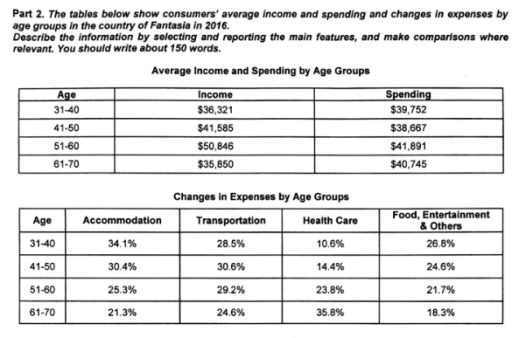
The image includes two tables: the first showing average income and spending by age groups, and the second showing changes in expenses by age groups. The first table reports income and spending: ages 31-40 ($36,321 income, $39,752 spending), ages 41-50 ($41,585 income, $38,667 spending), ages 51-60 ($50,846 income, $41,891 spending), and ages 61-70 ($35,850 income, $40,745 spending). The second table shows changes in expenses: ages 31-40 - Accommodation (34.1%), Transportation (28.5%), Health Care (10.6%), Food, Entertainment & Others (26.8%); ages 41-50 - Accommodation (30.4%), Transportation (30.6%), Health Care (14.4%), Food, Entertainment & Others (24.6%); ages 51-60 - Accommodation (25.3%), Transportation (29.2%), Health Care (23.8%), Food, Entertainment & Others (21.7%); ages 61-70 - Accommodation (21.3%), Transportation (24.6%), Health Care (35.8%), Food, Entertainment & Others (18.3%).
Given the complexity of the image, the above description may not be entirely accurate.
Skyrocket your IELTS band score by 1-2 points in under a month with our premium plan!
Note: Both the topic and the answer were created by one of our users.
There are 2 tables given that show the both amount of money and changes in expenses by age groups in the country of Fantasia in 2016.
Overall, the most total amount of money of the both income and spending by 51-60 age groups. However, the small sum of income by 31-40 and 61-70 age groups that they have been the same likewise amount of capital of spending.
Based on the table changes in expenses such as accomodation, transporation, health care and food entertaiment by age groups that it to illustrate that the accomodation and food entertaiment by 31-40 age group has higher percentage than others age groups – the both 34.1% and 26.8% compared to others. The group 41-50 has been the most greatest percentage of transporation: 30.6% versus 30.4%, 14.4% and 24.6% in others by age groups. By 61-70 group has been significally elevated percentage of healthy care – 35.8% than 21.3%, 24.6% and 18.3%.
The groups 31-40 and 61-70 have a more spending that income that influence on the expenses in the life.
Word Count: 175
