Our system will evaluate the answer based on this AI-generated description.
The image contains two graphs. The first graph, a line graph, displays the world population from 1800 to 2100 in billions, with points marked at 1800 (approximately 1 billion), 1900 (approximately 1.6 billion), 1950 (approximately 2.5 billion), 2000 (approximately 6 billion), 2050 (around 9 billion), and 2100 (a decline to about 7 billion). The second graph, a bar graph, shows the world urban population in billions, split into developed and developing regions from 2005 to 2030, with values for developed regions in 2005 (approximately 0.9 billion), 2010 (approximately 1 billion), 2015 (approximately 1.1 billion), 2020 (approximately 1.2 billion), 2025 (approximately 1.3 billion), 2030 (approximately 1.4 billion); and for developing regions in 2005 (approximately 1.8 billion), 2010 (approximately 2.2 billion), 2015 (approximately 2.6 billion), 2020 (approximately 3 billion), 2025 (approximately 3.4 billion), 2030 (approximately 3.8 billion).
Given the complexity of the image, the above description may not be entirely accurate.
Skyrocket your IELTS band score by 1-2 points in under a month with our premium plan!
Note: Both the topic and the answer were created by one of our users.
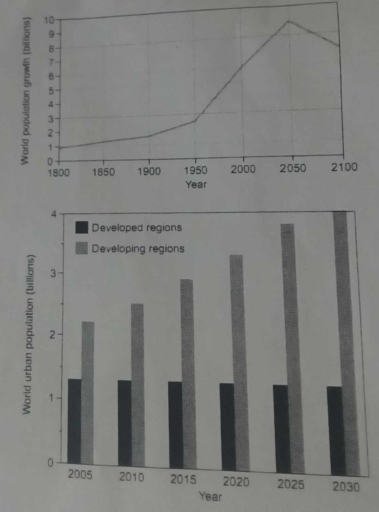
The line graph presents information about the world population from 1800 until 2100. The bar graph compares the urban population in developed and developing regions from 2005 to 2030.
Overall, the world population has been growing and is expected to continue to grow until 2050, when it will start to decline. The urban population in developed regions was significantly smaller than in developing regions, and this difference is expected to increase, as has been the trend since 2005.
The world population rose moderately from just under 1 billion in 1800 to around 2.5 billion in 1950. After that, it grew rapidly, and by 2050, the world’s population is expected to peak at 9 billion before dropping to 7 billion in 2100.
In 2005, just over 1 billion people lived in cities in developed regions, and this number has not varied since, nor is it expected to change. In contrast, just over 2 billion people lived in cities in developing regions in 2005. By 2020, the urban population in developing regions passed the mark of 3 billion, and by 2030, it is expected to peak at 4 billion.
Word Count: 187
