Our system will evaluate the answer based on this AI-generated description.
The image contains two bar graphs comparing the number of male and female students in full-time and part-time education across three academic years. For males in 1970/71, there were about 275 in part-time and 900 in full-time education. In 1980/81, males increased to approximately 325 in part-time and 975 in full-time education. By 1990/91, males in part-time education rose to around 400, and full-time education to 1100. For females in 1970/71, part-time education had about 225 students, and full-time had nearly 1150. In 1980/81, females in part-time education went up to roughly 350, and full-time to nearly 1250. In 1990/91, females in part-time education surged to about 475, and full-time education to around 1350. The trend for both genders indicates growth in both full-time and part-time education over the 20-year span, with females outnumbering males in full-time education, and the gap between genders in full-time education increasing over time.
Given the complexity of the image, the above description may not be entirely accurate.
Skyrocket your IELTS band score by 1-2 points in under a month with our premium plan!
Note: Both the topic and the answer were created by one of our users.
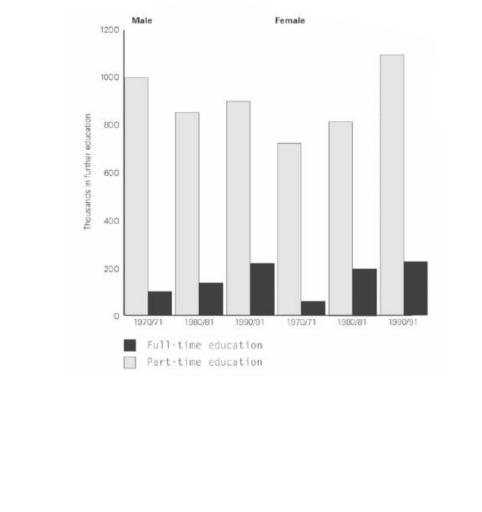
The bar graph illustrates the number of male and female in higher education in Britain in three periods and whether they were studying full time or part time.
It is clearly visible from the data that in 1970 to 1971 one thousand male students preferred part time education and around 700 women like the same. In the same year only 100 men and nearly 200 women enjoyed full-time study. The number of boys going to part time studydropped to a value little more than 800 in 1980. On the other hand the women like part time learning and the number rose to 800. Both gents and ladies developed interest in full time education as there is significant rise in the year 1980-81.
Moreover, in 1990 same number of man and women went to full time education. On the contrary more than 1000 ladies went to half day study whereas 700 man like part time study.
Overall, more women preferred part time as a positive trend is observed and full timeneduation was also rising throughout the years. On the other hand males developed interest in full time eduvation over years and part time study interest was changing frequently.
Word Count: 197
