Our system will evaluate the answer based on this AI-generated description.
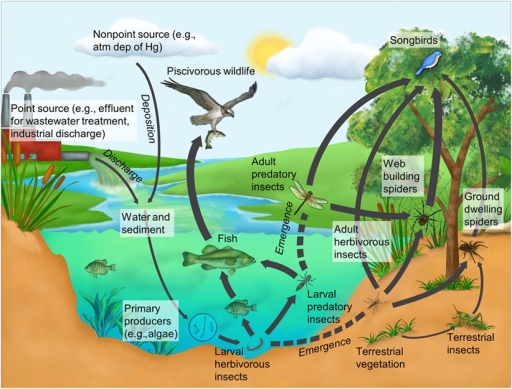
The image presents a conceptual diagram illustrating pollutant transfer and food web linkages between aquatic and terrestrial environments. Pollution inputs to "Water and sediment" comprise "Point source (e.g., effluent for wastewater treatment, industrial discharge)" via "Discharge" and "Nonpoint source (e.g., atm dep of Hg)" via "Deposition". Within the aquatic zone, "Water and sediment" connects to "Primary producers (e.g., algae)", which directs to "Larval herbivorous insects". These insects link to intermediate fish and "Fish", as well as to "Larval predatory insects", which also feeds into "Fish", and "Fish" leads to "Piscivorous wildlife". Two dashed pathways marked "Emergence" lead from aquatic larvae to terrestrial life stages: "Larval herbivorous insects" to "Adult herbivorous insects", and "Larval predatory insects" to "Adult predatory insects". In the terrestrial zone, "Adult predatory insects" leads to "Songbirds". "Adult herbivorous insects" points to "Songbirds", "Web building spiders", and "Ground dwelling spiders". On land, "Terrestrial vegetation" feeds into "Terrestrial insects", which connects to "Ground dwelling spiders". Both "Web building spiders" and "Ground dwelling spiders" subsequently direct arrows to "Songbirds".
Given the complexity of the image, the above description may not be entirely accurate.
Skyrocket your IELTS band score by 1-2 points in under a month with our premium plan!
Note: Both the topic and the answer were created by one of our users.
The diagram illustrates how pollutants spread through the food chain from bodies of water to the land.
Overall, the process commences either from industrial facilities pouring discharge into the water or from mercury falling back from air, and this waste is not only left in the freshwater ecosystem; by including bonds between aquatic and terrestrial organisms, it moves towards the ground, resulting in the creation of an unhealthy environment.
In the initial stage, primarily mercury penetrates the water in two ways: the first is by industrial hubs throwing remaining mercury into the bodies of water, while the second is atmospheric deposition of mercury. Following this, discharge and deposition accumulate in the water as sediment, where primary producers such as algae are absorbed. Once algae have been poisoned, larval consumers such as herbivorous and predatory insects are affected. Herbivorous insects become victims of fish, whereas predatory insects emerge onto the land. This represents that industrial discharge leads to pollution throughout the water system.
According to the land, atmospheric deposition of mercury is the main cause of growing poisoned terrestrial vegetation, which is the main food of terrestrial insects. Terrestrial insects fall into a web of spiders, which is a source of nutrition for spiders. Eventually, both poisoned fish in the water and ground-dwelling spiders become food for birds, including piscivorous wildlife and songbirds.
Word Count: 222
