Our system will evaluate the answer based on this AI-generated description.
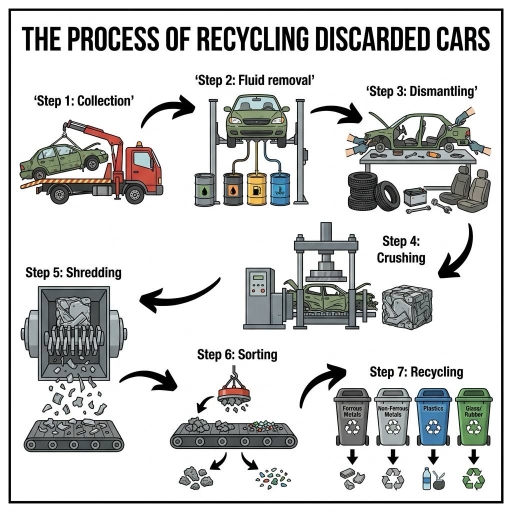
The image is titled "THE PROCESS OF RECYCLING DISCARDED CARS" and illustrates a 7-step recycling flow linked by sequential curved arrows: "'Step 1: Collection'" shows a damaged car being loaded onto a tow truck with a crane; "'Step 2: Fluid removal'" depicts a car raised on a hydraulic lift with drainage tubes running into four separate fluid collection drums; "'Step 3: Dismantling'" illustrates a car on a stand being manually stripped of parts, with removed tires, a battery, wrenches, and seats shown on the floor; "Step 4: Crushing" depicts the vehicle body inside a hydraulic press producing a compacted metal cube; "Step 5: Shredding" shows the crushed cube fed into a mechanical rotary shredder, discharging fragments onto a conveyor belt; "Step 6: Sorting" displays fragmented material on a conveyor belt being separated via an overhead crane magnet into two distinct piles below; and "Step 7: Recycling" presents four sorting bins labeled "Ferrous Metals", "Non-Ferrous Metals", "Plastics", and "Glass/ Rubber", each with downward-pointing arrows indicating final separated materials, including metal scraps, a plastic bottle/part, and recycled glass/rubber items.
Given the complexity of the image, the above description may not be entirely accurate.
Skyrocket your IELTS band score by 1-2 points in under a month with our premium plan!
Note: Both the topic and the answer were created by one of our users.
The diagram illustrates the process of how discarded cars have been recycled.
Overall, there are seven main stages in this process, beginning with the collection of old cars and ending with the recycling of different materials. During the process, fluids and useful parts are removed before the car is crushed and separated into different materials.
Firstly, discarded cars are collected and transported by a truck to a recycling facility. After that, different fluids, such as oil and fuel, are removed from the vehicle and stored in separate containers. In the next stage, the car is dismantled. Parts such as tyres, batteries and seats are taken out.
The remaining body of the car is then crushed into a smaller block. Thereafter, the crushed car is put into a shredding machine, which breaks it into small pieces. These pieces are then transported on a conveyer belt and sorted into different types of materials.
Finally, the separated materials are divided into several groups, including ferrous metals, non-ferrous metals, plastics, and glass or rubber. These materials are then recycled and can be used again.
Word Count: 180
