🔥 Today Only: Save 30% on Premium — Offer Ends Soon! - Upgrade Now!
Process Diagram

Band 9: The diagram below shows the stages in the process of manufacturing five different types of tea. Summarise the information by selecting and reporting the main features, and make comparisons where relevant.

Image for topic: The diagram below shows the stages in the process of manufacturing five different types of tea. Summarise the information by selecting and reporting the main features, and make comparisons where relevant.
Our system will evaluate the answer based on this AI-generated description.
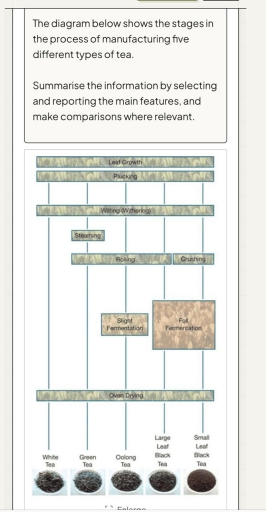
The image displays a flowchart illustrating the manufacturing stages of five tea varieties: White Tea, Green Tea, Oolong Tea, Large Leaf Black Tea, and Small Leaf Black Tea, each depicted at the bottom with a circular image of the final product in a small bowl. The process starts uniformly at the top with two full-width stages: 'Leaf Growth' followed by 'Plucking'. From 'Plucking', vertical paths proceed through 'Wilting (Withering)'. In the first column, White Tea bypasses intermediate processing, moving directly from 'Wilting (Withering)' to 'Oven Drying'. In the second column, Green Tea passes from 'Wilting (Withering)' to 'Steaming', then to a horizontal 'Rolling' stage, bypasses fermentation, and goes directly to 'Oven Drying'. In the third column, Oolong Tea proceeds from 'Wilting (Withering)' to 'Rolling', into 'Slight Fermentation', and then to 'Oven Drying'. In the fourth column, Large Leaf Black Tea passes from 'Wilting (Withering)' to 'Rolling' and enters a large 'Full Fermentation' box before reaching 'Oven Drying'. In the fifth column, Small Leaf Black Tea moves from 'Wilting (Withering)' to 'Crushing', enters the same 'Full Fermentation' box alongside Large Leaf Black Tea, and then proceeds to 'Oven Drying'. Finally, all five streams pass through the horizontal 'Oven Drying' bar to produce their respective teas.
Given the complexity of the image, the above description may not be entirely accurate.
Note: Both the topic and the answer were created by one of our users.

The diagram illustrates the procedure for manufacturing distinct types of tea.

Overall, all five types of tea undergo the same four processes, starting with tea leaf growing and culminating in drying in an oven, whereas the middle stages differ significantly, with large and small leaf black tea experiencing full fermentation, and oolong tea fermenting slightly.

Initially, white tea leaves are cultivated, plucked and wilted after which they are dried in an oven to get the finished product, whereas green tea should go through steaming and rolling before being subjected to oven drying.

In terms of other tea varieties, once large and small leaf black tea have been cultivated, plucked and wilted, the former is rolled, whereas the latter is crushed before both types being exposed to full fermentation and oven drying. As for oolong tea, its process is similar to that of large black tea, with only full fermentation being replaced by partial fermentation.

Word Count: 154

Other Topics:

The maps below shows university sports courts in 1990 and now. Summarise the information by selecting and reporting the main features, and make comparisons whereT

The maps illustrate the changes in the layout of the university sports centre between 1990 and the present day. Overall, the park and outdoor pool were replaced by a basketball court and an indoor pool, respectively. The tennis courts were relocated and expanded, whereas a fitness centre was added. The reception and cafe remained untouched. […]

The pictures show the process of making cherry jam. Summarise the information by selecting and reporting the main features, and make comparsons where relevant.

The diagram illustrates the various stages involved in the production of cherry jam. Overall, the process consists of nine stages, beginning with harvesting cherries from trees and transporting them to a processing plant by truck. It then involves preparing the ingredients and ends with packaging the jam into jars and attaching labels to them. In […]

The diagram below shows how rocks are created and destroyed in the rock cycle. Summarise the information by selecting and reporting the main features, and make comparisons where relevant

The given diagram illustrates the way in which rocks are formed and how they are destroyed. Overall, the process consists of three main parts. To be specific: when particles settle into the ground, rise up, and when the rock is destroyed due to erosion. Then the process repeats itself. Taking a closer look, the process […]

The diagram below shows the water supply in Australia at present and in the future

The diagram illustrates the current water supply system in Australia and the plan for a more sustainable one in the future. Overall, the nearby dam is the city’s main water source, it is used to supply households, shops and factories. A water treatment plant is also being used. At the moment, all waste water produced […]

The diagram shows two ways of using the energy from ocean waves to generate electricity.

The given diagram illustrates information about two ways for using ocean waves for to manufacture electricity between method one and method two Overall,it is clear that in the first trubine work on based on water,having more step,in contrast to the method 2,which work with rotates air At the beginning of this method with water,we have […]

See All
We have detected unusual activity on your device.
Please verify your identity to continue.
Note: This verification step won't sign you in. If you have a premium account, please log in to access the service as usual.
Google/Gmail Verification
Or verify using Email/Code
We've sent a verification code to:
youremail@gmail.com (Not your email?)
Enter it below to complete the verification process.
Ensure your email address is correct, your inbox is not full, and you check your spam folder. If no email arrives, consider using an alternative email.
You will need a Premium plan to perform your action!
Note: If you already have a premium account, please log in to access our services as usual.

Plans & Pricing

Our mission is to make quality education accessible for everyone.
However, to keep our hardworking team running and this service alive, we genuinely need your support!
By opting for a premium plan, not only do you sustain us in achieving the mission, but you also unlock advanced features to enrich your learning experience.

Free

For learners who aren't pressed for time

What's included on Free
100+ Cambridge IELTS Tests
Instant IELTS Writing Task 1 & 2 Evaluation (2 times/month)
Instant IELTS Speaking Part 1, 2, & 3 Evaluation (2 times/month)
Instant IELTS Writing Task 1 & 2 Essay Generator (2 times/month)
500+ Dictation & Shadowing Exercises
100+ Pronunciation Exercises
Flashcards
Other Advanced Tools

Premium

For those serious about advancing their English proficiency, and for IELTS candidates aspiring to boost their band score by 1-2 points (especially in writing & speaking) in just 30 days or less

What's included on Premium
Save Your IELTS Test Progress & Analyze Mistakes By Question Type
Save Your Own Flashcard Sets & Use Them On Any Device
Unlock All Courses, IELTS Tests, Section & Part Practice
Unlimited AI Conversations
Unlimited AI Writing Enhancement Exercises
Unlimited IELTS Writing Task 1 & 2 Evaluation
Unlimited IELTS Speaking Part 1, 2, & 3 Evaluation
Checked Answers Will Not Be Published
Unlimited IELTS Writing Task 1 & 2 Essay Generator
Unlimited IELTS Speaking Part 1, 2, & 3 Sample Generator
Unlimited Usage Of Advanced Tools & AI Features
Priority Support within 24h (12-month plan only)

Due to the nature of our service and the provided free trials, payments are non-refundable.