Our system will evaluate the answer based on this AI-generated description.
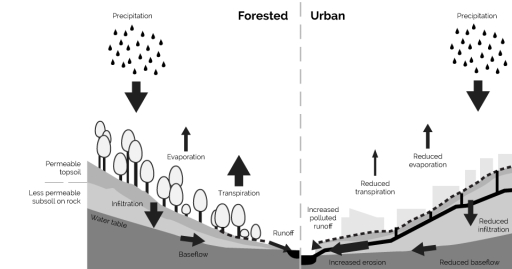
The image presents a comparative graphical depiction of water runoff in forested and urban settings. Both sections of the graph start with precipitation elements at the top. In the forested section, arrows point downward showing "Infiltration" through a "Permeable topsoil" and "Less permeable subsoil on rock" leading to "Water table" and then "Baseflow" with lateral arrows indicating "Evaporation" and "Transpiration" at the tree level, and "Runoff" at surface level. In contrast, the urban section arrows point towards "Reduced transpiration" and "Reduced evaporation" at the building level, with a significant arrow marked "Increased runoff" with side annotation "polluted" leading to "Increased erosion" with a consequential decrease in "Infiltration" and "Baseflow" compared to the forested section. There are no numerical data points or percentages provided.
Given the complexity of the image, the above description may not be entirely accurate.
Skyrocket your IELTS band score by 1-2 points in under a month with our premium plan!
Note: Both the topic and the answer were created by one of our users.
The diagram in question provides a insight view on water cycle forested and urban sides.
overall, the the water cycle of both areas are same.
As the picyure shows the water cycle has the same path in both areas, and it commences with the precipitation. as water fall to the permeable topsoil , and the first step,called infiltration, starts. I this phase water is absorbed by soil and passes through, less permeable subsoil on rock and it, reaches water to water table then it goes to Baseflow which drain water to runoff and then water
back to sky by evaporation and transpiration and same cycle restart.
However, the forested and urban areas land have different results during the water cycle. Because, the presence of buildings change the permeability of soil, which reduce the infiltration and baseflow which increased the erosion and it resulted the poluted runoff increased. and lastly,reduced the evaporation and transpiration process.
Word Count: 154
