Our system will evaluate the answer based on this AI-generated description.
The image features two comparative cross-sectional diagrams labeled "Normal Conditions" and "El Niño Conditions" across the Pacific Ocean from "West Pacific" to "East Pacific". Under "Normal Conditions", the West Pacific exhibits "weak winds" curving away, while the ocean surface shows "warm water" flowing westward; an upward vertical arrow near the East Pacific indicates "cool water and rich nutrients", driven by "strong trade winds" blowing westward from the East Pacific, beneath "storm clouds" and "rain"; accompanying side panels depict "Australia" with rain clouds, rain, and green vegetation, alongside "Peru" featuring a sun, two fish, and an upward arrow. Under "El Niño Conditions", the West Pacific displays "strong winds", with "warm water pushed eastwards" shown by an eastward arrow across the ocean surface, centered under "storm clouds" and "rain"; the East Pacific shows "weak trade winds", a reduced layer of "cool water" labeled "poor nutrients", while side panels show "Australia" under a bright sun with dry ground and palm trees, and "Peru" under a rain cloud with falling rain, a single fish, and a downward arrow.
Given the complexity of the image, the above description may not be entirely accurate.
Skyrocket your IELTS band score by 1-2 points in under a month with our premium plan!
Note: Both the topic and the answer were created by one of our users.
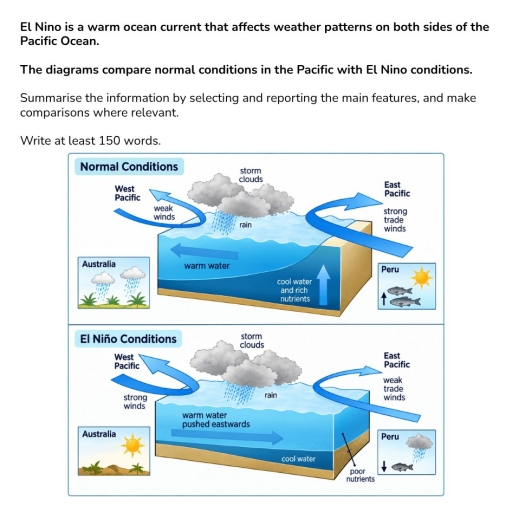
The diagrams compare weather and ocean conditions in the Pacific Ocean under normal circumstances with those during an El Nino event.
Overall, it is evident that El Nino causes a reversal in wind patterns and water temperature distribution across the Pacific Ocean. This leads to a shift in rainfall location, resulting in wet weather in South America and drier conditions in Australia.
Under normal conditions, strong trade winds blow from the East Pacific towards the West Pacific, pushing warm surface water westward towards Australia. As a result, storm clouds and heavy rain form over Australia. Meanwhile, off the coast of Peru in the East Pacific, cool water rich in nutrients rises to the surface, creating favorable conditions for marine life under sunny skies.
In contrast, during El Nino conditions, wind dynamics are inverted: trade winds in the East Pacific weaken, while strong winds blow in the West Pacific. Consequently, warm water is pushed eastwards toward Peru, suppressing the upwelling of cool, nutrient-rich water and leaving the coast with poor nutrients and reduced fish populations. Furthermore, rainfall shifts away from Australia, leaving it sunny and dry, while Peru experiences storm clouds and heavy precipitation
Word Count: 193
