🔥 Today Only: Save 30% on Premium — Offer Ends Soon! - Upgrade Now!
Process Diagram

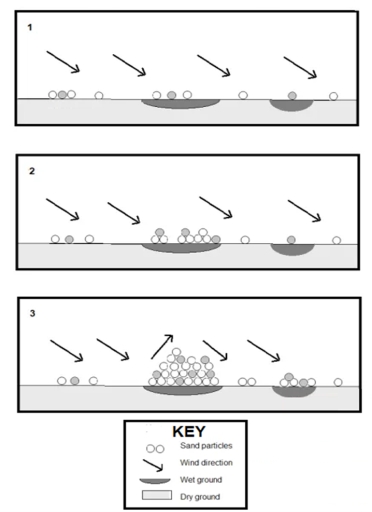
Band 5+: The diagrams below show how sand dunes are formed. Summarise the information by selecting and reporting the main features.

Image for topic: The diagrams below show how sand dunes are formed. Summarise the information by selecting and reporting the main features.
Our system will evaluate the answer based on this AI-generated description.
The image shows a three-part diagram illustrating the accumulation of sand particles driven by wind over wet and dry ground areas with all wind directions indicated by arrows pointing to the right; in the first diagram, six sand particles are present between two wet ground patches, with two particles approaching the first wet ground patch and three arrows indicating wind direction; the second diagram shows significant accumulation of sand particles, with twelve particles visibly collected on the first wet ground patch and an additional three marked by arrows pointing towards this accumulation; the third diagram presents a larger accumulation, tallying twenty-three sand particles gathered predominantly on the first wet ground patch, with six additional incoming sand particles dispersed in the windy section, as five arrows continue to denote the wind direction. The accompanying key defines symbols for sand particles (empty circles), wind direction (arrows), wet ground (shaded ovals), and dry ground (blank ground).
Given the complexity of the image, the above description may not be entirely accurate.
Note: Both the topic and the answer were created by one of our users.

The diagrams below illustrate how sand dunes are formed. Sand dune is a natural phenomenon that occurs in desserts and empty areas full of sand particles.

Overall, sand dunes are formed in three main steps with the presence of four essential factors that must be all gathered together: abundant of sand particles, strong wind, presence of wet ground and dry ground.

The first step the ground is still flat only small number of sand paricles are carried by wind to the dry and wet parts of the ground that makes the sand stick to the wet parts of the ground, then the wind carries more sand particles to the ground. That leads to stacking more and more sand gathering specially wet areas.Fianally, a pile of sand is created because the wind keeps stacking the sand particles, that leads to changing in wind direction and shaping the sand dunes to the well known and special shape of it.

Word Count: 157

Answers On The Same Topic:

The diagrams below show how sand dunes are formed. Summarise the information by selecting and reporting the main features.

The pictures illustrate the formation of sand dunes in a natural environment. Overall, the process involves 3 main stages,primarily driven by the interaction of wind directions and sand particles, patches of wet ground .A key feature of this process is that moisture traps sand particles, permitting them to accumulate to eventually create sand dunes. At […]

See All

Other Topics:

The diagram below gives information about stages of the process of producing olive oil. Summarise the information by selecting and reporting the main features, and make comparisons where

The diagram illustrates the multi-stage process of producing olive oil. In general, the process comprises seven distinct stages, commencing with picking olive from trees, followed by several treatments and culminating in the storage and sale of final products. At the first stage of the process, olives are harvested from olive trees by workers and are […]

The diagrams show growing and preparing pineapples and pineapple products

The process diagram illustrates the steps of planting and creating pineapples and pineapple products . Overall, pinapples are planted and processed then exported, sliced and extracted to produce juice .It takes a long time to mature into a full pineapple and after harvesting it is then washed to perfom various roles . To begin with, […]

The diagram below shows how electrisity is generated in a hydroelectric power station.

This picture illustrates how to produce electrisity from a hdyroelectric power station. Overall, process starts from high-level reservoir. With the debris of water , goes through several stages on the river .On the bottom there is a low-level reservoir, in addition to that the water has a circullar journey that leads to the high-level reservoir. […]

The diagram below shows how drinking water is produced by a solar-powered pump and filter. Summarise the information by selecting and reporting the main features, and make comparisons where relevant.

The diagram illustrates the extraction of groundwater using solar energy. Overall, the process involves four main stages, beginning with the generation of electricity, followed by the pumping of underground water into a tank, and ending with its collection as drinking water after being filtered and stored. In the first stage, electricity is generated from sunlight, […]

The diagram shows how the horse evolved through time, with particular emphasis on its foot structure

The diagram process gives information about transformation of the horse and four different names of horses also the foot structure, throughout 40 million years period. Overall, during evolution size of horse became much larger and the foot structure gradually simplified from multiple toes to a single hoof. Over the period, the horse developed into fragile […]

See All
We have detected unusual activity on your device.
Please verify your identity to continue.
Note: This verification step won't sign you in. If you have a premium account, please log in to access the service as usual.
Google/Gmail Verification
Or verify using Email/Code
We've sent a verification code to:
youremail@gmail.com (Not your email?)
Enter it below to complete the verification process.
Ensure your email address is correct, your inbox is not full, and you check your spam folder. If no email arrives, consider using an alternative email.
You will need a Premium plan to perform your action!
Note: If you already have a premium account, please log in to access our services as usual.

Plans & Pricing

Our mission is to make quality education accessible for everyone.
However, to keep our hardworking team running and this service alive, we genuinely need your support!
By opting for a premium plan, not only do you sustain us in achieving the mission, but you also unlock advanced features to enrich your learning experience.

Free

For learners who aren't pressed for time

What's included on Free
100+ Cambridge IELTS Tests
Instant IELTS Writing Task 1 & 2 Evaluation (2 times/month)
Instant IELTS Speaking Part 1, 2, & 3 Evaluation (2 times/month)
Instant IELTS Writing Task 1 & 2 Essay Generator (2 times/month)
500+ Dictation & Shadowing Exercises
100+ Pronunciation Exercises
Flashcards
Other Advanced Tools

Premium

For those serious about advancing their English proficiency, and for IELTS candidates aspiring to boost their band score by 1-2 points (especially in writing & speaking) in just 30 days or less

What's included on Premium
Save Your IELTS Test Progress & Analyze Mistakes By Question Type
Save Your Own Flashcard Sets & Use Them On Any Device
Unlock All Courses, IELTS Tests, Section & Part Practice
Unlimited AI Conversations
Unlimited AI Writing Enhancement Exercises
Unlimited IELTS Writing Task 1 & 2 Evaluation
Unlimited IELTS Speaking Part 1, 2, & 3 Evaluation
Checked Answers Will Not Be Published
Unlimited IELTS Writing Task 1 & 2 Essay Generator
Unlimited IELTS Speaking Part 1, 2, & 3 Sample Generator
Unlimited Usage Of Advanced Tools & AI Features
Priority Support within 24h (12-month plan only)

Due to the nature of our service and the provided free trials, payments are non-refundable.