Our system will evaluate the answer based on this AI-generated description.
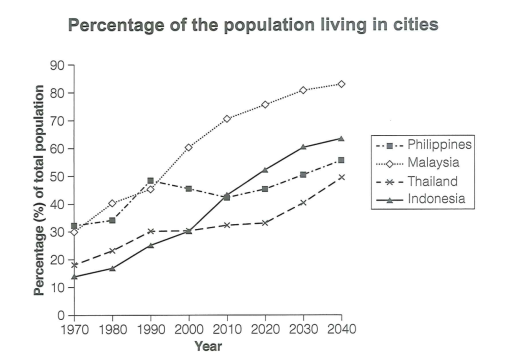
The image shows a line graph with four different lines representing the Philippines, Malaysia, Thailand, and Indonesia, with data points from 1970 to 2040 projected, illustrating the percentage of their population living in cities. The Philippines' line is a dashed line with squares, starting around 35% in 1970 and reaching approximately 70% by 2040. Malaysia's line is a dotted line with circles, starting around 30% in 1970 and reaching approximately 75% by 2040. Thailand's line is a dashed line with asterisks, starting around 15% in 1970 and reaching approximately 60% by 2040. Indonesia's line is a solid line with triangles, starting just below 20% in 1970 and reaching approximately 65% by 2040. The y-axis shows the percentage of total population, scaling from 0% to 90%, and the x-axis represents the years in increments of ten.
Given the complexity of the image, the above description may not be entirely accurate.
Skyrocket your IELTS band score by 1-2 points in under a month with our premium plan!
Note: Both the topic and the answer were created by one of our users.
The line graph illustrates the proportion of urban population in four different Asian countries between 1970 and 2020, with projections for the years 2030 and 2040.
Overall, there was a significant increase in the percentage of people living in cities across all countries, and this trend is expected to continue in the future. Malaysia witnessed the highest rise in the percentage of urban population.
In 1970, 30% of the total population in Malaysia lived in cities. Following this, the figures increased steadily to nearly 70% in 2020, and it is predicted to follow the same pattern, reaching 80% in 2040. Meanwhile, the Philippines’ proportion of urban population stood at around 31% in 1970, then it increased to just under 50% in 1990, before starting to decline to just 40% in 2020. It is foreseen to witness a steady rise to more than 50% in 2040.
Conversely, Thailand and Indonesia started the period at just under 20% and about 15%, respectively. After which the figures rose sharply to 30% for Thailand and 50% for Indonesia. The proportions are expected to increase in 2030 and 2040, with around 45% for Thailand and nearly 60% for Indonesia.
Word Count: 194
