Our system will evaluate the answer based on this AI-generated description.
The image displays a line graph illustrating the price of bananas in Japan, France, Germany, and the USA from 1994 to 2004 in USD per kilogram. In 1994, Japan starts at 2.00, France at 1.50, Germany at 1.10, and the USA at 1.00. By 1995, Japan rises to 2.80, France remains at 1.50, Germany slightly increases to 1.20, and USA maintains at 1.00. In 1996, Japan decreases to 2.50, France slightly rises to 1.60, Germany stays at 1.10, USA remains at 1.00. In 1997, Japan dips to 2.00, France remains at 1.60, Germany constant at 1.10, USA still at 1.00. The year 1998 shows Japan at 2.00, France at 1.50, Germany continues at 1.10, USA remains at 1.00. In 1999, Japan shows a slight decline to 1.90, France at 1.40, Germany again unchanged at 1.10, USA still stable at 1.00. By 2000, Japan registers 1.80, France holds at 1.40, Germany stable at 1.10, USA remains at 1.00. In 2001, Japan further declines to 1.70, France rises to 1.50, Germany stays at 1.10, USA at 1.00. In 2002, Japan increases back to 2.00, France rises slightly to 1.60, Germany again at 1.10, USA stays at 1.00. For 2003, Japan stands at 2.60, France remains at 1.60, Germany at 1.00, while USA continues at 1.00. Finally, in 2004, Japan falls to 2.50, France slightly rises to 1.70, Germany drops to 1.00, USA holds at 1.00.
Given the complexity of the image, the above description may not be entirely accurate.
Skyrocket your IELTS band score by 1-2 points in under a month with our premium plan!
Note: Both the topic and the answer were created by one of our users.
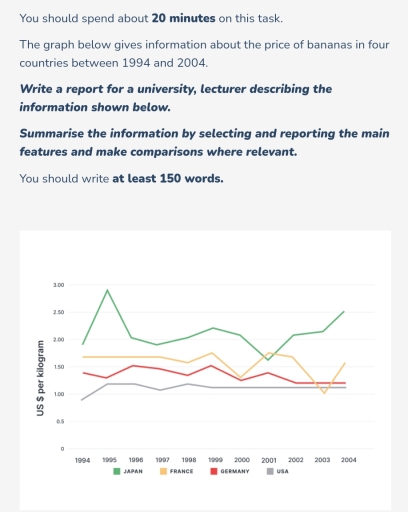
The line graph compares banana prices in Japan, France, Germany and the USA from 1994 to 2004, measured in US dollars per kilogram.
Overall, Japan had the highest banana prices for most of the period and recorded the biggest fluctuations. Prices in the USA were generally the lowest and remained relatively stable. By 2004, bananas cost more in Japan and the USA than they had in 1994, while prices in France and Germany ended slightly lower.
In Japan, the price rose sharply from about $1.90 per kilogram in 1994 to a peak of nearly $2.90 in 1995. It then fell to around $2.00 in 1996 and reached a low of approximately $1.60 in 2001 before recovering to $2.50 by 2004. In France, the price stayed close to $1.70 for the first few years. It dropped to about $1.00 in 2003 but rebounded to roughly $1.60 the following year.
In Germany, prices fluctuated between about $1.20 and $1.50, ending at the lower end of that range. Meanwhile, the US price rose from approximately $0.90 to $1.20 in the first year and then changed little, finishing at just over $1.10 per kilogram.
Word Count: 190
