Our system will evaluate the answer based on this AI-generated description.
The image contains two separate data representations on carbon dioxide emissions. The first part shows two pie charts for 2002 and 2030 with three categories: OECD, Transition economies, and Developing countries. In 2002, OECD has 52%, Transition economies 10%, and Developing countries 38%; in 2030, OECD has 43%, Transition economies 9%, and Developing countries 48%. The second part shows a bar graph titled "Worldwide Carbon Dioxide Emissions by sector" with two bars for each sector representing 2002 and 2030. Sectors include Other sectors, Waste combustion, Transportation, Consumer, and Industry. In 2002, Other sectors have less than 2 billion tons, Waste combustion around 1.5 billion tons, Transportation nearly 6 billion tons, Consumer over 2 billion tons, and Industry approximately 10 billion tons. By 2030, Other sectors increase to just under 4 billion tons, Waste combustion around 2 billion tons, Transportation nearly 10 billion tons, Consumer around 3.5 billion tons, and Industry close to 12 billion tons.
Given the complexity of the image, the above description may not be entirely accurate.
Skyrocket your IELTS band score by 1-2 points in under a month with our premium plan!
Note: Both the topic and the answer were created by one of our users.
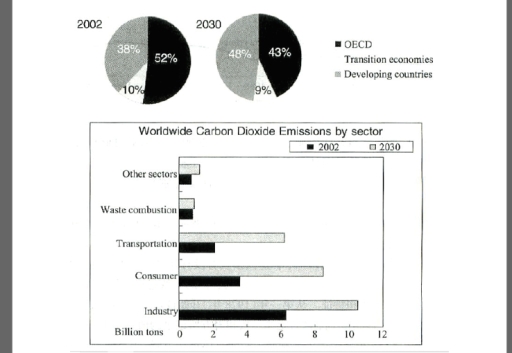
The pie charts and columns show past and the prediction of Greenhouse gas (GHG) for nearly 30 years in the world.
As we can see, the OECD countries had the biggest proportion of GHG diffusion in 2002 by 52% how ever, scientists believe the Developing countries will take place by 48% in 2030. the Transition economies remained lowest, ranging from 10% to 9% in 2002 to 2030. In the second place of Sources of pollution by 38% there’s the Developing countries in 2002 on the other hand, we have OECD countries in this rank by 43% of gas emission prospection in 2030.
In the column chart of Carbon Dioxides disposal shows different components amount of output from 2002 to 2030. The bar chart of Industry would has been increasing from 6 billion tons in 2002 to above 10 billion tons in 2030. The same expand forecasted for the Consumer, 4 billion tons more than 2002 , from 4 to more than 8 billion tons in 2030. respectively we can see top Growth rate happened in Transportation by 3 times multiply from 2002 by 2 billion tons researchers studies go with 6 billion tons an 2030.
To summarize, Developing countries will overtakes the OECD countries in GHG release by 2030 and the Carbon dioxide emission mostly spread by Industry Consumer and Transportation.
Word Count: 221
