
Production and Trade of Rice - IELTS Listening Answers & Explanations
From IELTS Simulation Tests Academic Listening Test 03 · Part 4 · Questions 31–40
Audio
Questions
Questions 31–34 Table Completion
Complete the table below.
Write ONE WORD OR A NUMBER for each answer.
| Cereal | MMT |
|---|---|
| 31 | 600 |
| 32 | 560 |
| coarse grain | 33 |
| cereal grown for 34 | 300 |
Questions 35–39 Summary Completion
Complete the summary below.
Write NO MORE THAN TWO WORDS for each answer.
Production of Rice
Rice gives more 35 per hectare than other cereal crops and production has increased over 100% in recent years because of better yields. Land area has only increased by 30% due to the need for wet land so availability of land is quite limited by 36 type and 37 supply. The dry-land variety gives poorer yields and poorer 38. No weed killers have been developed yet that do not harm the main crop. Heavy machines are unable to work in paddy fields so most rice is still grown 39.
Questions 40–40 Diagram Labeling
Complete the diagram below.
Write ONE WORD ONLY for the answer.
Answers & Explanations Summary
| # | Answer | Evidence | Explanation |
|---|---|---|---|
| Q31 | wheat | about 560 million metric tons of rice is grown each year compared with about 600 million metric tons of wheat | Excerpt/Transcript Explanation: The transcript states that approximately 600 million metric tons of wheat are produced annually, which matches the number 600 in the table. Answer Explanation: The answer "wheat" refers to a type of grain crop produced around the world. Reason For Correctness: The correct answer is "wheat" because the table asks for the type of cereal grain that has a production volume of 600 million metric tons (MMT). The speaker explicitly mentions that about 600 million metric tons of wheat is grown each year. |
| Q32 | rice | about 560 million metric tons of rice is grown each year compared with about 600 million metric tons of wheat | Excerpt/Transcript Explanation: The transcript states that approximately 560 million metric tons of rice are produced annually, which matches the number 560 in the table. Answer Explanation: The answer "rice" refers to a major food cereal grain that has a worldwide yearly production of 560 million metric tons. Reason For Correctness: The correct answer is "rice" because the speaker explicitly states that "about 560 million metric tons of rice is grown each year". In the table, 560 MMT (million metric tons) matches this specific cereal. |
| Q33 | 900 | Some 900 million metric tons of coarse grains are grown annually worldwide | Excerpt/Transcript Explanation: The transcript states that about 900 million metric tons of coarse grains are produced every year across the world. Answer Explanation: The answer "900" represents the number of million metric tons (MMT) of coarse grains produced globally each year. Reason For Correctness: The correct answer is supported by the speaker's statement comparing the production of various grains. The speaker clearly notes that around 900 million metric tons of coarse grains (such as corn, barley, and oats) are grown worldwide each year. Therefore, "900" is the missing number in the table under MMT for coarse grain. |
| Q34 | oil | a further 300 million metric tons of grain is produced for the oil in its seeds | Excerpt/Transcript Explanation: The transcript states that another 300 million metric tons of grain are grown each year to make oil from their seeds. Answer Explanation: The answer "oil" refers to the smooth liquid fat obtained from plant seeds, commonly used for cooking or other products. Reason For Correctness: The correct answer is "oil" because the speaker states that an additional 300 million metric tons of grain are produced specifically for the oil contained in their seeds. Matching this to the table row where 300 million metric tons (MMT) corresponds to "cereal grown for [input]", the required word is "oil". |
| Q35 | food energy | rice produces more food energy per hectare than any other cereal grain | Excerpt/Transcript Explanation: The transcript explains that for each unit of land area (hectare), rice provides a higher amount of energy from food compared to any other type of cereal crop. Answer Explanation: The answer refers to the nutritional calories or power from food that the body gets from eating rice. Reason For Correctness: The correct answer is supported by the speaker's explanation about rice production. The speaker states that rice produces more "food energy" per hectare than any other type of cereal grain. In the summary sentence, "rice gives more" matches "rice produces more", and "cereal crops" corresponds to "cereal grain". Therefore, the missing term is "food energy". |
| Q36 | soil | As you know, rice is primarily grown in flooded fields and therefore cultivation area is restricted by the sort of soil and the availability of water | Excerpt/Transcript Explanation: The transcript explains that the area where rice can be planted is limited by the kind of soil and how much water is available. Answer Explanation: The answer "soil" means the top layer of earth or dirt where plants grow. Reason For Correctness: The correct answer is "soil" because the speaker mentions that rice cultivation area is limited or restricted by "the sort of soil" and the availability of water. In the summary, the phrase "limited by [soil] type" corresponds directly to "restricted by the sort of soil". |
| Q37 | water | As you know, rice is primarily grown in flooded fields and therefore cultivation area is restricted by the sort of soil and the availability of water | Excerpt/Transcript Explanation: The transcript explains that because rice grows mostly in water-filled fields, the amount of land that can be used for farming is restricted by the type of soil and the supply of water. Answer Explanation: The answer "water" refers to the clear liquid needed for rice plants to grow in flooded fields. Reason For Correctness: The correct answer is "water" because the speaker notes that rice is usually grown in flooded fields, meaning that the area suitable for planting is limited by the soil type and how much water is available. In the summary sentence, "restricted by... the availability of water" matches the phrase "limited by [soil] type and water supply". |
| Q38 | quality | Although rice can be grown on dry land—it is essentially after all a type of grass—the yields and quality in this case are much lower and other grasses and weeds can easily overtake the rice | Excerpt/Transcript Explanation: The transcript explains that growing rice on dry land results in much lower amounts produced and much lower quality. Answer Explanation: The answer means the standard or how good the rice is. Reason For Correctness: The correct answer is confirmed because the speaker explains that when rice is grown on dry land instead of flooded fields, both its amount (yields) and its standard (quality) are much lower. In the summary, the word 'poorer' corresponds to the transcript's phrase 'much lower'. |
| Q39 | by hand | Much of the world's rice is still grown and cultivated by hand because for mechanized farming the land must be able to be drained and hold heavy equipment | Excerpt/Transcript Explanation: The transcript states that a large portion of rice is still grown manually using human labor because using heavy machines requires land that can be drained and support heavy weight. Answer Explanation: The answer "by hand" means using human manual labor rather than big machines. Reason For Correctness: The correct answer is confirmed by the speaker, who explains that mechanized farming requires land that can support heavy machinery, which is not possible in many flooded fields. Therefore, a large portion of the world's rice must still be planted and cultivated manually using human hands. |
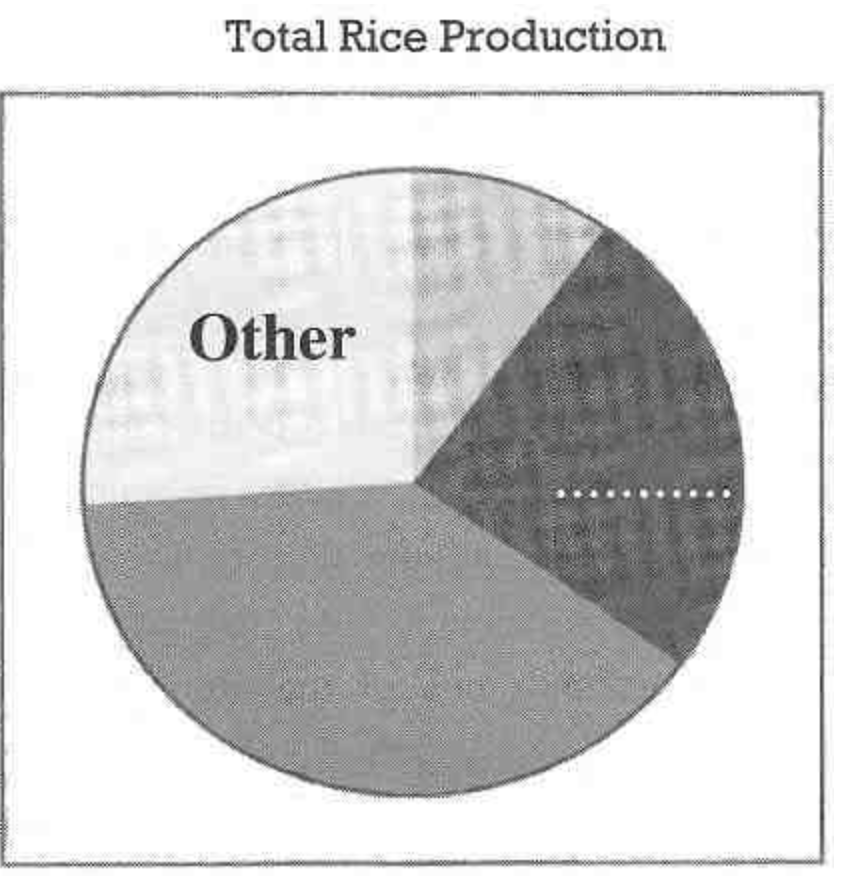
| Q40 | India | You will see from the chart that the leading producers of rice are China at around 39% followed by India with a quarter of the total | Excerpt/Transcript Explanation: The transcript explains that China grows the largest amount of rice, followed directly by India, which produces one-fourth of the world's total rice. Answer Explanation: The answer refers to the country of India. Reason For Correctness: The correct answer is "India" because the speaker outlines the main producers of rice in the world shown on the chart. After mentioning China as the leading producer at around 39%, the speaker states that it is followed by India, which accounts for a quarter (25%) of the total rice production. |
Transcript
Good morning and welcome to our inaugural lecture on Agricultural Economics. Today's topic is the world's production and trade of rice.
As you are all well aware rice is the staple ingredient in the diet of much of the world's population. Its importance as a food cereal in the human diet cannot be underestimated. In fact, it's a close second to wheat—about 560 million metric tons of rice is grown each year compared with about 600 million metric tons of wheat. Coarse grains, such as corn, sorghum, barley, oats, rye, and millet mostly go into animal feed which, by the way, is seen by many as a wasteful and inefficient use of fertile land because around 4 kilos of grain is needed to produce about half a kilo of beef. Some 900 million metric tons of coarse grains are grown annually worldwide and a further 300 million metric tons of grain is produced for the oil in its seeds...Now, I'll return to the subject of rice production...
What do we know about rice production? Well, firstly, rice produces more food energy per hectare than any other cereal grain and almost as much protein per hectare as wheat. Secondly, the production of rice has more than doubled in the last 40 years. How has this increase in production come about? Mainly as a result of improved field yields—the actual land area planted in rice has only risen by about 30%. As you know, rice is primarily grown in flooded fields and therefore cultivation area is restricted by the sort of soil and the availability of water.
Although rice can be grown on dry land—it is essentially after all a type of grass—the yields and quality in this case are much lower and other grasses and weeds can easily overtake the rice. As yet there are no herbicides that can selectively kill other grass types without killing the rice. Much of the world's rice is still grown and cultivated by hand because for mechanized farming the land must be able to be drained and hold heavy equipment.
Of the total rice production, it's no surprise to learn that the greatest proportion by far is grown and consumed in Asia. You will see from the chart that the leading producers of rice are China at around 39% followed by India with a quarter of the total. Indonesia produces almost one tenth and other countries, like Bangladesh, Vietnam, Thailand, Japan and Brazil, grow another 25—almost 26—percent of the total.
As I said before, most rice is consumed in the countries where it is grown. That means that very little rice is actually traded and for this reason the market price is very volatile.