
Colour Blindness - IELTS Reading Answers & Explanations
From Succeed in IELTS Academic Reading Test 4 · Part 2 · Questions 14–26
Reading Passage
You should spend about 20 minutes on Questions 14 - 26, which are based on Reading Passage 2 below.
Colour Blindness
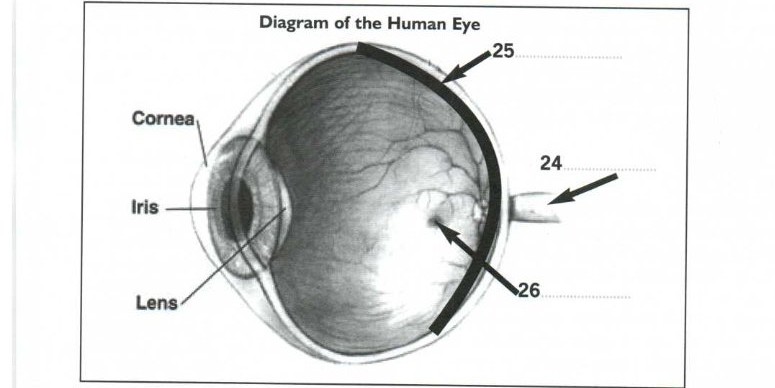
Colour blindness results from an absence or malfunction of certain colour-sensitive cells in the retina. The retina is a neuro-membrane lining the inside back of the eye, behind the lens. The retina contains both rod cells (active in low light or night vision but which cannot distinguish colour) and cone cells (active in normal daylight, sensitive to colour). Cone cells, also called photoreceptors, are concentrated mostly in the central part of the retina, in an area called the macula. Cone cells provide clear, sharp colour vision. The cones contain light-sensitive pigments that are sensitive to the range of wavelengths. There are three different types of cones with one sensitive to short wavelengths, or the colour blue, one sensitive to medium wave-lengths, or the colour green, and the other sensitive to higher wavelengths, or the colour red. All of these cells send information about colour to the brain via the optic nerve which connects to the retina at a point very close to the macula. Normal persons, referred to as trichromats, are able to match all colours of the spectrum by using a combination of these three fundamental colour sensitivities. Hence, the huge variety of colours we perceive stems from the cone cells' response to different compositions of wavelengths of light.
There are many types of colour blindness. When there are deficiencies in the cones, either at birth or acquired in other ways, the cones are not able to distinguish the particular wavelengths and thus, that colour range is seen differently. Those with defective colour vision have a deficiency or absence in one or more of the pigments. People with a deficiency in one of the pigments (the most common type of colour vision problem) are called anomalous trichromats. When one of the cone pigments is absent and colour is reduced to two dimensions, dichromacy occurs. These individuals normally know they have a colour vision problem and it can affect their lives on a daily basis. They see no perceptible difference between red, orange, yellow, and green. All these colours that seem so different to the normal viewer appear to them to be the same colour. Missing the cones responsible for green and red hues can also affect the sensitivity to brightness.
Most cases of colour blindness, about 99%, are inherited, resulting from partial or complete loss of function in one or more of the different cone systems and affect both eyes without worsening over time. The most common are red-green hereditary (genetic) photoreceptor disorders collectively referred to as "red-green colour blindness". It affects 8% of all males of European origin and 0.4% of all females. The gene for this is carried in the X chromosome. Since males have an X-Y pairing and females have X-X, colour blindness can occur much more easily in males and is typically passed to them by their mothers. In other words, females may be carriers of colour blindness, but males are more commonly affected. People with this disorder can-not identify red or green by itself but can if among a coloured group. Other forms of colour blindness are much more rare. They include problems in discriminating blues from yellows. Both colours are seen as white or grey. This disorder occurs with equal frequency in men and women and usually accompanies certain other physical disorders, such as liver disease or diabetes.
The rarest form of all is total colour blindness, monochromacy, where one can only see grey or shades of black, grey and white as in a black-and-white film or photograph. Monochromacy occurs when two or all three of the cone pigments are missing and colour and lightness vision is reduced to one dimension. Another term for total colour blindness is achromatopsia, the inability to see colour.
Inherited colour vision problems cannot be treated or corrected. Some acquired colour vision problems can be treated with surgery, such as the removal of a cataract, depending on the cause. Certain types of tinted filters and contact lenses may also help an individual to distinguish different colours better. Additionally, computer software has been developed to assist those with visual colour difficulties and those with mild colour deficiencies to learn to associate colours with certain objects and are usually able to identify colour in the same way as everyone else. One frequent problem encountered is with traffic lights, and worst of all, warning lights: colour-blind people always know the position of the colours on the traffic light – in most situations; red on top, yellow in the centre, green on the bottom. But warning lights present an entirely different problem. In this situation there is only one light; no top or bottom, no right or left, just one light that is either red or yellow.
Colour vision problems can have a significant impact on a person's life, learning abilities and career choices. On an everyday basis, there are some annoyances and frustrations: not being able to differentiate between green or ripe tomatoes when preparing food, for example, or buying clothes that to the 'normal' eye seem positively garish. However, people with colour vision problems usually learn to compensate for their inability to see colours. Although there is little or no treatment for colour blindness, most colour deficient persons compensate well for their defect and may even discover instances in which they can discern details and images that would escape normal-sighted persons. At one time the US Army found that colour-blind persons can spot camouflage colours in cases where those with normal colour vision are typically fooled.
Questions
Questions 14–20 Matching Sentence Endings
Complete each sentence with the correct ending A - K from the box below.
A. can see better at night than during the day.
B. cannot be treated by surgery.
C. can affect men much more easily than women.
D. can affect their sensitivity to bright lights.
E. can see no colour at all, other than shades of black, grey and white.
F. can see things that people with normal vision cannot.
G. can have very dangerous consequences for colour-blind people.
H. can be acquired or inherited.
I. can mean having to wear contact lenses.
J. cannot distinguish certain colours if they stand alone.
K. can match all colours of the spectrum.
Questions 21–23 One Choice
Choose the correct letter A, B, C or D.
Questions 24–26 Diagram Labeling
Complete the diagram below.
Choose NO MORE THAN TWO WORDS from the passage for each answer.
Answers & Explanations Summary
| # | Answer | Evidence | Explanation |
|---|---|---|---|
| Q14 | H | When there are deficiencies in the cones, either at birth or acquired in other ways, the cones are not able to distinguish the particular wavelengths and thus, that colour range is seen differently | Excerpt/Passage Explanation: The passage explains that eye cone problems can be present right when a person is born or can develop later in life through other causes. Answer Explanation: The answer means that colour vision problems can either be passed down from parents at birth (inherited) or developed later in life (acquired). Reason For Correctness: The correct answer is H because the passage explains that colour blindness occurs when there are problems with cone cells that exist "either at birth or acquired in other ways." Furthermore, the text contrasts "inherited" cases (passed down from family genes) with "acquired" cases (which develop later). Therefore, colour blindness can be acquired or inherited. |
| Q15 | F | Although there is little or no treatment for colour blindness, most colour deficient persons compensate well for their defect and may even discover instances in which they can discern details and images that would escape normal-sighted persons | Excerpt/Passage Explanation: The passage explains that even though colour blindness usually cannot be cured, many people with this condition can find moments where they are able to see details and images that people with normal vision completely miss. Answer Explanation: The answer means that people who cannot see certain colours can sometimes notice things that individuals with standard, healthy vision fail to see. Reason For Correctness: The correct answer is F because the last paragraph explains that people with colour vision deficiencies can sometimes notice details and pictures that normal-sighted people miss. The author provides an example showing that the US Army noticed colour-blind people could see camouflage patterns that trick people with normal vision. In the text, "discern details and images that would escape normal-sighted persons" directly matches option F's idea of being able to "see things that people with normal vision cannot." |
| Q16 | B | Inherited colour vision problems cannot be treated or corrected. Some acquired colour vision problems can be treated with surgery, such as the removal of a cataract, depending on the cause | Excerpt/Passage Explanation: The passage explains that vision problems you are born with cannot be cured or fixed. In contrast, only some vision problems that happen later in life can be helped with an operation (surgery). Answer Explanation: The answer means that individuals who receive colour blindness through their family genes cannot have an operation to fix their vision problem. Reason For Correctness: The correct answer is B because the text explains that colour vision issues passed down from parents cannot be treated or fixed at all. While some acquired cases can be helped with surgery, inherited (hereditary) colour blindness cannot. Keywords to pay attention to include "hereditary" (which has the same meaning as "inherited"), and "treated with surgery" vs. "cannot be treated or corrected". |
| Q17 | C | Since males have an X-Y pairing and females have X-X, colour blindness can occur much more easily in males and is typically passed to them by their mothers | Excerpt/Passage Explanation: The passage explains that because men have an X-Y chromosome combination and women have an X-X combination, men get colour blindness much more easily than women. Answer Explanation: The answer "C" means that colour blindness happens much more often to men than to women. Reason For Correctness: The correct answer is C because the text explains that the gene for red-green colour blindness is carried on the X chromosome. Because of the difference in chromosomes (males have X-Y and females have X-X), colour blindness happens far more easily in men than in women. In the sentence, the phrase "genetic make-up" relates to the passage's discussion of chromosomes ("X-Y pairing" and "X-X"), and "men much more easily than women" directly reflects "can occur much more easily in males". |
| Q18 | J | People with this disorder can-not identify red or green by itself but can if among a coloured group | Excerpt/Passage Explanation: The passage explains that individuals with red-green colour blindness cannot recognize the colour red or the colour green on its own, but they are able to see the difference when these colours are placed in a group with other colours. Answer Explanation: The answer "J" means that people are unable to tell specific colours apart when those colours appear by themselves. Reason For Correctness: The correct answer is J because paragraph 3 talks about "red-green hereditary (genetic) photoreceptor disorders". The text explains that people with this condition cannot recognize red or green when the colour appears alone ("by itself"), although they can tell them apart when seen together with other colours ("among a coloured group"). In the question and choice J, the phrase "cannot distinguish certain colours if they stand alone" directly matches the passage's statement that they "can-not identify red or green by itself". |
| Q19 | E | The rarest form of all is total colour blindness, monochromacy, where one can only see grey or shades of black, grey and white as in a black-and-white film or photograph | Excerpt/Passage Explanation: The passage explains that monochromacy means complete colour blindness, and someone with this condition can only view the world in black, white, and grey, just like watching an old black-and-white movie. Answer Explanation: The answer means that individuals with this condition cannot see any real colours; they only see black, white, and different tones of grey. Reason For Correctness: The correct answer is E because paragraph 4 clearly states that "monochromacy" is total colour blindness, in which a person "can only see grey or shades of black, grey and white as in a black-and-white film or photograph." Therefore, people with monochromacy can see no colour at all, matching option E perfectly. |
| Q20 | G | One frequent problem encountered is with traffic lights, and worst of all, warning lights: colour-blind people always know the position of the colours on the traffic light – in most situations; red on top, yellow in the centre, green on the bottom. But warning lights present an entirely different problem. In this situation there is only one light; no top or bottom, no right or left, just one light that is either red or yellow | Excerpt/Passage Explanation: The passage explains that colour-blind individuals struggle especially with single warning lights, because they cannot rely on the position of the light to know whether it is red or yellow. Answer Explanation: The answer means that not being able to tell the difference between certain lights can lead to very unsafe and hazardous situations for people who are colour-blind. Reason For Correctness: The correct answer is G because the passage highlights that a major issue for colour-blind people is dealing with traffic lights and "worst of all, warning lights." While normal traffic lights allow people to identify the colour by its position (top, middle, or bottom), warning lights have only a single light that is either red or yellow. Because warning lights indicate hazards and lack positional clues, being unable to correctly identify them can cause serious, dangerous consequences. |
| Q21 | C | Colour blindness results from an absence or malfunction of certain colour-sensitive cells in the retina. The retina is a neuro-membrane lining the inside back of the eye, behind the lens. The retina contains both rod cells (active in low light or night vision but which cannot distinguish colour) and cone cells (active in normal daylight, sensitive to colour) | Excerpt/Passage Explanation: The passage explains that colour blindness happens when the cells that see colour do not work correctly, and it identifies these colour-sensitive cells as cone cells. Answer Explanation: The answer means that colour blindness happens when cone cells do not work the right way. Reason For Correctness: The correct answer is C because the text states that colour blindness is caused by the absence or "malfunction" of colour-sensitive cells. It then explains that "cone cells" are the specific cells that can detect colour, while rod cells cannot distinguish colours. Therefore, when cone cells do not function properly, colour blindness occurs. |
| Q22 | D | The rarest form of all is total colour blindness, monochromacy, where one can only see grey or shades of black, grey and white as in a black-and-white film or photograph. Monochromacy occurs when two or all three of the cone pigments are missing and colour and lightness vision is reduced to one dimension. Another term for total colour blindness is achromatopsia, the inability to see colour | Excerpt/Passage Explanation: The passage explains that total colour blindness is the rarest form of colour blindness, and another word for total colour blindness is achromatopsia. Answer Explanation: The answer means people who have a condition known as achromatopsia. Reason For Correctness: The correct answer is D because the text states that the rarest kind of colour blindness is total colour blindness. The text also explains that another name for total colour blindness is "achromatopsia". In English, "the rarest" means the same thing as "the least common". Therefore, people with achromatopsia are the least common group. |
| Q23 | D | On an everyday basis, there are some annoyances and frustrations: not being able to differentiate between green or ripe tomatoes when preparing food, for example, or buying clothes that to the 'normal' eye seem positively garish | Excerpt/Passage Explanation: The passage explains that in daily life, colour-blind people face small irritating problems, such as not knowing if a tomato is ripe when cooking, or purchasing clothes that look awkwardly bright or mismatched to other people. Answer Explanation: The answer means that people who are colour-blind find it difficult and annoying to pick out clothes that match well together. Reason For Correctness: The correct answer is D because the text mentions daily difficulties using the words "annoyances and frustrations", which directly mean "nuisance". The author gives two specific daily examples: telling ripe tomatoes from green tomatoes, and buying clothes that appear "garish" (unpleasantly bright or clashing in colour) to people with normal vision. This shows that struggling to buy clothes that go well together is an everyday problem for them. |
| Q24 | optic nerve | All of these cells send information about colour to the brain via the optic nerve which connects to the retina at a point very close to the macula | Excerpt/Passage Explanation: The passage explains that eye cells pass colour information to the brain through a part named the optic nerve, which joins the retina right near the macula. Answer Explanation: The answer refers to the special eye nerve that sends visual messages from the eye to the brain. Reason For Correctness: The correct answer is identified in the first paragraph. The text explains that the cells in the eye collect colour information and send it to the brain through the "optic nerve." This nerve attaches to the retina very close to the area called the macula. |
| Q25 | retina | The retina is a neuro-membrane lining the inside back of the eye, behind the lens | Excerpt/Passage Explanation: The passage states that the retina is a layer found on the inside back part of the eye, situated right behind the lens. Answer Explanation: The answer refers to the "retina", which is the layer at the back of the eyeball that detects light and colour. Reason For Correctness: The correct answer is "retina" because the passage identifies it as the special membrane lining the inside back of the eye, behind the lens, which holds the cells (rods and cones) needed to see colour and light. |
| Q26 | macula | Cone cells, also called photoreceptors, are concentrated mostly in the central part of the retina, in an area called the macula | Excerpt/Passage Explanation: The passage explains that the cells that see colour (cone cells) are mostly gathered together in the middle section of the retina, which is named the macula. Answer Explanation: The answer refers to the "macula", which is the central area of the retina inside the eye where most cone cells are gathered. Reason For Correctness: The correct answer is confirmed by the passage when it describes the structure of the retina in the eye. The author states that cone cells are gathered mainly in the middle part of the retina, and this specific region is called the "macula". |