
PROJECT: Reform Of The Prison System In The UK - IELTS Reading Answers & Explanations
From Succeed in IELTS Academic Reading Test 3 · Part 1 · Questions 1–13
Reading Passage
You should spend about 20 minutes on Questions 1 - 13, which are based on Reading Passage 1 below.
PROJECT: Reform Of The Prison System In The UK
Penal progress
The UK's large prison population is fuelled by a high level of recidivism - when criminals repeatedly relapse into crime. This project for a model prison tackles issues of architecture, management and funding in an enlightened attempt to achieve lasting rehabilitation.
Project:
The penal system is one of the most direct manifestations of the power of the state, but is often also a revealing reflection of the national psyche and the public's attitude to punishment and rehabilitation. Surprisingly, for a prosperous, progressive Western democracy, the UK has a lamentable penal record. Britain's prison population is currently in excess of 60,000 (up 50 per cent from a decade ago) making it the second largest in Europe. The average cost of keeping an individual prisoner incarcerated for a year is £27,000 (ten times the average expenditure on a secondary school pupil in the state sector). Despite such substantial investment, over half of British prisoners re-offend within two years of release.
Such high rates of recidivism is a serious problem. It means that the prison population is continuing to grow at an alarming rate (recently by as many as 700 a week), so overcrowding is endemic, hampering opportunities for education and rehabilitation and lowering staff and prisoner morale. To ease this pressure, the UK government is investing in the prison estate at historic levels, with 12,000 new prison places proposed within the next few years. Yet, like their nineteenth-century predecessors, Britain's 'new Victorian' prisons are designed for security and control rather than for the rehabilitation and education which is increasingly recognised as what prisoners need. Most are poorly educated young men under 30 (at least 60 per cent of whom are functionally illiterate and innumerate), so without education and skills few will be able to build meaningful lives away from crime, no matter how often they go to prison, or how long they spend there.
Any transformation of the penal system must start with the redesign of prison buildings. Prison architecture has a clearly discernible effect on behaviour, operational efficiency, interaction and morale. Last year, architects Buschow Henley were commissioned by a think tank organisation working with the Home Office Prison Service to research and develop an alternative prison model that focuses more intensely on rehabilitation through a concentrated programme of intellectual, physical and social education. The model is not intended as a blueprint but rather a series of principles that might be adapted to support the wider concept of the 'Learning Prison' in which other aspects such as organisation, management and funding would obviously play a part. Key to this is the introduction of a system that groups together prisoners in small communities or 'houses' of between 30 and 40 inmates. This has two important consequences. First, the more compact spatial organisation of the house reduces staff time spent on supervising and escorting prisoners. Second, the system places educational and other facilities at the heart of the building, within easy reach at all times of day, reinforced by a supportive social environment. This model also enables resources to be dramatically redeployed, from a current estimated ratio of 80:20 (costs of security versus rehabilitation) to a predicted reversed figure of 20:80, freeing up much-needed funds to invest in educational programmes, thereby helping to promote rehabilitation, reduce recidivism and initiate a virtuous cycle.
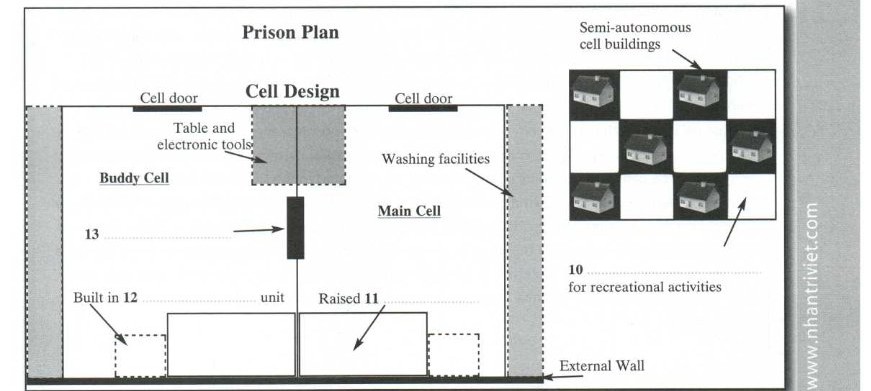
In Buschow Henley's scheme, the proposed group size of 30-40 has the potential for social accountability - each prisoner being known within the community and personally accountable for his behaviour. Houses are semi-autonomous, not just dormitories, with communal, as opposed to centralised, facilities. Circulation is simplified and reduced. Buildings are arranged in a chess-board formation, as opposed to pavilions marooned in space, each with a discrete external area that can be productively used for sport, games or gardening with a minimum of supervision.
Individual cells are replanned to make them less like domestic lavatories and more conducive to learning. In an inversion of the conventional layout, the bed is placed lengthways along the external wall at high level, freeing up space below. Storage is built in and each inmate is provided with a moveable table equipped with electronic tools for study. Washing facilities are contained in a small adjoining space (included in the basic 8 sqm allowance) so reducing pressure on prison staff to manage inmate hygiene and ablution. Each cell is paired with a neighbouring 'buddy' cell linked by sliding doors controlled by individual prisoners to mitigate the risk of self-harm.
While this new type of prison appears to be somewhat liberal, the arrangement of spaces and functions both inside and out is actually tightly controlled. Paradoxically, however, this proscription enables a greater range of activities to take place, and makes general supervision easier. In this environment the prisoners are judged not by their degree of conformity, but by the scope of their activities and achievements, so laying the foundations for genuine rehabilitation. As Martin Narey, Director General of the UK Prison Services observes, 'We have got to accept that prison must be a humane and constructive place, not least because all but 23 of my population are going home some day.'
Questions
Questions 1–5 Matching Sentence Endings
Complete each sentence with the correct ending, A - H, below.
Write the correct letter A - H.
A. improved security, supervision and education.
B. rehabilitation and education.
C. reduced efficiency, morale and interaction.
D. reduced risk of self harm.
E. security and control.
F. an alternative prison model
G. a learning environment rather than a punitive compound.
H. organisation, management and funding.
Questions 6–9 One Choice
Choose the correct letter A, B, C or D.
Questions 10–13 Diagram Labeling
Label the diagram below.
Write NO MORE THAN THREE WORDS from the passage for each answer.
Answers & Explanations Summary
| # | Answer | Evidence | Explanation |
|---|---|---|---|
| Q1 | E | Yet, like their nineteenth-century predecessors, Britain's 'new Victorian' prisons are designed for security and control rather than for the rehabilitation and education which is increasingly recognised as what prisoners need | Excerpt/Passage Explanation: The passage explains that modern British prisons are made to guard and manage prisoners strictly, instead of teaching them skills and helping them change their lives. Answer Explanation: The answer "E" means keeping prisoners safe, locked up, and strictly managed. Reason For Correctness: The correct answer is E because the text states that modern British prisons are built mainly for "security and control" instead of helping inmates learn and reform. In the passage, "designed for security and control" matches the idea that the main goal or agenda of current prisons is "security and control." |
| Q2 | B | Britain's 'new Victorian' prisons are designed for security and control rather than for the rehabilitation and education which is increasingly recognised as what prisoners need | Excerpt/Passage Explanation: The passage explains that modern prisons focus on guarding and controlling inmates, instead of providing reform and learning, even though people know that reform and education are what prisoners truly need. Answer Explanation: The answer means that the main purpose of prisons ought to be helping inmates reform and teaching them useful knowledge. Reason For Correctness: The correct answer is B because the passage explains that although prisons are currently built for security and control, people now realize that inmates actually need support to reform and learn. In the text, the phrase "what prisoners need" matches the sentence starter "The primary role of prisons should be", pointing directly to "rehabilitation and education". |
| Q3 | G | The model is not intended as a blueprint but rather a series of principles that might be adapted to support the wider concept of the 'Learning Prison' in which other aspects such as organisation, management and funding would obviously play a part | Excerpt/Passage Explanation: The passage explains that this new prison plan is designed to help build and support the bigger idea of a 'Learning Prison' where inmates can study, learn skills, and rehabilitate. Answer Explanation: The answer means that the proposed design for the prison aims to build a place focused on studying and training instead of just a place designed to punish people. Reason For Correctness: The correct answer is G because the text discusses how the new architectural plan supports the idea of a 'Learning Prison'. Rather than sticking to the old style of prisons that focused purely on security, control, and punishment, this new project prioritizes rehabilitation by creating spaces that are 'conducive to learning' and offering education. Therefore, the scheme seeks to establish a learning environment instead of a purely punitive compound. |
| Q4 | C | Prison architecture has a clearly discernible effect on behaviour, operational efficiency, interaction and morale | Excerpt/Passage Explanation: The passage explains that the way a prison is designed and built clearly affects how people behave, how well the prison runs, how people talk and connect with each other, and how positive or hopeful staff and prisoners feel. Answer Explanation: The answer "C" means that the current design and layout of prison buildings lead to lower work effectiveness, worse mood or spirits among people, and poorer communication and contact. Reason For Correctness: The correct answer is C because the passage explains that reforming the prison system requires changing the design of prison buildings. It points out that prison design directly influences several key areas: "operational efficiency, interaction and morale." Because existing prisons were built poorly for modern needs, their design causes problems in these exact areas, leading to reduced efficiency, morale, and interaction. |
| Q5 | A | Key to this is the introduction of a system that groups together prisoners in small communities or 'houses' of between 30 and 40 inmates. This has two important consequences. First, the more compact spatial organisation of the house reduces staff time spent on supervising and escorting prisoners. Second, the system places educational and other facilities at the heart of the building, within easy reach at all times of day, reinforced by a supportive social environment | Excerpt/Passage Explanation: The passage explains that keeping prisoners in smaller groups of 30 to 40 people makes supervising them easier for staff and gives the prisoners better, easier access to education. Answer Explanation: The answer "A" means that having fewer prisoners together in one area leads to better monitoring, safety, and learning opportunities. Reason For Correctness: The correct answer is A because the text explains the effects of grouping prisoners into smaller "houses" of 30 to 40 inmates. This smaller, more compact group size has two key benefits: it saves prison staff time when "supervising" prisoners, and it puts "educational" facilities right in the center for prisoners to use easily. |
| Q6 | A | This project for a model prison tackles issues of architecture, management and funding in an enlightened attempt to achieve lasting rehabilitation | Excerpt/Passage Explanation: The passage explains that this prison design project uses advanced and enlightened ideas about buildings, rules, and money to give prisoners long-term help and education. Answer Explanation: The answer "A" means that the new plan to improve British prisons uses modern, forward-thinking, and enlightened ideas to help prisoners change. Reason For Correctness: The correct answer is A because the text describes this prison reform plan under the title "Penal progress" and calls it an "enlightened attempt to achieve lasting rehabilitation." The word "enlightened" means modern, well-informed, and forward-looking, which directly matches the keyword "progressive." In contrast, the other choices are incorrect: it does not say the project is cheap or inexpensive, it simplifies supervision rather than completely eliminating it, and its main goal is rehabilitation through education rather than simply making inmates comfortable. |
| Q7 | C | It means that the prison population is continuing to grow at an alarming rate (recently by as many as 700 a week), so overcrowding is endemic, hampering opportunities for education and rehabilitation and lowering staff and prisoner morale. To ease this pressure, the UK government is investing in the prison estate at historic levels, with 12,000 new prison places proposed within the next few years | Excerpt/Passage Explanation: The passage explains that the number of prisoners is increasing very quickly, leading to overcrowded prisons. Because of this growing number, the government plans to build 12,000 new prison places to reduce the strain. Answer Explanation: The answer means that the number of criminals in prison in the UK is going up. Reason For Correctness: The correct answer is C because the text explains that the "prison population is continuing to grow at an alarming rate," causing severe overcrowding. To relieve or "ease this pressure," the UK government plans to create 12,000 new spaces for prisoners. This clearly shows that more prison places are needed because the number of prisoners (offenders) in the country is rising. |
| Q8 | B | Prison architecture has a clearly discernible effect on behaviour, operational efficiency, interaction and morale | Excerpt/Passage Explanation: The passage means that the way a prison is built and arranged clearly changes how prisoners act, how they get along with others, and how positive they feel about themselves. Answer Explanation: The answer means that the new prison designs mainly aim to improve prisoners' confidence, feelings of worth, and the way they act and communicate with other people. Reason For Correctness: The correct answer is B because the passage explains why changing prison design is essential. It states that prison architecture has a clear impact on prisoners' "morale" (which refers to mood, confidence, and self-esteem) as well as their "behaviour" and "interaction" (which describe social behaviour). None of the other options are supported, as the changes are not meant to make the buildings look pretty (aesthetic value), expand overall living area, or increase running costs. |
| Q9 | C | the bed is placed lengthways along the external wall at high level, freeing up space below. Storage is built in | Excerpt/Passage Explanation: The passage explains that lifting the bed up high against the wall leaves open room underneath, and this extra space is used for built-in storage. Answer Explanation: The answer means that putting the bed up high creates empty area underneath it where cupboards or storage spaces can be placed. Reason For Correctness: The correct answer is C because the text states that the bed is placed high up against the wall to free up room underneath it ("freeing up space below"), right before mentioning that "Storage is built in". This shows that the space under the bed is used for storage. Other choices are incorrect because the washing facilities are located in a separate "small adjoining space", and the sliding doors connect two neighboring rooms, not the area under the bed. |
| Q10 | discrete external area / external area | Buildings are arranged in a chess-board formation, as opposed to pavilions marooned in space, each with a discrete external area that can be productively used for sport, games or gardening with a minimum of supervision | Excerpt/Passage Explanation: The passage explains that the prison buildings are organized like a chess board, and every building has its own separate outdoor space where prisoners can play sports, play games, or do gardening. Answer Explanation: The answer means a separate outside space or yard belonging to each building. Reason For Correctness: The correct answer is supported by paragraph 5, which explains the layout of the proposed prison buildings. The text states that the buildings are set up in a chess-board pattern, and each building has its own "discrete external area" (a separate outside zone) that inmates can use for outdoor activities like gardening or sports with very little supervision. |
| Q11 | bed | In an inversion of the conventional layout, the bed is placed lengthways along the external wall at high level, freeing up space below | Excerpt/Passage Explanation: The passage explains that unlike a normal room layout, the bed is fixed up high against the outside wall, which creates more usable space on the floor. Answer Explanation: The answer "bed" refers to the piece of furniture that a prisoner sleeps on in their room. Reason For Correctness: The correct answer is "bed" because the passage describes the new design of individual prison rooms (cells). In this new design, the "bed" is positioned high up along the outside wall to save and open up floor area underneath. |
| Q12 | storage | Storage is built in | Excerpt/Passage Explanation: The passage explains that spaces for keeping items are already constructed directly into the room. Answer Explanation: The answer means a place or space where items and belongings can be kept. Reason For Correctness: The correct answer is confirmed by paragraph 6, which describes the layout of the newly designed prison cell. The text explicitly states that "Storage is built in", matching the feature pointed out in the cell diagram. |
| Q13 | sliding doors | Each cell is paired with a neighbouring 'buddy' cell linked by sliding doors controlled by individual prisoners to mitigate the risk of self-harm | Excerpt/Passage Explanation: The passage explains that every cell is joined to a partner cell beside it using doors that slide, which the inmates can open or close. Answer Explanation: The answer refers to doors that slide open and closed to connect two neighboring prison cells. Reason For Correctness: The correct answer is supported by the paragraph detailing the design of individual cells. The text explains that two nearby cells are connected together as 'buddy' cells through 'sliding doors' that the prisoners can control themselves. |