
THE ROCKET – FROM EAST TO WEST - IELTS Reading Answers & Explanations
From Cambridge IELTS 03 Academic Reading Test 1 · Part 1 · Questions 1–14
Reading Passage
You should spend about 20 minutes on Questions 1-14 which are based on Reading Passage 1 on the following pages.
THE ROCKET - FROM EAST TO WEST
A The concept of the rocket, or rather the mechanism behind the idea of propelling an object into the air, has been around for well over two thousand years. However, it wasn’t until the discovery of the reaction principle, which was the key to space travel and so represents one of the great milestones in the history of scientific thought, that rocket technology was able to develop. Not only did it solve a problem that had intrigued man for ages, but, more importantly, it literally opened the door to exploration of the universe.
B An intellectual breakthrough, brilliant though it may be, does not automatically ensure that the transition is made from theory to practice. Despite the fact that rockets had been used sporadically for several hundred years, they remained a relatively minor artefact of civilisation until the twentieth century. Prodigious efforts, accelerated during two world wars, were required before the technology of primitive rocketry could be translated into the reality of sophisticated astronauts. It is strange that the rocket was generally ignored by writers of fiction to transport their heroes to mysterious realms beyond the Earth, even though it had been commonly used in fireworks displays in China since the thirteenth century. The reason is that nobody associated the reaction principle with the idea of travelling through space to a neighbouring world.
C A simple analogy can help us to understand how a rocket operates. It is much like a machine gun mounted on the rear of a boat. In reaction to the backward discharge of bullets, the gun, and hence the boat, move forwards. A rocket motor’s ‘bullets’ are minute, high-speed particles produced by burning propellants in a suitable chamber. The reaction to the ejection of these small particles causes the rocket to move forwards. There is evidence that the reaction principle was applied practically well before the rocket was invented. In his Noctes Atticae or Greek Nights, Aulus Gellius describes ‘the pigeon of Archytas’, an invention dating back to about 360 BC. Cylindrical in shape, made of wood, and hanging from string, it was moved to and fro by steam blowing out from small exhaust ports at either end. The reaction to the discharging steam provided the bird with motive power.
D The invention of rockets is linked inextricably with the invention of ‘black powder’. Most historians of technology credit the Chinese with its discovery. They base their belief on studies of Chinese writings or on the notebooks of early Europeans who settled in or made long visits to China to study its history and civilisation. It is probable that, some time in the tenth century, black powder was first compounded from its basic ingredients of saltpetre, charcoal and sulphur. But this does not mean that it was immediately used to propel rockets. By the thirteenth century, powder-propelled fire arrows had become rather common. The Chinese relied on this type of technological development to produce incendiary projectiles of many sorts, explosive grenades and possibly cannons to repel their enemies. One such weapon was the ‘basket of fire’ or, as directly translated from Chinese, the ‘arrows like flying leopards’. The 0.7 metre-long arrows, each with a long tube of gunpowder attached near the point of each arrow, could be fired from a long, octagonal-shaped basket at the same time and had a range of 400 paces. Another weapon was the ‘arrow as a flying sabre’, which could be fired from crossbows. The rocket, placed in a similar position to other rocket-propelled arrows, was designed to increase the range. A small iron weight was attached to the 1.5m bamboo shaft, just below the feathers, to increase the arrow’s stability by moving the centre of gravity to a position below the rocket. At a similar time, the Arabs had developed the ‘egg which moves and burns’. This ‘egg’ was apparently full of gunpowder and stabilised by a 1.5m tail. It was fired using two rockets attached to either side of this tail.
E It was not until the eighteenth century that Europe became seriously interested in the possibilities of using the rocket itself as a weapon of war and not just to propel other weapons. Prior to this, rockets were used only in pyrotechnic displays. The incentive for the more aggressive use of rockets came not from within the European continent but from far-away India, whose leaders had built up a corps of rocketeers and used rockets successfully against the British in the late eighteenth century. The Indian rockets used against the British were described by a British Captain serving in India as ‘an iron envelope about 200 millimetres long and 40 millimetres in diameter with sharp points at the top and a 3m-long bamboo guiding stick’. In the early nineteenth century the British began to experiment with incendiary barrage rockets. The British rocket differed from the Indian version in that it was completely encased in a stout, iron cylinder, terminating in a conical head, measuring one metre in diameter and having a stick almost five metres long and constructed in such a way that it could be firmly attached to the body of the rocket. The Americans developed a rocket, complete with its own launcher, to use against the Mexicans in the mid-nineteenth century. A long cylindrical tube was propped up by two sticks and fastened to the top of the launcher, thereby allowing the rockets to be inserted and lit from the other end. However, the results were sometimes not that impressive as the behaviour of the rockets in flight was less than predictable.
F Since then, there have been huge developments in rocket technology, often with devastating results in the forum of war. Nevertheless, the modern day space programs owe their success to the humble beginnings of those in previous centuries who developed the foundations of the reaction principle. Who knows what it will be like in the future?
Questions
Questions 1–4 Matching Headings
Reading Passage 1 has six paragraphs A-F.
Choose the most suitable headings for paragraphs B-E from the list of headings below.
i. How the reaction principle works
ii. The impact of the reaction principle
iii. Writers’ theories of the reaction principle
iv. Undeveloped for centuries
v. The first rockets
vi. The first use of steam
vii. Rockets for military use
viii. Developments of fire
ix. What’s next?
Questions 5–6 One Choice
Choose the appropriate letters A-D
Questions 7–10 Matching Features
From the information in the text, indicate who FIRST invented or used the items in the list below.
NB You may use any letter more than once.
A. the Chinese
B. the Indians
C. the British
D. the Arabs
E. the Americans
Questions 11–14 Matching Features
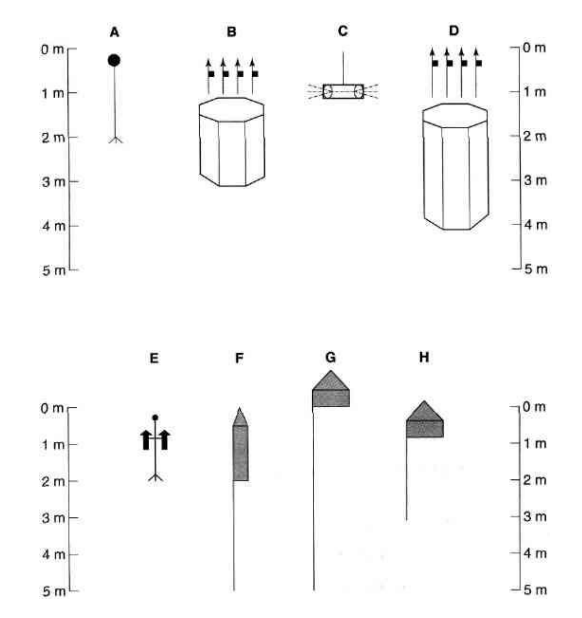
Look at the drawings of different projectiles below, A-H, and the names of types of projectiles given in the passage. Match each name with one drawing.
A. Drawing A
B. Drawing B
C. Drawing C
D. Drawing D
E. Drawing E
F. Drawing F
G. Drawing G
H. Drawing H
Answers & Explanations Summary
| # | Answer | Evidence | Explanation |
|---|---|---|---|
| Q1 | iv | Despite the fact that rockets had been used sporadically for several hundred years, they remained a relatively minor artefact of civilisation until the twentieth century | Excerpt/Passage Explanation: The passage explains that even though people had rockets for hundreds of years, the rockets were only simple objects used occasionally and were not very important to the world until the 1900s. Answer Explanation: The answer means that the technology for building and using rockets stayed very simple and did not improve for hundreds of years. Reason For Correctness: The correct answer is **iv** because Paragraph B focuses on how rockets were ignored for big tasks like space travel for a very long time. It explains that although they were invented hundreds of years ago, they stayed a 'relatively minor artefact' and weren't made into 'sophisticated' technology until the 20th century. This long period of time where they didn't become advanced matches the heading 'Undeveloped for centuries'. |
| Q2 | i | A simple analogy can help us to understand how a rocket operates. It is much like a machine gun mounted on the rear of a boat. In reaction to the backward discharge of bullets, the gun, and hence the boat, move forwards. A rocket motor’s ‘bullets’ are minute, high-speed particles produced by burning propellants in a suitable chamber. The reaction to the ejection of these small particles causes the rocket to move forwards | Excerpt/Passage Explanation: The passage explains that rockets work by pushing things out of the back to move the front forward, similar to how shooting a gun from the back of a boat makes the boat go forward. This process of things pushing against each other to create movement is the 'reaction principle'. Answer Explanation: The answer is heading 'i', which refers to 'How the reaction principle works'. Reason For Correctness: The correct answer is 'i' because Paragraph C is dedicated to explaining the mechanics behind rocket movement. It uses a simple story (an analogy) about a machine gun on a boat to show that pushing something backward (bullets) results in the boat moving forward. The text then links this explanation directly to the 'reaction principle' and describes how particles moving out of a rocket motor create the same effect. Key terms like 'how a rocket operates', 'reaction', and 'move forwards' guide the reader to understand the functional process of the principle. |
| Q3 | v | The invention of rockets is linked inextricably with the invention of ‘black powder’. Most historians of technology credit the Chinese with its discovery | Excerpt/Passage Explanation: The passage says that the creation of rockets is closely tied to the invention of gunpowder and that most history experts believe people in China were the ones who first discovered how to make them. Answer Explanation: The answer 'v' stands for 'The first rockets,' which means this section of the text describes the early history, the invention, and the original versions of rocket technology. Reason For Correctness: The correct answer is 'v' because Paragraph D focuses on the origins of rockets. It links their invention to the discovery of 'black powder' (gunpowder) in China and describes specific early examples of rocket-powered devices, such as the Chinese 'fire arrows' and 'basket of fire,' as well as the Arab 'egg which moves and burns.' These details explain when and how the very first rockets were created. |
| Q4 | vii | It was not until the eighteenth century that Europe became seriously interested in the possibilities of using the rocket itself as a weapon of war and not just to propel other weapons | Excerpt/Passage Explanation: The passage explains that in the 1700s, people in Europe began to see rockets as tools that could be used as weapons in a war instead of just being used for light shows. Answer Explanation: The answer vii means that Paragraph E mainly talks about how rockets were used for fighting in wars or by the army. Reason For Correctness: The correct answer is vii because Paragraph E describes the change of the rocket from a simple tool used for firework shows to a serious weapon used in major battles. It discusses how military leaders in India used them against the British, how the British then made their own versions for war, and how Americans used them in a conflict against Mexico. The focus on a 'weapon of war' and 'incendiary barrage rockets' directly relates to military use. |
| Q5 | B | it wasn’t until the discovery of the reaction principle, which was the key to space travel and so represents one of the great milestones in the history of scientific thought, that rocket technology was able to develop. Not only did it solve a problem that had intrigued man for ages, but, more importantly, it literally opened the door to exploration of the universe | Excerpt/Passage Explanation: The passage states that the reaction principle was the most important factor in developing rockets for space. It highlights that while the physics helped solve old puzzles, its most important role was allowing humans to explore outer space. Answer Explanation: The answer means that the most significant result of discovering the reaction principle was making it possible for humans to travel into space. Reason For Correctness: The correct answer is B because the passage identifies the reaction principle as the 'key' to space travel. Although the discovery also solved an old problem (choice C), the text emphasizes that its most significant impact was that it 'opened the door' to traveling through the universe. By using the phrase 'more importantly,' the author signals that space exploration was the greatest outcome compared to other achievements. |
| Q6 | D | Despite the fact that rockets had been used sporadically for several hundred years, they remained a relatively minor artefact of civilisation until the twentieth century. Prodigious efforts, accelerated during two world wars, were required before the technology of primitive rocketry could be translated into the reality of sophisticated astronauts | Excerpt/Passage Explanation: The passage explains that even though people knew about rockets for a long time, they were not very important symbols of human history until the 1900s. It says that a lot of very hard work, especially during big wars, helped turn simple rockets into the advanced machines that we use to send people into space today. Answer Explanation: The answer D means that the most significant and biggest improvements in rocket science occurred starting from the end of the 1800s (late nineteenth century) and continuing through to today. Reason For Correctness: The correct answer is D because the text explains that for a long time, rockets were just simple objects. It highlights that they were not very important until the 20th century. The passage notes that 'prodigious efforts' (meaning huge amounts of work and progress) were made around the time of the two world wars, which led to the creation of 'sophisticated' (highly advanced) technology for space travel. Since the 20th century is included in the timeframe of 'late nineteenth century to the present day,' this choice correctly identifies when the most progress happened. |
| Q7 | A | Most historians of technology credit the Chinese with its discovery | Excerpt/Passage Explanation: The passage explains that most experts who study how things were made believe the Chinese people were the first to find or invent black powder. Answer Explanation: The answer identifies the Chinese as the group of people who first created black powder. Reason For Correctness: The correct answer is A because the text clearly links the invention of black powder to the Chinese. It states that experts who study history believe the Chinese discovered it. The text also mentions that they likely first made it around the tenth century using ingredients like saltpetre, charcoal, and sulphur. Keywords like 'credit the Chinese' and 'discovery' confirm they were the first. |
| Q8 | A | By the thirteenth century, powder-propelled fire arrows had become rather common. The Chinese relied on this type of technological development to produce incendiary projectiles of many sorts, explosive grenades and possibly cannons to repel their enemies | Excerpt/Passage Explanation: The passage says that in the 1200s, arrows moved by gunpowder were very common in China. The Chinese used these weapons to fight back against their enemies. Answer Explanation: The answer says the Chinese people were the first to make and use arrows pushed forward by rockets for war. Reason For Correctness: The correct answer is A because the text explains that by the thirteenth century, the Chinese were already using "powder-propelled fire arrows" to fight or "repel" their enemies. While other groups like the Arabs, Indians, and British used rockets later, the Chinese are the first mentioned in the passage to use these specific types of weapons for combat. Synonyms like "powder-propelled" indicate they were moved by the reaction principle used in rockets. |
| Q9 | B | The incentive for the more aggressive use of rockets came not from within the European continent but from far-away India, whose leaders had built up a corps of rocketeers and used rockets successfully against the British in the late eighteenth century | Excerpt/Passage Explanation: The passage explains that India was the source of the idea to use rockets to attack enemies in war. It mentions that Indian leaders used rockets to fight against the British army in the late 1700s. Answer Explanation: The answer B means that the people from India were the first group mentioned in the text to use rockets specifically as tools for fighting in battles. Reason For Correctness: The correct answer is B because the passage makes a distinction between using rockets to push other objects (like arrows) and using the rocket itself as a weapon. While the Chinese used rocket-powered arrows earlier, paragraph E states that the first time rockets were used aggressively as weapons of war was in India during the late 18th century. Indian leaders created specialized groups of soldiers called 'rocketeers' to use these weapons successfully against the British military, which then inspired other countries to do the same. |
| Q10 | E | The Americans developed a rocket, complete with its own launcher, to use against the Mexicans in the mid-nineteenth century | Excerpt/Passage Explanation: The passage states that in the mid-1800s, people from America made a rocket and its own special machine to fire it, which they called a launcher. Answer Explanation: The answer means that the group of people who first created a machine to shoot rockets (a launcher) were the Americans. Reason For Correctness: The correct answer is E because the text specifically mentions that the Americans created a rocket that came with its own 'launcher' to use in a war in the middle of the 1800s. While other groups like the Chinese used baskets or arrows, the term 'launcher' is used to describe the specific tool developed by the Americans. This identifies them as the ones who used this item. |
| Q11 | B | One such weapon was the ‘basket of fire’ or, as directly translated from Chinese, the ‘arrows like flying leopards’. The 0.7 metre-long arrows, each with a long tube of gunpowder attached near the point of each arrow, could be fired from a long, octagonal-shaped basket at the same time and had a range of 400 paces | Excerpt/Passage Explanation: The passage explains that the ‘basket of fire’ used many short arrows with gunpowder tubes. These arrows were put inside a long basket with eight sides (octagonal) so that many of them could be shot out at once. Answer Explanation: The answer identifies Drawing B as the illustration representing the ancient Chinese weapon known as the ‘basket of fire’. Reason For Correctness: The correct answer is B because Paragraph D provides specific details about the ‘basket of fire’. It explains that this weapon involved multiple 0.7-meter-long arrows, each equipped with a gunpowder tube. These arrows were stored in an ‘octagonal-shaped basket’ so they could be ‘fired... at the same time’. In the context of matching names to drawings, Drawing B would show this multi-arrow basket design as described in the text. |
| Q12 | E | At a similar time, the Arabs had developed the ‘egg which moves and burns’. This ‘egg’ was apparently full of gunpowder and stabilised by a 1.5m tail. It was fired using two rockets attached to either side of this tail | Excerpt/Passage Explanation: The passage explains that Arabs created a device known as 'the egg which moves and burns'. It describes it as an egg-shaped container with a long back part (tail) for balance and two small rockets on the sides of the tail to make it fly. Answer Explanation: The answer is the drawing labeled as E. Reason For Correctness: The correct answer is E because paragraph D describes the Arab invention called the 'egg which moves and burns'. According to the text, this object was shaped like an egg, had a long tail (1.5 meters) to keep it steady or 'stabilised', and was pushed forward by two rockets fixed to the sides of that tail. |
| Q13 | F | The Indian rockets used against the British were described by a British Captain serving in India as ‘an iron envelope about 200 millimetres long and 40 millimetres in diameter with sharp points at the top and a 3m-long bamboo guiding stick’ | Excerpt/Passage Explanation: The passage describes the physical parts of the Indian rocket: it was made of iron, had sharp points at the top, and used a long bamboo stick to help it stay on the right path. Answer Explanation: The answer identifies drawing F as the visual representation of the Indian rocket used in the 1700s. Reason For Correctness: The correct answer is F because it matches the specific details given in the text about how Indian rockets looked. In paragraph E, the passage says these rockets had an iron body (the 'envelope'), sharp tips on the top, and a long stick made of bamboo to help steer it. Comparing these details—a metal body, sharp points, and a bamboo stick—leads to the selection of the matching drawing. |
| Q14 | G | The British rocket differed from the Indian version in that it was completely encased in a stout, iron cylinder, terminating in a conical head, measuring one metre in diameter and having a stick almost five metres long and constructed in such a way that it could be firmly attached to the body of the rocket | Excerpt/Passage Explanation: The passage explains that the British rocket was different because it was kept inside a strong iron tube, ended in a cone-shaped top, was one meter wide, and had a stick nearly five meters long fixed to its body. Answer Explanation: The answer is drawing G, which represents the British barrage rocket based on the details provided in the text. Reason For Correctness: The correct answer is G because the passage provides a specific description of the British barrage rocket in paragraph E. It describes the rocket as having a strong metal body shaped like a cylinder, a cone-shaped tip on the top, and a very long stick attached to it. Keywords and synonyms to notice include 'encased' (covered/contained), 'cylinder' (tube-shaped), 'terminating' (ending), 'conical head' (cone-shaped top), and 'stick' (a long piece of wood used for steering). |