

You should spend about 20 minutes on Questions 1—13 which are based on Reading Passage 1 below.
Port One
A Air pollution is increasingly becoming the focus of government and citizen concern around the globe. From Mexico City and New York, to Singapore and Tokyo, new solutions to this old problem are being proposed, Mailed and implemenred with ever increasing speed. It is feared that unless pollution reduction measures are able to keep pace with the continued pressures of urban growth, air quality in many of the world’s major cities will deteriorate beyond reason.
B Acrion is being taken along several fronts: through new legislation, improved enforcement and innovative technology. In Los Angeles, state regulations are forcing manufacturers to try to sell ever cleaner cars: their first of the cleanest, titled "Zero Emission Vehicles’, hove to be available soon, since they are intended to make up 2 per cent of sales in 1997. Local authorities in London are campaigning to be allowed to enforce anti-pollution lows themselves; at present only rhe police have the power to do so, but they tend to be busy elsewhere. In Singapore, renting out toad space to users is the woy of the future.
C When Dritain’s Royal Automobile Club monitored rhe exhausts of 60,000 vehicles, it found that 12 per cent of them produced more than half the total pollution. Older cars were the worst offenders; though a sizeable number of quire new cars were also identified as gross polluters, they were simply badly tuned. California has developed a scheme to get these gross polluters off rhe streets: they offer a flat $700 for any old, run-down vehicle driven in by its owner. The aim is to remove rhe heaviesr-polluring, most decrepit vehicles from rhe roads.
D As part of a European Union environmental programme, a London council is resting an infra-red specrrometer from rhe University of Denver in Colorado. It gauges the pollution from a passing vehicle - more useful than the annual stationary rest that is the British standard today - by bouncing a beam through the exhaust and measuring what gets blocked. The councils next step may be to link the system to a computerised video camera able to read number plates automatically.
E The effort to clean up cars may do little to cut pollution if nothing is done about the tendency to drive them more. Los Angeles has some of the world’s cleanest cars - far better than those of Europe - but the total number of miles those cars drive continues to grow. One solution is car-pooling, an arrangement in which a number of people who share the same destination share the use of one car. However, the average number of people in o car on the freeway in Los Angeles, which is 1.0, has been falling steadily. Increasing it would be an effecrive way of reducing emissions as well as easing congestion. The trouble is, Los Angelenos seem to like being alone in their cars.
F Singapore has for a while had o scheme that forces drivers to buy a badge if they wish to visit a certain parr of the city. Electronic innovations make possible increasing sophistication: rates can vary according to road conditions, time of day and so on. Singapore is advancing in this direction, with a city-wide network of transmittets to collect information and charge drivers as they pass certain points. Such road-pricing, however, can be conrroversial. When the local government in Cambridge, England, considered introducing Singaporean techniques, it faced vocal and ultimately successful opposition.
Part Two
The scope of the problem facing the world’s cities is immense. In 1992, the United Nations Environmental Programme and the World Healrh Organisation (WHO) concluded that all of a sample of twenty megacities - places likely to have more than ten million inhabitants in the year 2000 - already exceeded the level the WHO deems healthy in at least one major pollutant. Two-thirds of them exceeded the guidelines for two, seven for three or more.
Of the six pollutants monitored by the WHO - carbon dioxide, nittogen dioxide, ozone, sulphur dioxide, lead and parriculate matter - it is this last category rhar is attracting the most attention from health researchers. PM10, a sub-category of particulate matter measuring ten-millionths of a mette across, has been implicated in thousands of deaths a year in Britain alone. Research being conducred in two counties of Southern California is reaching similarly disturbing conclusions concerning this little-understood pollutant.
A world-wide rise in allergies, particularly asthma, over the past four decades is now said to be linked with increased air pollution. The lungs and brains of children who grow up in pollured air offer further evidence of its desttuctive power The old and ill, however, are the most vulnerable to the acute effects of heavily polluted stagnant air. It con actually hasten death, os it did in December 1991 when a cloud of exhaust fumes lingered over the city of London for over a week.
The United Nations has estimated that in the year 2000 there will be twenty-four mega-cities and a further eighty-five cities of more than three million people. The ptessure on public officials, corporations and urban citizens to reverse established trends in air pollution is likely to grow in proportion with the growth of cities themselves. Progress is being made. The quesrion, though, remains rhe same: ‘Will change happen quickly enough?’
You should spend about 20 minutes on Questions 14-27 which are based on Reading Passage 2 below.
VOTES FOR WOMEN
The suffragette movement, which campaigned for votes for women in the early twentieth century, is most commonly associated with the Pankhurst family and militant acts of varying degrees of violence. The Museum of London has drawn on its archive collection to convey a fresh picture with its exhibition The Purple, White and Green: Suffragettes in London 1906-14.
The name is a reference to the colour scheme that the Women’s Social and Political Union (WSPU) created to give the movement a uniform, nationwide image. By doing so, it became one of the first groups to project a corporate identity, and it is this advanced marketing strategy, along with the other organisational and commercial achievements of the WSPU, to which the exhibition is devoted.
Formed in 1903 by the political campaigner Mrs Emmeline Pankhurst and her daughters Christabel and Sylvia, the WSPU began an educated campaign to put women’s suffrage on the political agenda. New Zealand, Australia and parts of the United States had already enfranchised women, and growing numbers of their British counterparts wanted the same opportunity.
With their slogan ‘Deeds not words’, and the introduction of the colour scheme, the WSPU soon brought the movement the cohesion and focus it had previously lacked. Membership grew rapidly as women deserted the many other, less directed, groups and joined it. By 1906 the WSPU headquarters, called the Women’s Press Shop, had been established in Charing Cross Road and in spite of limited communications (no radio or television, and minimal use of the telephone) the message had spread around the country, with members and branch officers stretching to as far away as Scotland.
The newspapers produced by the WSPU, first Votes for Women and later The Suffragette, played a vital role in this communication. Both were sold throughout the country and proved an invaluable way of informing members of meetings, marches, fund-raising events and the latest news and views on the movement.
Equally importantly for a rising political group, the newspaper returned a profit. This was partly because advertising space was bought in the paper by large department stores such as Selfridges, and jewellers such as Mappin & Webb. These two, together with other like-minded commercial enterprises sympathetic to the cause, had quickly identified a direct way to reach a huge market of women, many with money to spend.
The creation of the colour scheme provided another money-making opportunity which the WSPU was quick to exploit. The group began to sell playing cards, board games, Christmas and greeting cards, and countless other goods, all in the purple, white and green colours. In 1906 such merchandising of a corporate identity was a new marketing concept.
But the paper and merchandising activities alone did not provide sufficient funds for the WSPU to meet organisational costs, so numerous other fund-raising activities combined to fill the coffers of the ‘war chest’. The most notable of these was the Woman’s Exhibition, which took place in 1909 in a Knightsbridge ice-skating rink, and in 10 days raised the equivalent of £250,000 today.
The Museum of London’s exhibition is largely visual, with a huge number of items on show. Against a quiet background hum of street sounds, copies of The Suffragette, campaign banners and photographs are all on display, together with one of Mrs Pankhurst’s shoes and a number of purple, white and green trinkets.
Photographs depict vivid scenes of a suffragette’s life: WSPU members on a self-proclaimed ‘monster’ march, wearing their official uniforms of a white frock decorated with purple, white and green accessories; women selling The Suffragette at street corners, or chalking up pavements with details of a forthcoming meeting.
Windows display postcards and greeting cards designed by women artists for the movement, and the quality of the artwork indicates the wealth of resources the WSPU could call on from its talented members.
Visitors can watch a short film made up of old newsreels and cinema material which clearly reveals the political mood of the day towards the suffragettes. The programme begins with a short film devised by the ‘antis’ - those opposed to women having the vote -depicting a suffragette as a fierce harridan bullying her poor, abused husband. Original newsreel footage shows the suffragette Emily Wilding Davison throwing herself under King George V’s horse at a famous race-
Although the exhibition officially charts the years 1906 to 1914, graphic display boards outlining the bills of enfranchisement of 1918 and 1928, which gave the adult female populace of Britain the vote, show what was achieved. It demonstrates how advanced the suffragettes were in their thinking, in the marketing of their campaign, and in their work as shrewd and skilful image-builders. It also conveys a sense of the energy and ability the suffragettes brought to their fight for freedom and equality. And it illustrates the intelligence employed by women who were at that time deemed by several politicians to have ‘brains too small to know how to vote’.
You should spend about 20 minutes on Questions 28-40 which are based on Reading Passage 3 below.
Measuring Organisational Performance
There is clear-cut evidence that, for a period of at least one year, supervision which increases the direct pressure for productivity can achieve significant increases in production. However, such short-term increases are obtained only at a substantial and serious cost to the organisation.
To what extent can a manager make an impressive earnings record over a short period of one to three years by exploiting the company’s investment in the human organisation in his plant or division? To what extent will the quality of his organisation suffer if he does so? The following is a description of an important study conducted by the Institute for Social Research designed to answer these questions.
The study covered 500 clerical employees in four parallel divisions. Each division was organised in exactly the same way, used the same technology, did exactly the same kind of work, and had employees of comparable aptitudes.
Productivity in all four of the divisions depended on the number of clerks involved. The work entailed the processing of accounts and generating of invoices. Although the volume of work was considerable, the nature of the business was such that it could only be processed as it came along. Consequently, the only way in which productivity could be increased was to change the size of the workgroup.
The four divisions were assigned to two experimental programmes on a random basis. Each programme was assigned at random a division that had been historically high in productivity and a division that had been below average in productivity. No attempt was made to place a division in the programme that would best fit its habitual methods of supervision used by the manager, assistant managers, supervisors and assistant supervisors.
The experiment at the clerical level lasted for one year. Beforehand, several months were devoted to planning, and there was also a training period of approximately six months. Productivity was measured continuously and computed weekly throughout the year. The attitudes of employees and supervisory staff towards their work were measured just before and after the period.
Turning now to the heart of the study, in two divisions an attempt was made to change the supervision so that the decision levels were pushed down and detailed supervision of the workers reduced. More general supervision of the clerks and their supervisors was introduced. In addition, the managers, assistant managers, supervisors and assistant supervisors of these two divisions were trained in group methods of leadership, which they endeavoured to use as much as their skill would permit during the experimental year. For easy reference, the experimental changes in these two divisions will be labelled the ‘participative programme’.
In the other two divisions, by contrast, the programme called for modifying the supervision so as to increase the closeness of supervision and move the decision levels upwards. This will be labelled the ‘hierarchically controlled programme’. These changes were accomplished by a further extension of the scientific management approach. For example, one of the major changes made was to have the jobs timed and to have standard times computed. This showed that these divisions were overstaffed by about 30%. The general manager then ordered the managers of these two divisions to cut staff by 25%. This was done by transfers without replacing the persons who left; no one was to be dismissed.
Results of the Experiment
Changes in Productivity
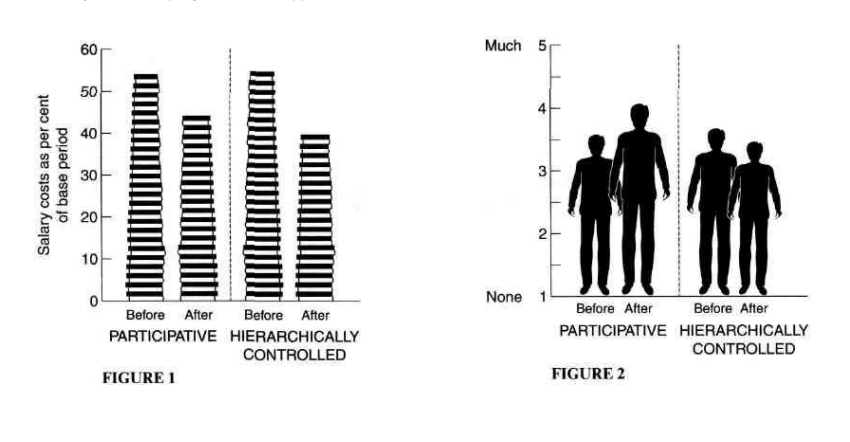
Figure 1 shows the changes in salary costs per unit of work, which reflect the change in productivity that occurred in the divisions. As will be observed, the hierarchically controlled programmes increased productivity by about 25%. This was a result of the direct orders from the general manager to reduce staff by that amount. Direct pressure produced a substantial increase in production.
A significant increase in productivity of 20% was also achieved in the participative programme, but this was not as great an increase as in the hierarchically controlled programme. To bring about this improvement, the clerks themselves participated in the decision to reduce the size of the work group. (They were aware of course that productivity increases were sought by management in conducting these experiments.) Obviously, deciding to reduce the size of a work group by eliminating some of its members is probably one of the most difficult decisions for a work group to make. Yet the clerks made it. In fact, one division in the participative programme increased its productivity by about the same amount as each of the two divisions in the hierarchically controlled programme. The other participative division, which historically had been the poorest of all the divisions, did not do so well and increased productivity by only 15%.
Changes in Attitudes
Although both programmes had similar effects on productivity, they had significantly different results in other respects. The productivity increases in the hierarchically controlled programme were accompanied by shifts in an adverse direction in such factors as loyalty, attitudes, interest, and involvement in the work. But just the opposite was true in the participative programme.
For example, Figure 2 shows that when more general supervision and increased participation were provided, the employees’ feeling of responsibility to see that the work got done increased. Again, when the supervisor was away, they kept on working. In the hierarchically controlled programme, however, the feeling of responsibility decreased, and when the supervisor was absent, work tended to stop.
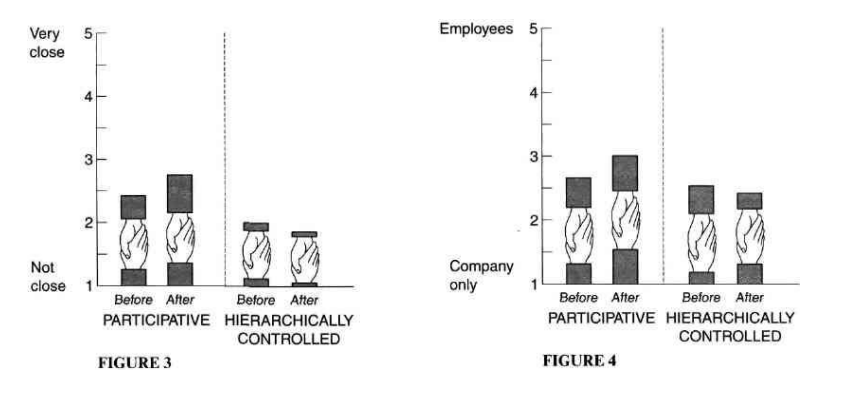
As Figure 3 shows, the employees in the participative programme at the end of the year felt that their manager and assistant manager were ‘closer to them’ than at the beginning of the year. The opposite was true in the hierarchical programme. Moreover, as Figure 4 shows, employees in the participative programme felt that their supervisors were more likely to ‘pull’ for them, or for the company and them, and not be solely interested in the company, while in the hierarchically controlled programme, the opposite trend occurred.
reading was hard
what’s the tricks brooo can anyone teach me for free instra: Itz.j9yy
32
band 6.5