

Part 1
You should spend about 20 minutes on this task. Write at least 150 words.
Part 2
You should spend about 40 minutes on this task. Write at least 250 words.
You should spend about 20 minutes on this task.
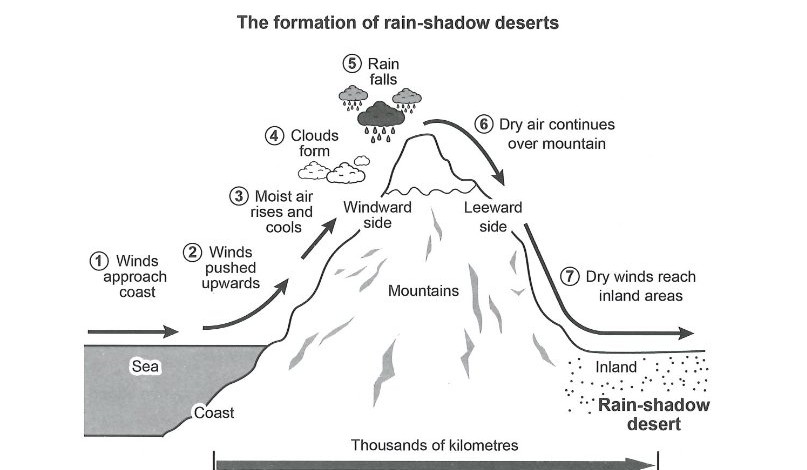
The diagram below shows how one type of desert, known as a rain-shadow desert, is formed.
Summarise the information by selecting and reporting the main features, and make comparisons where relevant.
Write at least 150 words.
Samples
Words: 0
You should spend about 40 minutes on this task.
Write about the following topic:
All university undergraduate courses should include a period of time spent studying abroad or doing a work placement.
Do you think the advantages of this would outweigh the disadvantages?
Give reasons for your answer and include any relevant examples from your own knowledge or experience.
Write at least 250 words.
Samples
Words: 0
pretty good
The provided diagram illustrates the sequential formation of a rain-shadow desert, a process that unfolds over vast distances spanning thousands of kilometres from coastal regions to inland areas.
Overall, the formation is a seven-stage natural process that commences with moisture-laden winds arriving from the sea and culminates in the creation of arid desert conditions on the leeward side of a mountain range, driven by orographic precipitation.
On the windward side, the process begins when winds carrying moisture approach the coast from the ocean. These winds are subsequently forced upward along the windward slopes of the mountains. As the moist air ascends, it undergoes cooling, leading to cloud formation and, eventually, precipitation in the form of rain on this side of the range.
Conversely, on the leeward side, the now dry air continues its journey over the mountain summit and descends towards lower elevations. This descending dry air ultimately reaches inland areas, where its lack of moisture contributes to the formation of a rain-shadow desert. This entire mechanism, spanning from coastal winds to inland aridity, illustrates the transformative effect of topography on regional climate.
Well-written, bravo!
Nothing is impossible
Majeeda
4
6
overall band 7.5 with 7 in task 1 and 8 in task 2
how did you get a higher band in task 2 ?
Bro could u guide me on wa +91 6281213435
broo, help me i get only 6.5 from task 1 and 5.0 from task 2.
hey, did anyone get a band over then 6?
5.5 🙁
Bro its so good mark i got 1 😅😅
The illustration represents the formation of a distinct type of desert called a rain-shadow desert.
Overall, the image has 7 different steps, starting from winds approaching towards mountains and, after that, forming clouds, then climbing up the mountains, pouring rain. Furthermore, finishing after transforming into dry air and being pushed down inland causes desertification.
At the beginning, there are winds approaching from the coastline towards the mountains; after colliding with the mountains, the winds are pushed upwards by the mountainous terrain. Subsequently, the winds become moist and cool down on the windward side of the mountain as they keep rising; before reaching the very top of the mountains, they convert into clouds and cause rainfall on the peaks. Following this, the rainfall turns into dry air that travels straight downward to the mountain by the leeward side. Eventually, the dry winds reach the inland and become the cause of the formation of rain-shadow deserts.