Our system will evaluate the answer based on this AI-generated description.
The image contains two graphs related to travel by UK residents. The first graph is a line graph with two lines representing 'visits abroad by UK residents' and 'visits to the UK by overseas residents' from 1979 to 1999. The 'visits abroad by UK residents' line shows a steady increase starting at about 10 million in 1979, surpassing 20 million around 1986, reaching 30 million between 1989 and 1990, and surpassing 50 million just before 1999. The 'visits to the UK by overseas residents' line also shows an increase but at a slower rate, starting below 10 million in 1979, reaching approximately 10 million between 1984 and 1985, surpassing 20 million just before 1994, and hitting nearly 30 million in 1999. The second graph is a bar chart titled 'Most popular countries visited by UK residents' showing five countries with varying lengths of bars representing 'millions of UK visitors'. France has the longest bar with over 10 million visitors, followed by Spain with just under 10 million. The USA has a bar representing just over 5 million visitors, Greece has a shorter bar indicating fewer visitors, and Turkey has the shortest bar with the least number of visitors amongst the listed countries, not surpassing 2 million.
Given the complexity of the image, the above description may not be entirely accurate.
Skyrocket your IELTS band score by 1-2 points in under a month with our premium plan!
Note: Both the topic and the answer were created by one of our users.
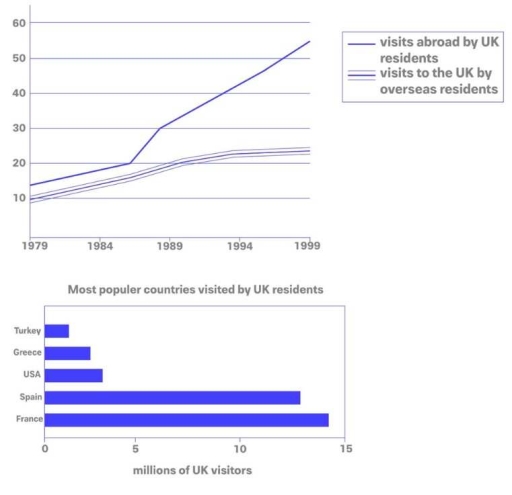
The line graph illustrates the number of visits to and from the UK between 1979 and 1999, while the bar chart shows the five most popular destinations visited by UK residents in 1999. Viewed together, the figures indicate a strong relationship between the growth in outbound travel and the concentration of visits in a limited number of countries.
Outbound trips rose sharply from about 12 million in 1979 to roughly 55 million in 1999, with particularly rapid growth after 1984. In contrast, visits to the UK by overseas residents increased more gradually, from around 10 million to approximately 25 million, and remained consistently lower than outbound travel.
In 1999, France and Spain were the leading destinations, receiving about 11 million and 9 million UK visitors respectively. The USA attracted around 4 million travellers, while Greece and Turkey accounted for smaller figures.
Together, these five countries represented approximately 29 million of the 55 million overseas trips made that year, meaning that over half of all outbound travel was concentrated in just a few destinations.
Word Count: 173
