Our system will evaluate the answer based on this AI-generated description.
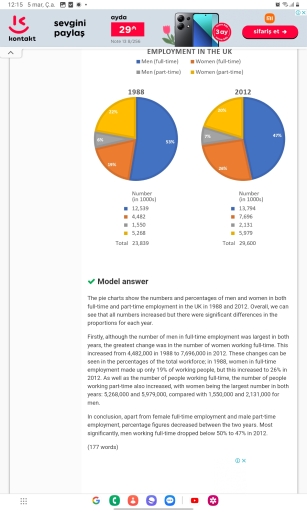
The image contains two pie charts comparing the number of men and women in full-time and part-time employment in the UK in 1988 and 2012 respectively. In 1988, there were a total of 23,180 individuals employed, with men in full-time work accounting for the majority at 12,650, followed by women in full-time work at 4,899, men in part-time work at 1,298, and women in part-time work at 4,332. In 2012, the total employed individuals increased to 25,259 with men in full-time work slightly reduced to 12,566, women in full-time work increased to 7,246, men in part-time work increased to 2,374, and women in part-time work increased to 3,073. The data demonstrates that over the 24 year period, there was a decrease in the proportion of men in full-time employment and an increase in all other categories, with a significant rise in the number of women in full-time employment.
Given the complexity of the image, the above description may not be entirely accurate.
Skyrocket your IELTS band score by 1-2 points in under a month with our premium plan!
Note: Both the topic and the answer were created by one of our users.
The pie charts illustrates the rate of employment of men and women in the UK in the years of 1998 and 2012.
It appears that, the majority full-time workers in the United Kingdom are men while the ratio of part-time working males are the least over the given years. Females are thriving almost similarly in both the sectors.
In 1998, 12,539 men were engaged in full-time job and only 6% was in shifting jobs. Femles on the other hand, were employed nearly equal in both categories of jobs, where 19% of them was deployed fully and 4,482 women were connected in part-time duties.
After an era in 2012, the scenerio didn’t change much. The proportion of full-time working men decreased by 6%, whereas that of the other type of jobholders increased by 1%. Suprisingly, females started to shift in full time career options leading to a climb to 26%. Moreover, 5,979 girls were still in the by-rotation job sector.
Word Count: 159
