Our system will evaluate the answer based on this AI-generated description.
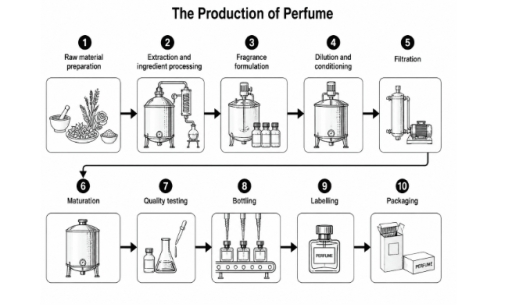
The image features a flow diagram titled "The Production of Perfume" consisting of 10 sequential steps connected by arrows. Step 1, "Raw material preparation," shows plant materials, flowers, leaves, and a mortar and pestle. Step 2, "Extraction and ingredient processing," depicts a large distillation tank connected to a condenser unit and collection flask. Step 3, "Fragrance formulation," illustrates a motorized mixing tank beside three small ingredient bottles. Step 4, "Dilution and conditioning," displays a large processing tank with an agitator. Step 5, "Filtration," shows an upright cylindrical filter connected to a pump unit. Step 6, "Maturation," illustrates a large closed resting tank. Step 7, "Quality testing," shows a small vial, a conical flask, and a dropper pipette. Step 8, "Bottling," displays a conveyor belt moving three bottles under filling nozzles. Step 9, "Labelling," depicts a completed perfume bottle with a central "PERFUME" label. Step 10, "Packaging," shows the perfume bottle inside an open box next to a sealed box with "PERFUME" printed on the side.
Given the complexity of the image, the above description may not be entirely accurate.
Skyrocket your IELTS band score by 1-2 points in under a month with our premium plan!
Note: Both the topic and the answer were created by one of our users.
The diagram illustrates how perfume is manufactured in the factory.
Overall, it’s a linear process and involves ten stages. The production of perfume occurs in factories with help of modern equipments. The process begins with collecting raw materials and ends with packaging of manufactured perfume on bottles ready to use.
Firstly, raw materials are collected and are prepared for further processes. Secondly, the materials are transferred for extraction and ingredients processing facility, and later the byproduct is placed in another machine for fragnance formulation. Then, it is transported to dilution and conditioning processes, and after that, it becomes ready for filtration.
The resultant producted is left for maturation, and later it is moved towards laboratory for the quality testing. The tested perfume is then becomes ready for bottling, where limited quantity of liquid perfume is measured and poured into bottles placed in conveyor belts. Later, the bottles are labled with company’s logo. Finally, the perfume bottles are packaged and ready for sale.
Word Count: 162
