🔥 Today Only: Save 30% on Premium — Offer Ends Soon! - Upgrade Now!
Process Diagram

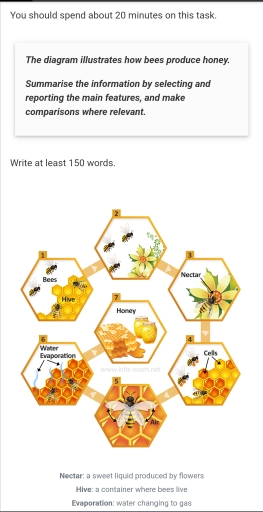
Band 8+: The diagram illustrates how bees produce honey. Summarise the information by selecting and reporting the main features and make comparisons where relevant

Image for topic: The diagram illustrates how bees produce honey. Summarise the information by selecting and reporting the main features and make comparisons where relevant
Our system will evaluate the answer based on this AI-generated description.
The image shows a process diagram with six steps demonstrating how bees produce honey. The first step shows bees flying around flowers. The second step involves the bees collecting nectar from the flowers. In the third step, the bees store the nectar in a hive. The fourth step shows the bees producing honey within the hive. The fifth step illustrates water evaporation from the honey. The final step shows the honey being stored in cells within the hive. No numerical data points, percentages, or specific years are provided in the diagram. Each step is visually represented with an illustration and labeled with a brief description: "Bees," "Nectar," "Hive," "Honey," "Water Evaporation," and "Cells." The bottom of the image includes a brief definition of three terms: "Nectar: a sweet liquid produced by flowers," "Hive: a container where bees live," and "Evaporation: water changing to gas."
Given the complexity of the image, the above description may not be entirely accurate.
Note: Both the topic and the answer were created by one of our users.

The diagram illustrates how honey is produced. Overall, there are three main stages in this process: the construction of beehives, the collection of nectar, and finally, the production of honey. It is clear that this process requires specialized skills, with nectar being the main ingredient used.

Initially, bees build their hives and store honey. The next step involves using their innate abilities to locate different types of flowers in order to collect nectar. When they find valuable flowers, they gather the nectar and transport it using their small legs, which have special baskets. Afterward, the collected nectar is stored in cells within the hive.

The next stage begins with the ventilation of the beehives. Bees use their small and delicate wings to facilitate air circulation, which helps with the evaporation of water in the cells and prepares high-quality honey. Finally, the finished product is harvested by people and sent to the market for consumption.

Word Count: 154

Answers On The Same Topic:

The diagram illustrates how bees produce honey. Summarise the information by selecting and reporting the main features and make comparisons where relevant

This diagram shows the process of bees procuding a honey. The process begin with bees go out from their hive where bees live to find a flower. Then, after they find a flowew, they will take the nectar that located at the middle of flower as much as they can. They will bring it back […]

The diagram illustrates how bees produce honey. Summarise the information by selecting and reporting the main features and make comparisons where relevant

The process graph illustrates how honey is produced by bees. Overall, it is a linear process consisting of seven main stages. The bees will first leave their living places, and after several procedures, they can ultimately collect the nectar and transfer into honey. First, the bees will fly away from the hives. Then, the bees […]

The diagram illustrates how bees produce honey. Summarise the information by selecting and reporting the main features and make comparisons where relevant

The illustration depicts seven stage process of honey production, conducted by bees. Overall, it is a natural linear process that begins with nest preparation and ends with honey being produced and ready for consumption. All stages are placed in a field and hives. To begin with, bees are flying around their nests and preparing to […]

The diagram illustrates how bees produce honey. Summarise the information by selecting and reporting the main features and make comparisons where relevant

The illustration depicts the steps involved in the process of honey production, conducted by bees. This is a natural linear process consisting of seven distinct stages, beginning with the bees flying out of the hive, looking for flower’s nectar, and ending when honey is produced and ready to collected and served at the table. The […]

The diagram illustrates how bees produce honey. Summarise the information by selecting and reporting the main features and make comparisons where relevant

The diagram illustrates the seven-stage process by which bees produce honey, beginning with nectar collection and ending with the final product stored in the hive. Overall, the process is a continuous cycle that involves foraging, transformation, evaporation, and storage. Initially, bees leave the hive in search of flowering plants. Using their proboscis, they extract nectar, […]

See All

Other Topics:

The diagram shows how chocolate is produced. Summarise the information by selecting and reporting the main features, and make comparisons where relevant.

The diagram illustrates how chocolate is produced. Overall, there are nine steps, starting with the harvesting of ripe cacao pods and finishing with the molding of the chocolate. It is a linear process in which cacao beans are fermented, dried, roasted, crushed, pressed and tempered before the final product is made. The first step of […]

The diagram shows how meal is cooked by solar box oven.

The diagram illustrates how a solar box cooks food. It explains the cooking process in six steps. Overall the box in the diagram uses sunlight to cook the food inside of it. It also makes use of the colour of black and its property to absorb light. First of all a box should be painted […]

The diagram shows how chocolate is produced. Summarise the information by selecting and reporting the main features, and make comparisons where relevant.

The diagram illustrates the process involved in the manufacture of a chocolate. Overall, chocolate is produced throught a linear nine-stage process, begin with the grap ripe from cocoa tree and culminating with molding to chocolate bar at the finish product. At the first stage, ripe cocoa pods will grab from tree. Next, the mature pods […]

The diagram below shows how leather goods are produced. Summarize the information by selecting and reporting the main features, and making comparisons where relevant.

The diagram illustrates the way in which leather goods are produced. Overall, it is clear that there are 11 stages in the process, beginning with drying animal skin and culminating in making products and selling them. To begin, animal skin is dried in an open area for a few days. Once it has dried, it […]

The diagram below shows how plastic products are recycled. Summarise the information by selecting and reporting the main features, and make comparisons where relevant.

The process diagram illustrates the process for recycling plastic bottles starting from collection of bottles to producing end product.There are 9 steps in this process. The process begins with people started putting waste plastic products into bins.In the next step, a vehicle collected all the waste and took it to the recycling centre.In the center, […]

You should spend about 20 minutes on this task. The diagram illustrates the process that is used to manufacture bricks for the building industry. Summarize the information by selecting and reporting the main features, and make comparison where relevant.

The figure displays the process used by the building industry to manufacture bricks. Overall, this process has 3 phases: obtaining and shaping the clay, heating the clay using a kiln and delivering the bricks. First, the clay is dug using a digger. After that, it is transferred onto a metal grid, then a roller. Next, […]

See All
We have detected unusual activity on your device.
Please verify your identity to continue.
Note: This verification step won't sign you in. If you have a premium account, please log in to access the service as usual.
Google/Gmail Verification
Or verify using Email/Code
We've sent a verification code to:
youremail@gmail.com (Not your email?)
Enter it below to complete the verification process.
Ensure your email address is correct, your inbox is not full, and you check your spam folder. If no email arrives, consider using an alternative email.
You will need a Premium plan to perform your action!
Note: If you already have a premium account, please log in to access our services as usual.

Plans & Pricing

Our mission is to make quality education accessible for everyone.
However, to keep our hardworking team running and this service alive, we genuinely need your support!
By opting for a premium plan, not only do you sustain us in achieving the mission, but you also unlock advanced features to enrich your learning experience.

Free

For learners who aren't pressed for time

What's included on Free
100+ Cambridge IELTS Tests
Instant IELTS Writing Task 1 & 2 Evaluation (2 times/month)
Instant IELTS Speaking Part 1, 2, & 3 Evaluation (2 times/month)
Instant IELTS Writing Task 1 & 2 Essay Generator (2 times/month)
500+ Dictation & Shadowing Exercises
100+ Pronunciation Exercises
Flashcards
Other Advanced Tools

Premium

For those serious about advancing their English proficiency, and for IELTS candidates aspiring to boost their band score by 1-2 points (especially in writing & speaking) in just 30 days or less

What's included on Premium
Save Your IELTS Test Progress & Analyze Mistakes By Question Type
Save Your Own Flashcard Sets & Use Them On Any Device
Unlock All Courses, IELTS Tests, Section & Part Practice
Unlimited AI Conversations
Unlimited AI Writing Enhancement Exercises
Unlimited IELTS Writing Task 1 & 2 Evaluation
Unlimited IELTS Speaking Part 1, 2, & 3 Evaluation
Checked Answers Will Not Be Published
Unlimited IELTS Writing Task 1 & 2 Essay Generator
Unlimited IELTS Speaking Part 1, 2, & 3 Sample Generator
Unlimited Usage Of Advanced Tools & AI Features
Priority Support within 24h (12-month plan only)

Due to the nature of our service and the provided free trials, payments are non-refundable.