Our system will evaluate the answer based on this AI-generated description.
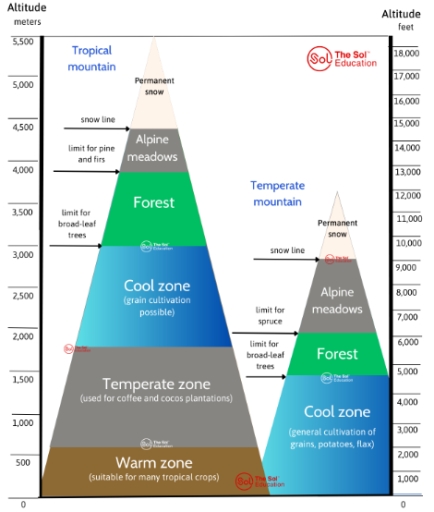
The image depicts two triangular diagrams representing tropical and temperate mountain altitudes, divided into various ecological zones. Tropical mountain altitude ranges from 0 to 5,500 meters (18,000 feet). Warm zone is 0-1,000 meters (0-3,300 feet) for tropical crops. Temperate zone is 1,000-2,000 meters (3,300-6,600 feet) for coffee and cocos. Cool zone is 2,000-3,000 meters (6,600-10,000 feet) for grain cultivation. Forest begins at 3,000 meters (10,000 feet), with a limit for broad-leaf trees at 3,500 meters (11,500 feet) and pine and firs limit at 4,000 meters (13,000 feet). Alpine meadows start at 4,000 meters (13,000 feet), snow line is at 5,000 meters (16,500 feet), and permanent snow begins at 5,500 meters (18,000 feet). Temperate mountain altitude ranges from 0 to 3,500 meters (12,000 feet). Warm zone is 0-500 meters (0-1,500 feet), Temperate zone is 500-1,000 meters (1,500-3,000 feet), Cool zone is 1,000-1,500 meters (3,000-5,000 feet) for grains, potatoes, flax. Forest begins at 1,500 meters (5,000 feet), with a limit for broad-leaf trees at 2,000 meters (6,500 feet) and spruce limit at 2,500 meters (8,500 feet). Alpine meadows start at 2,500 meters (8,500 feet), snow line is at 3,000 meters (10,000 feet), and permanent snow begins at 3,500 meters (12,000 feet).
Given the complexity of the image, the above description may not be entirely accurate.
Skyrocket your IELTS band score by 1-2 points in under a month with our premium plan!
Note: Both the topic and the answer were created by one of our users.
The diagram shows differences in temperature zones in tropical and temperate mountains. Overall, while four climatic zones from the top downwards of both regions are similar, tropical mountains feature a wider range of regions, because they are higher.
Temperate mountains have a less complex structure than tropical mountains. From sea level to approximately 1,500 meters, the area is characterized by a cool zone which contains crops such as grains, potatoes and flax and marks the upper limit of broadleaf trees . Level about 1,500 to 2,000 meters, this zone defines the upper boundary of forests, particularly spruce trees. The altitude of alpine meadows extends from 2,000 to 3,000 meters. Over nearly 3,000 meters is a region of permanent snow in which snowfall is possible.
Tropical mountains have six climate zones. From level the sea to more than 500 meters, the area is a warm zone which is sustainable for many tropical crops. Above the warm zone, there is a temperate zone, which extends from more than 500 meters to about 1,800 meters. This place is used for planting coffee and cacao. From about 1,800 meters to 3,000 meters is a cool zone, where grain cultivation is possible. From sea level to 3,000 meters is also the upper limit of broadleaf trees. The next nearly 1,000 meters is forest. Below about 4,000 meters is the upper limit of pine and fir trees. From about 4,000 meters to nearly 4,500 meters is place for alpine meadows. Above about 4,500 meters is a region of permanent snow.
Word Count: 254
