Our system will evaluate the answer based on this AI-generated description.
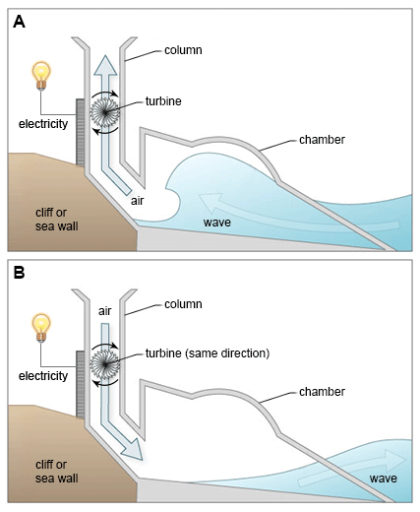
The image displays two diagrams, A and B, illustrating wave energy conversion methods using air to drive turbines for electricity generation. Both show waves approaching a cliff or sea wall, compressing air in a chamber which then turns a turbine connected to an electricity generator at the top. Diagram A depicts the turbine blades orientated to spin in one direction when air flows upwards due to a wave and depicts the absence of air movement with the receding wave. Diagram B shows a one-way air flow system where the turbine blades rotate in the same direction regardless of the wave's motion. Each diagram has three labels: "electricity," "turbine," and "cliff or sea wall," with additional labels "column" and "chamber" for the passages where air and water move, respectively. The diagrams use blue for water and shades of gray for the mechanical and structural components.
Given the complexity of the image, the above description may not be entirely accurate.
Skyrocket your IELTS band score by 1-2 points in under a month with our premium plan!
Note: Both the topic and the answer were created by one of our users.
The above pictorial elucidates how seawater produces electric energy, showcasing the main stages. However, these stages require a right execution of each, as it greatly impacts the possibility of obtaining the result. The provided mechanism consists of a huge chamber situated nearby to a cliff of a coast. This chamber includes columns between which a turbine is layered, and the space for sea waves themselves.
First and foremost, a coming wave promotes wind’s emergence, thereby putting a turbine into action. While rotating a turbine, an air enters the chamber back, when water’s influx mitigates. Thus, electricity has started to be generated.
Noteworthy is the consistency of turbine’s direction, as regardless of wind gusts it proceeds to be turned into the same way. Electricity production is then continued anyway and prepared for utilization by people in the foreseeable future.
To summarize, the system is very effective and able to generate energy from water flow, that significantly simplify the task of its supply.
Word Count: 161
