Our system will evaluate the answer based on this AI-generated description.
The image displays two diagrams, A and B, illustrating wave energy conversion methods using air to drive turbines for electricity generation. Both show waves approaching a cliff or sea wall, compressing air in a chamber which then turns a turbine connected to an electricity generator at the top. Diagram A depicts the turbine blades orientated to spin in one direction when air flows upwards due to a wave and depicts the absence of air movement with the receding wave. Diagram B shows a one-way air flow system where the turbine blades rotate in the same direction regardless of the wave's motion. Each diagram has three labels: "electricity," "turbine," and "cliff or sea wall," with additional labels "column" and "chamber" for the passages where air and water move, respectively. The diagrams use blue for water and shades of gray for the mechanical and structural components.
Given the complexity of the image, the above description may not be entirely accurate.
Skyrocket your IELTS band score by 1-2 points in under a month with our premium plan!
Note: Both the topic and the answer were created by one of our users.
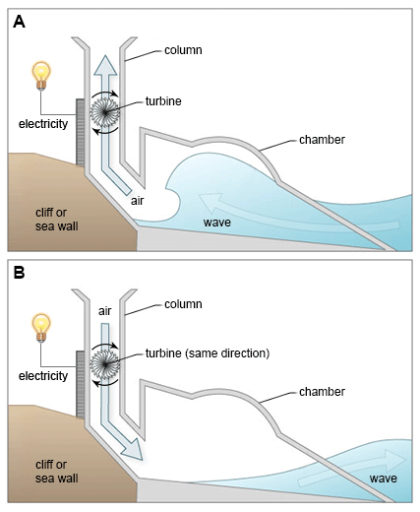
The diagram above illustrates the process of generating electricity from marine water. Overall, it is evident that the electricity is generated by the tide period of seawater, with a turbine machine.
From a broader perspective, the chamber is located adjacent to a cliff or sea wall to accommodate seawater’s waves. Initially, when the wave is high and moves into the chamber, the air flows to the column, where the turbine is situated in the middle. The air contributes to rotating the turbine. Eventually, electricity, which is attached to the column is manufactured.
Another significant feature is the process of generating electricity when the wave is low. After the wave is up and the airflow is up from the wave, then the wave is low, with the air passing through the column in the reverse direction to the chamber. Consequently, the turbine rotates in a similar direction. The electricity is off, and then the next tide, the electricity is continuous generate.
In conclusion, seawater generates electricity through the tide period of sea waves, with air flowing, leading to a rotating turbine, and then manufacturing electricity.
Word Count: 184
