Our system will evaluate the answer based on this AI-generated description.
The image presents two charts: a 100% stacked bar chart titled "Reasons For Study By Age Group" and a line graph titled "Employee Training Fee Support By Age". The stacked bar chart has a vertical axis measuring 0% to 100% in 10% increments and a horizontal axis with age categories: Under 25, 25-29, 30-39, 40-49, and 50-59, divided by legend into "For Career" and "For Interest". Data values show: Under 25: approximately 80% For Career and 20% For Interest; 25-29: approximately 75% For Career and 25% For Interest; 30-39: approximately 62% For Career and 38% For Interest; 40-49: approximately 47% For Career and 53% For Interest; 50-59: approximately 22% For Career and 78% For Interest. The line graph has a vertical axis labeled "Percentage" ranging from 0% to 90% in 10% increments and a horizontal axis labeled "Age" with values 20, 30, 40, 50, and 60. Data points on the line are: age 20 at 80%, age 30 at 75%, age 40 at 62%, age 50 at 35%, and age 60 at 20%.
Given the complexity of the image, the above description may not be entirely accurate.
Skyrocket your IELTS band score by 1-2 points in under a month with our premium plan!
Note: Both the topic and the answer were created by one of our users.
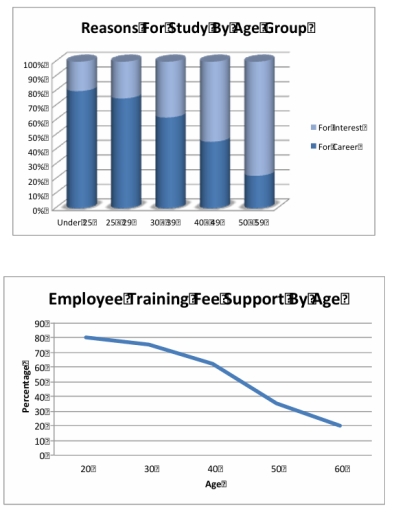
The bar graph shows the reasons for studying in the UK by age, while the line graph shows the support given by employers for training by age.
Under 25 year’s age group studying for their best career are higher in percentage around 80% and only 20% of this group studying for their interest. Therefore, the percentage of studying for their career in deceases over the age, while increases over the aged for interest base studying. Age group of 25-29 studying for career is 75%, 30-39 age group studying for career 60%, these percentage decline to 20% for 50-59 age group, but studying for interest have jump to 80%.
Furthermore, employers gives higher support for study to young age group as compare to aged group. 20 year’s age group gets 80% employers support for studying. These percentage declines time to time accordingly age increased. Employers gives 75% supports to 30 age group, 62% for 40% age group, 35% for 50 age group and only 20% for 60 age group.
In conclusion, young aged people studying for there career and older age people studying for there interest. In addition, employers also support to young aged employees for study as campare to older aged employees.
Word Count: 202
