Our system will evaluate the answer based on this AI-generated description.
The image shows a line graph detailing employment in sport throughout 2011-2014 measured in thousands of people across six countries: Belgium, Czech Republic, Estonia, Bulgaria, Denmark, and Ireland. In 2011, Belgium recorded approximately 23,000, Czech Republic nearly 14,000, Estonia about 8,000, Bulgaria around 5,000, Denmark approximately 25,000, and Ireland about 16,000. By 2012, Belgium's figure rose slightly above 24,000, Czech Republic decreased to nearly 11,000, Estonia edged up to around 8,500, Bulgaria continued just over 5,000, Denmark dipped below 24,000, and Ireland increased marginally to about 17,000. In 2013, Belgium climbed over 25,000, Czech Republic steadied close to 12,000, Estonia surged to around 9,000, Bulgaria remained steady over 5,000, Denmark stalled at approximately 24,000, and Ireland marginally rose beyond 17,000. In 2014, Belgium peaked beyond 26,000, Czech Republic grew steadily to above 15,000, Estonia reached just above 10,000, Bulgaria maintained its plateau over 5,000, Denmark heightened to roughly 27,000, and Ireland continued its ascension nearing 19,000.
Given the complexity of the image, the above description may not be entirely accurate.
Skyrocket your IELTS band score by 1-2 points in under a month with our premium plan!
Note: Both the topic and the answer were created by one of our users.
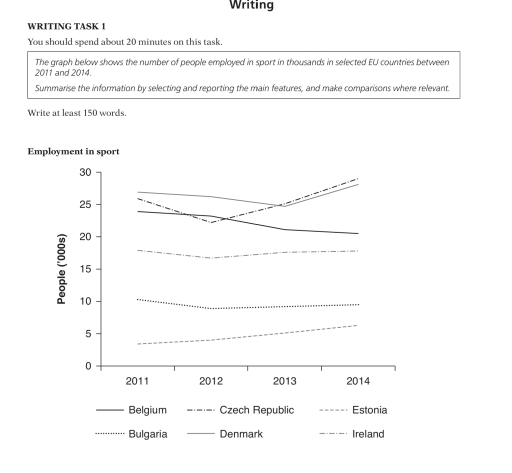
The graph illustrates the propotion of people employed in sport sector in thousthands in European countries, such as Denmark, Czech Republic, Belgium, Estonia, Ireland, and Bulgaria from 2011 to 2014. Overall, employement figures were the highest in Czech Republic and Denmark whilst Bulgaria and Estonia being the lowest. Despite some fluctuations, Ireland and Belgium’s numbers remained stable by 2014.
In Czech Republic, the figure started around 24,000 in 2011, dipped slightly in 2012, but then increased gradualily to approximately 30,000 by 2014. In similar to Czech Republic, Denmark began around 26,000 in 2011, experienced a drop in numbers to 25,000 in 2013, then rose again by 2014 to almost reach 30,000.
Bulgium and Ireland followed a similar trend but at lower levels, fluctuating between 25,000 and 15,000. Despite the decrease in 2012 in Belgium around 19,000 and in 2012 in Ireland reaching around 16,000, both countries successed in stablizing their figures by 2014 with Belgium recording slightly higher number at 21,000 than Ireland. In contrast, Bulgaria and Estonia recorded fewer employees in sport at 5,500 and 10,000. Although their numbers increased slightly by 2014, both countries remained the lowest in the graph throughout the given period.
Word Count: 196
