Our system will evaluate the answer based on this AI-generated description.
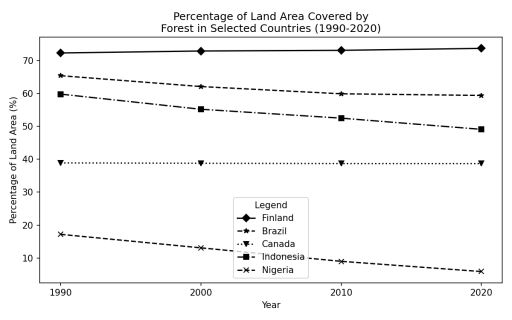
The image features a line graph titled "Percentage of Land Area Covered by Forest in Selected Countries (1990-2020)". The vertical axis is labeled "Percentage of Land Area (%)" with scale values ranging from 10 to 70 in increments of 10. The horizontal axis is labeled "Year" with points at 1990, 2000, 2010, and 2020. A box labeled "Legend" specifies five categories: Finland (solid line, diamond markers) showing ~72% (1990), ~73% (2000), ~73% (2010), and ~73.5% (2020); Brazil (dashed line, star markers) showing ~65.4% (1990), ~62% (2000), ~60% (2010), and ~59.5% (2020); Indonesia (dash-dotted line, square markers) showing ~59.7% (1990), ~55.2% (2000), ~52.4% (2010), and ~49.1% (2020); Canada (dotted line, upside-down triangle markers) showing ~38.8% across all four years (1990, 2000, 2010, 2020); and Nigeria (dashed line, x markers) showing ~17.2% (1990), ~13.1% (2000), ~9.1% (2010), and ~6.0% (2020).
Given the complexity of the image, the above description may not be entirely accurate.
Skyrocket your IELTS band score by 1-2 points in under a month with our premium plan!
Note: Both the topic and the answer were created by one of our users.
The line graph compares the proportion of forest-covered land in Finland, Brazil, Canada, Indonesia, and Nigeria over the period of three decades.
Overall, marginal changes can be observed in all five countries. The percentage generally decreased for all countries, with the exception of Canada and Finland.
Finland maintained the most forest area over the years. Not to mention, the amount of land covered by forests remained fairly stable, increasing by roughly 1%-2%. Forests in Canada, however, remained at a static rate during the thirty years.
The rest of the countries all experienced a decline in their forest land. Nigera experienced the most decline in the forest, dropping gradually from below 20% to almost 5% during this time. Indonesia’ forest, on the other hand, reduced by aproximately 5% during the first 10 years, then 2% in the next, and before finishing off at 50% in 2020. Finally, Brazil lost around 4% forest land in the first 20 years before stabilising at 60% forest since 2010.
Word Count: 164
