Our system will evaluate the answer based on this AI-generated description.
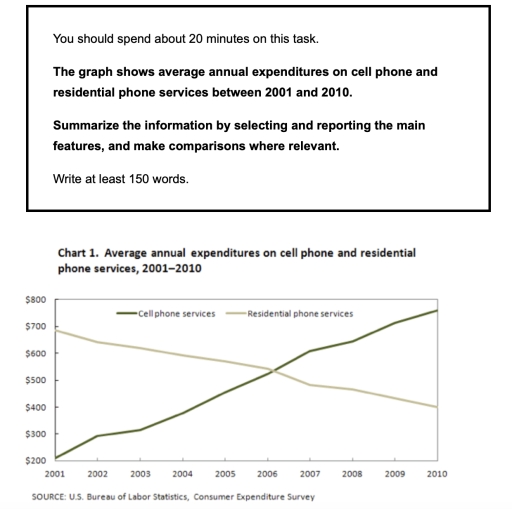
The image displays a line graph titled "Chart 1. Average annual expenditures on cell phone and residential phone services, 2001–2010," with two lines representing cell phone services and residential phone services. The y-axis ranges from $200 to $800 in increments of $100, and the x-axis lists years from 2001 to 2010. In 2001, the cell phone services line begins at approximately $210, while the residential phone services line starts at around $670. Over the 10-year period, the cell phone services line exhibits a steady upward trend, culminating at approximately $760 in 2010. Conversely, the residential phone services line experiences a gradual decline, falling to about $350 by 2010. The graph indicates a crossover point between the two lines around the year 2006, where expenditures on cell phone services surpass those on residential phone services for the first time. The exact numerical data points for each line at every year mark are not provided. The source of the data is cited as the U.S. Bureau of Labor Statistics, Consumer Expenditure Survey.
Given the complexity of the image, the above description may not be entirely accurate.
Skyrocket your IELTS band score by 1-2 points in under a month with our premium plan!
Note: Both the topic and the answer were created by one of our users.
The graph shows the average annual spendings on cell phone and residential phone services between 2001 and 2010. Over the years the average expenditure on cell phone services show a gradual rise. However the average amount spent for residential phone services show a gradual decline over the years.
The average spendings for cell phone services at the start of the time period was around $200 and rose to $750. On the other hand the average spending for cell phone services at the end of the time period was around $750. On the contrary, average annual expenditure on residential services started out at around $700 and by the end it dropped to around $400.
We can see that around the year 2006 was when cell phone services took over residential phone services in average annual expenditures. Furthermore, the annual expenditures on cell phone services nearly quadrupled over the 2001 – 2010 time period. Whilst average expenditure on residential phone services dropped by nearly half.
Word Count: 163
