Our system will evaluate the answer based on this AI-generated description.
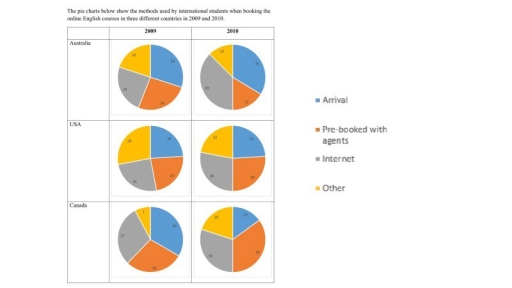
The image consists of six pie charts comparing the methods used by international students to book online English courses in three different countries (Australia, the USA, and Canada) in 2009 and 2010. The charts show the percentage breakdown of four booking methods: Arrival, Pre-booked with agents, Internet, and Other. In Australia, in 2009, 70% of students booked on arrival, 10% pre-booked with agents, 10% used the internet, and 10% used other methods. In 2010, those percentages changed to 50%, 30%, 10%, and 10%, respectively. In the USA, in 2009, 50% booked on arrival, 30% pre-booked with agents, 10% used the internet, and 10% used other methods. In 2010, those percentages changed to 60%, 20%, 10%, and 10%, respectively. In Canada, in 2009, 40% booked on arrival, 40% pre-booked with agents, 10% used the internet, and 10% used other methods. In 2010, those percentages changed to 30%, 50%, 10%, and 10%, respectively.
Given the complexity of the image, the above description may not be entirely accurate.
Skyrocket your IELTS band score by 1-2 points in under a month with our premium plan!
Note: Both the topic and the answer were created by one of our users.
The pie chart below illustrates the methods used by different students when reserving online English courses across three countries in 2009 and 2010.
Overall, it can be seen that in Australia was dominance in internet booking while in USA it experience the opposite trend, showing the similar results in both 2009 and 2010 and student’s booking in Canada experience both decline and increase in proportions in some categories. The most biggest sector was in Canada in 2009. compared with all.
As for the Australia’ students, most students pre booked the courses with agent, making it the largest category with 27% while in the USA the booking on the internet and other have showed the same rates, respectively, 26%.As for the booking in the Canada, there was most booking on the arrival which accounted for 45%.
Word Count: 135
