Our system will evaluate the answer based on this AI-generated description.
The image is a bar graph depicting coffee production in million tonnes for four countries - Brazil, Colombia, Indonesia, and Vietnam - over four time periods: 1990, 1995, 2000, and 2010. In 1990, Brazil produced 1.2 million tonnes, Colombia produced 0.6 million tonnes, Indonesia produced 0.2 million tonnes, and Vietnam produced 0.1 million tonnes. In 1995, Brazil increased to 1.4 million tonnes, Colombia decreased slightly to 0.5 million tonnes, Indonesia increased to 0.5 million tonnes, and Vietnam increased to 0.2 million tonnes. In 2000, Brazil decreased to 1.0 million tonnes, Colombia remained at 0.5 million tonnes, Indonesia increased to 0.6 million tonnes, and Vietnam saw a significant increase to 0.8 million tonnes. In 2010, Brazil jumped to 1.8 million tonnes, Colombia decreased to 0.4 million tonnes, Indonesia remained at 0.6 million tonnes, and Vietnam saw a substantial increase to 1.6 million tonnes. Brazil consistently had the highest production, while Vietnam saw the most dramatic increase from 1990 to 2010.
Given the complexity of the image, the above description may not be entirely accurate.
Skyrocket your IELTS band score by 1-2 points in under a month with our premium plan!
Note: Both the topic and the answer were created by one of our users.
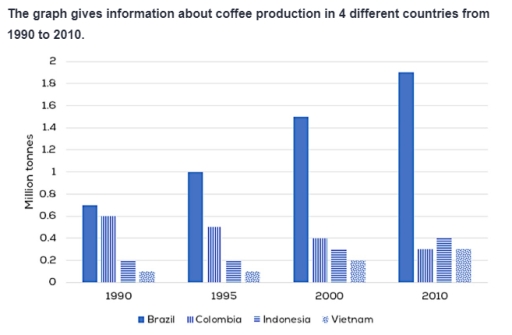
The bar chart provided illustrates the amount of coffee output in four various nations between 1990 and 2010.
Overall, coffee output witnessed an increasing trend over the span, with the exception of Colombia. It is noticeable that Brazil consistently had the highest amount of coffee, whereas Vietnam’s output was the lowest.
Looking first at the countries with increased output, Brazil started at approximately 0.7 million tons, after which this figure sharply jumped by 0.4 million tons every five years to reach around 1.9 million tons, making it the biggest producer at the end of the period. This growth made its output more than three times greater than that of the other nations. Similar changes, but to a lesser extent, were seen in the production of coffee in Indonesia and Vietnam, with the figure doubling from 0.2 million tons to 0.4 million tons in the former and tripling from 0.1 to 0.3 million tons in the latter.
Colombia, however, experienced a substantial decline over the 20-year period. In 1990, 0.6 million tons of coffee was produced in this nation, and this figure had halved to 0.3 million tons of coffee by 2010, equaling the output of Vietnam.
Word Count: 196
