You should spend about 20 minutes on this task. Write at least 150 words.
Part 2
You should spend about 40 minutes on this task. Write at least 250 words.
You should spend about 20 minutes on this task.
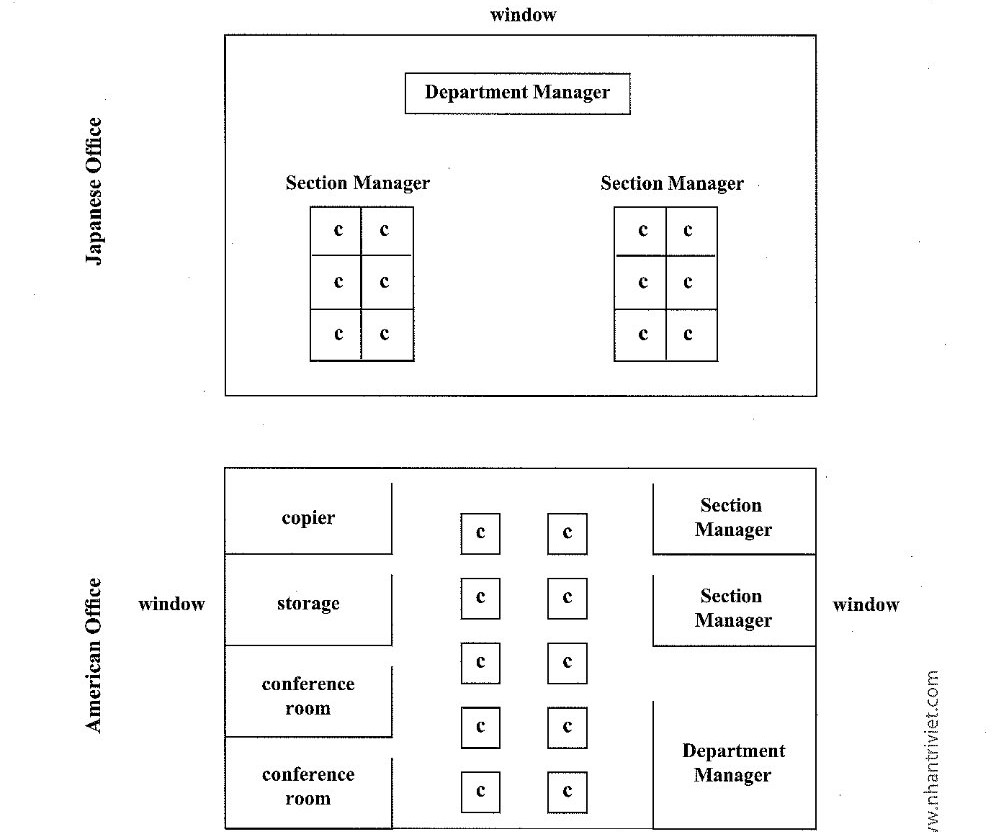
The two pictures show a typical Japanese office and a typical American office.
Summarise the information by selecting and reporting the main features, and make comparisons where relevant.
Write at least 150 words.
Samples
Words: 0
More Samples:
As most people spend a major part of their adult life at work, job satisfaction is an important element of individual well-being. What factors contribute to job satisfaction? How realistic is the expectation of job satisfaction for all workers?
Samples
Words: 0
More Samples:
Part 1
Part 2
Tip: Press F11 (Windows) or Ctrl+Cmd+F (Mac) to cycle between normal, focus, and fullscreen modes.
What to Expect from Recent Actual Tests Academic Series
The Recent Actual Tests Academic series uses real questions collected from past exam sessions, providing extensive material for extra practice. They are suitable for candidates who have already completed the Cambridge materials and are looking for further exposure to the test’s question styles.
BAND 9 SAMPLE
job satisfaction plays a central role in overall well-being because work occupies a significant portion of adult life. When people feel fulfilled in their jobs, it often positively affects their mental health, relationships, and sense of purpose. Several key factors contribute to job satisfaction, though expecting it universally across all workers may not be entirely realistic.
One of the most important contributors is fair compensation. People are more likely to feel satisfied when they believe they are paid appropriately for their skills, experience, and effort. However, salary alone is rarely sufficient. Work environment also matters greatly—this includes supportive management, respectful colleagues, and a culture that values employees. A toxic or overly stressful environment can outweigh even a high salary.
Another critical factor is meaningful work. Employees tend to feel more satisfied when they believe their work has purpose or contributes to something valuable. Closely related is the opportunity for growth and development. Jobs that offer learning opportunities, promotions, or skill-building tend to keep workers engaged and motivated.
Work-life balance has become increasingly important. Flexible schedules, reasonable working hours, and the ability to manage personal responsibilities alongside professional ones significantly improve satisfaction. Additionally, job security and clear expectations provide a sense of stability, reducing anxiety and increasing commitment.
Despite these factors, it is not entirely realistic to expect all workers to achieve high levels of job satisfaction. Economic conditions, educational access, and labor market inequalities mean that many individuals must accept jobs primarily for survival rather than fulfillment. In lower-income or highly competitive sectors, workers may have limited choice, making satisfaction a secondary concern.
Moreover, job satisfaction is subjective. What one person finds fulfilling, another may find monotonous or stressful. Personal values, personality, and life circumstances all influence how a job is perceived. Even within the same role, satisfaction can vary widely between individuals.
In conclusion, while factors such as fair pay, a positive work environment, meaningful tasks, growth opportunities, and work-life balance strongly contribute to job satisfaction, achieving it universally is challenging. Structural inequalities and individual differences make it unlikely that all workers will experience the same level of fulfillment. Nonetheless, improving workplace conditions remains a worthwhile goal, as even incremental changes can significantly enhance overall well-being.
You will need a Premium plan to perform your action!
Note: If you already have a premium account, please log in to access our services as usual.
Plans & Pricing
Our mission is to make quality education accessible for everyone. However, to keep our hardworking team running and this service alive, we genuinely need your support! By opting for a premium plan, not only do you sustain us in achieving the mission, but you also unlock advanced features to enrich your learning experience.
For those serious about advancing their English proficiency, and for IELTS candidates aspiring to boost their band score by 1-2 points (especially in writing & speaking) in just 30 days or less
What's included on Premium
Save Your IELTS Test Progress
Unlock All Courses & IELTS Tests
Unlimited AI Conversations
Unlimited AI Writing Enhancement Exercises
Unlimited IELTS Writing Task 1 & 2 Evaluation
Unlimited IELTS Speaking Part 1, 2, & 3 Evaluation
Due to the nature of our service and the provided free trials, payments are non-refundable.
Nếu bạn là người Việt Nam và không có hoặc không muốn trả bằng credit/debit cards, bạn có thể thanh toán bằng phương thức chuyển khoản:
Chọn gói:
419,000₫277,000 ₫ cho gói 1 tháng(chỉ 9,233₫/ngày)
1,239,000₫597,000 ₫ cho gói 3 tháng(chỉ 6,633₫/ngày)
2,469,000₫1,027,000 ₫ cho gói 6 tháng(chỉ 5,706₫/ngày)
4,929,000₫1,417,000 ₫ cho gói 12 tháng(chỉ 3,936₫/ngày)
Sau khi chuyển khoản, vui lòng đợi trình duyệt tự động điều hướng bạn trở lại Engnovate và bạn sẽ ngay lập tức nhận được mã kích hoạt tài khoản premium.
BAND 9 SAMPLE
job satisfaction plays a central role in overall well-being because work occupies a significant portion of adult life. When people feel fulfilled in their jobs, it often positively affects their mental health, relationships, and sense of purpose. Several key factors contribute to job satisfaction, though expecting it universally across all workers may not be entirely realistic.
One of the most important contributors is fair compensation. People are more likely to feel satisfied when they believe they are paid appropriately for their skills, experience, and effort. However, salary alone is rarely sufficient. Work environment also matters greatly—this includes supportive management, respectful colleagues, and a culture that values employees. A toxic or overly stressful environment can outweigh even a high salary.
Another critical factor is meaningful work. Employees tend to feel more satisfied when they believe their work has purpose or contributes to something valuable. Closely related is the opportunity for growth and development. Jobs that offer learning opportunities, promotions, or skill-building tend to keep workers engaged and motivated.
Work-life balance has become increasingly important. Flexible schedules, reasonable working hours, and the ability to manage personal responsibilities alongside professional ones significantly improve satisfaction. Additionally, job security and clear expectations provide a sense of stability, reducing anxiety and increasing commitment.
Despite these factors, it is not entirely realistic to expect all workers to achieve high levels of job satisfaction. Economic conditions, educational access, and labor market inequalities mean that many individuals must accept jobs primarily for survival rather than fulfillment. In lower-income or highly competitive sectors, workers may have limited choice, making satisfaction a secondary concern.
Moreover, job satisfaction is subjective. What one person finds fulfilling, another may find monotonous or stressful. Personal values, personality, and life circumstances all influence how a job is perceived. Even within the same role, satisfaction can vary widely between individuals.
In conclusion, while factors such as fair pay, a positive work environment, meaningful tasks, growth opportunities, and work-life balance strongly contribute to job satisfaction, achieving it universally is challenging. Structural inequalities and individual differences make it unlikely that all workers will experience the same level of fulfillment. Nonetheless, improving workplace conditions remains a worthwhile goal, as even incremental changes can significantly enhance overall well-being.