
Elephant Communication - IELTS Reading Answers & Explanations
From IELTS Recent Actual Test 6 Academic Reading Test 5 · Part 3 · Questions 28–40
Reading Passage
You should spend about 20 minutes on Questions 28-40, which are based on Reading Passage 3 below.
Elephant Communication
O' Connell-Rodwell, a postdoctoral fellow at Stanford University, has travelled to Namibia's first-ever wildlife reserve to explore the mystical and complicated realm of elephant communication. She, along with her colleagues, is part of a scientific revolution that started almost 20 years ago. This revolution has made a stunning revelation: elephants are capable of communicating with each other over long distances with low-frequency sounds, also known as infrasounds, which are too deep for humans to hear.
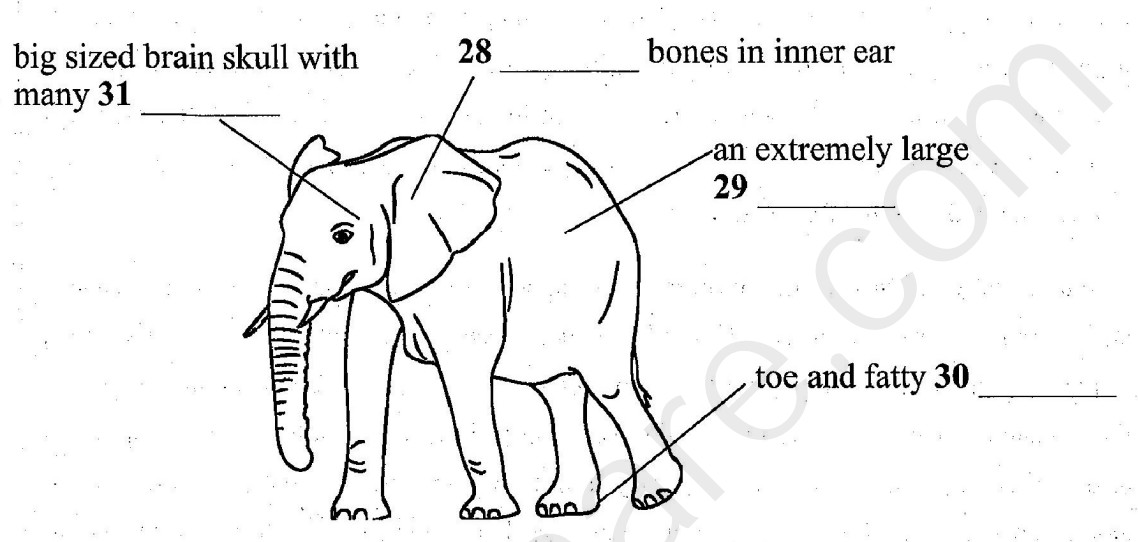
As might be expected, African elephants able to detect seismic sound may have something to do with their ears. The hammer bone in an elephant's inner ear is proportionally huge for a mammal, but it is rather normal for animals that use vibrational signals. Thus, it may be a sign that suggests elephants can use seismic sounds to communicate.
Other aspects of elephant anatomy also support that ability. First, their massive bodies, which enable them to give out low-frequency sounds almost as powerful as the sound a jet makes during takeoff, serve as ideal frames for receiving ground vibrations and transmitting them to the inner ear. Second, the elephant's toe bones are set on a fatty pad, which might be of help when focusing vibrations from the ground into the bone. Finally, the elephant has an enormous brain that sits in the cranial cavity behind the eyes in line with the auditory canal. The front of the skull is riddled with sinus cavities, which might function as resonating chambers for ground vibrations.
It remains unclear how the elephants detect such vibrations, but O' Connell-Rodwell raises a point that the pachyderms are 'listening' with their trunks and feet instead of their ears. The elephant trunk may just be the most versatile appendage in nature. Its utilisation encompasses drinking, bathing, smelling, feeding and scratching. Both trunk and feet contain two types of nerve endings that are sensitive to pressure—one detects infrasonic vibration, and another responds to vibrations higher in frequencies. As O' Connell-Rodwell sees, this research has a boundless and unpredictable future. 'Our work is really interfaced of geophysics, neurophysiology and ecology,' she says. 'We're raising questions that have never even been considered before.'
It has been well-known to scientists that seismic communication is widely observed among small animals, such as spiders, scorpions, insects and quite a lot of vertebrate species like white-lipped frogs, blind mole rats, kangaroo rats and golden moles. Nevertheless, O'Connell-Rodwell first argued that a giant land animal is also sending and receiving seismic signals. 'I used to lay a male planthopper on a stem and replay the calling sound of a female, and then the male one would exhibit the same kind of behaviour that happens in elephants—he would freeze, then press down on his legs, move forward a little, then stay still again. I find it so fascinating, and it got me thinking that perhaps auditory communication is not the only thing that is going on.'
Scientists have confirmed that an elephant's capacity to communicate over long distance is essential for survival, especially in places like Etosha, where more than 2,400 savanna elephants range over a land bigger than New Jersey. It is already difficult for an elephant to find a mate in such a vast wild land, and the elephant reproductive biology only complicates it. Breeding herds also adopt low-frequency sounds to send alerts regarding predators. Even though grown-up elephants have no enemies else than human beings, baby elephants are vulnerable and are susceptible to lions and hyenas attack. At the sight of a predator, older ones in the herd will clump together to form protection before running away.
We now know that elephants can respond to warning calls in the air, but can they detect signals transmitted solely through the ground? To look into that matter, the research team designed an experiment in 2002, which used electronic devices that enabled them to give out signals through the ground at Mushara. 'The outcomes of our 2002 study revealed that elephants could indeed sense warning signals through the ground,' O'Connell-Rodwell observes.
Last year, an experiment was set up in the hope of solving that problem. It used three different recordings—the 1994 warning call from Mushara, an anti-predator call recorded by scientist Joyce Poole in Kenya and a made-up warble tone. 'The data I've observed to this point implies that the elephants were responding the way I always expected. However, the fascinating finding is that the anti-predator call from Kenya, which is unfamiliar to them, caused them to gather around, tense up and rumble aggressively as well—but they didn't always flee. I didn't expect the results to be that clear-cut.'
Questions
Questions 28–31 Diagram Labeling
Label the diagram below.
Choose NO MORE THAN TWO WORDS from the passage for each answer.
Questions 32–38 Summary Completion
Complete the summary below.
Choose NO MORE THAN THREE WORDS from the passage for each answer.
How the elephants sense these sound vibrations is still unknown, but O'Connell-Rodwell, a postdoctoral researcher at Stanford University, proposes that elephants are 'listening' with their 32 by two kinds of nerve endings that respond to vibrations with both 33 frequency and slightly higher frequencies. O'Connell-Rodwell's work is at the combination of geophysics, neurophysiology and 34.
It was known that seismic communication existed extensively within small animals, but O'Connell-Rodwell was the first person to indicate that a large land animal would send and receive 35 too. Also, he noticed the freezing behaviour by putting a male planthopper on a stem and play back a female call, which might prove the existence of other communicative approaches besides 36.
Scientists have determined that an elephant's ability to communicate over long distances is essential, especially, when elephant herds are finding a 37, or are warning of predators. Finally, the results of our 2002 study showed us that elephants could detect warning calls through the 38.
Questions 39–40 One Choice
Choose the correct letter, A, B, C or D.
Answers & Explanations Summary
| # | Answer | Evidence | Explanation |
|---|---|---|---|
| Q28 | hammer | The hammer bone in an elephant's inner ear is proportionally huge for a mammal, but it is rather normal for animals that use vibrational signals | Excerpt/Passage Explanation: The passage states that a bone called the 'hammer bone' in an elephant's inner ear is very big for an animal. It also says that having this big bone is common for animals that use ground vibrations or shaking to communicate. Answer Explanation: The answer 'hammer' means a small bone inside the elephant's ear. Reason For Correctness: The correct answer is 'hammer' because the passage mentions that the 'hammer bone' is a part of an elephant's inner ear. This bone is described as being 'proportionally huge' and is linked to the elephant's ability to 'detect seismic sound' and 'use vibrational signals', suggesting it's important for their hearing and communication. |
| Q29 | body | First, their massive bodies, which enable them to give out low-frequency sounds almost as powerful as the sound a jet makes during takeoff, serve as ideal frames for receiving ground vibrations and transmitting them to the inner ear | Excerpt/Passage Explanation: The passage says that elephants have very big bodies. These big bodies are like perfect tools for catching the small shakes or movements from the ground and sending them to the elephant's inner ear, which helps them hear or feel these ground signals. Answer Explanation: The answer, 'body,' means the main part of the elephant's physical shape. Reason For Correctness: The correct answer is 'body' because the passage explains how elephants' large bodies help them pick up vibrations from the ground. The text states that their 'massive bodies' are like perfect structures for getting these ground shakes and sending them to their inner ear. This shows that the body plays a key role in receiving these warning signals. |
| Q30 | pads / pad | Second, the elephant's toe bones are set on a fatty pad, which might be of help when focusing vibrations from the ground into the bone | Excerpt/Passage Explanation: The passage states that the elephant's toe bones sit on a soft, thick part called a 'fatty pad'. This pad helps to concentrate the shaking movements from the ground and guide them into the bones. Answer Explanation: The answer is 'pad' or 'pads'. This word means a soft, thick part. Reason For Correctness: The correct answer is 'pad' because the passage explains that an elephant's toes have a 'fatty pad'. This pad is important because it helps to gather and send vibrations from the ground into the elephant's bones, which might be how they 'listen' to ground signals. |
| Q31 | sinus cavities | The front of the skull is riddled with sinus cavities, which might function as resonating chambers for ground vibrations | Excerpt/Passage Explanation: The passage states that the front part of an elephant's head has many "sinus cavities," which are like empty rooms. These rooms might work as "resonating chambers," meaning they help make the ground vibrations louder or stronger, allowing the elephant to hear or feel them better. Answer Explanation: The answer, "sinus cavities," means empty spaces in an elephant's skull, near its brain. Reason For Correctness: The correct answer is "sinus cavities" because the passage describes these cavities as being in the front part of the elephant's skull. It then explains that these 'sinus cavities' might help by acting like sound boxes, which make ground vibrations stronger and send them to the ear. This makes the answer a perfect fit for explaining a part of the elephant's anatomy that helps with detecting ground vibrations. |
| Q32 | trunks and feet | It remains unclear how the elephants detect such vibrations, but O' Connell-Rodwell raises a point that the pachyderms are 'listening' with their trunks and feet instead of their ears | Excerpt/Passage Explanation: The passage explains that we don't fully understand how elephants feel these shaky sounds. But, O'Connell-Rodwell thinks that elephants are 'listening', or sensing, these sounds using their trunks (their long noses) and their feet, not just their ears like humans do. Answer Explanation: The answer, 'trunks and feet', means that elephants use their long noses (trunks) and their sturdy bottom parts (feet) to feel sounds, not just their ears. Reason For Correctness: The correct answer is 'trunks and feet' because the passage states that O'Connell-Rodwell suggests elephants use these body parts to 'listen' for vibrations. The text mentions that it's still unknown exactly how elephants detect these vibrations, but this idea is a key point raised by the researcher. The passage explicitly links O'Connell-Rodwell's proposition to the use of 'trunks and feet' for sensing sounds. |
| Q33 | infrasonic / low | Both trunk and feet contain two types of nerve endings that are sensitive to pressure—one detects infrasonic vibration, and another responds to vibrations higher in frequencies | Excerpt/Passage Explanation: The passage states that elephants have special nerves in their trunks and feet. These nerves can feel two kinds of shakes or movements: one type can feel very deep sounds (called infrasonic vibration), and another type can feel sounds that are a bit higher in pitch. Answer Explanation: The answer 'infrasonic/low' means sounds that have a very deep pitch, too deep for most humans to hear easily. Reason For Correctness: The correct answer is 'infrasonic/low' because the passage explains that elephants have two kinds of nerve endings in their trunks and feet. One kind 'detects infrasonic vibration,' and the other reacts to 'vibrations higher in frequencies.' Since 'infrasonic' means very 'low' frequency, it correctly fills the blank describing the type of frequency the nerve endings respond to. |
| Q34 | ecology | 'Our work is really interfaced of geophysics, neurophysiology and ecology,' she says | Excerpt/Passage Explanation: The passage states that O'Connell-Rodwell describes her work as a meeting point of three different scientific fields: 'geophysics' (the study of Earth's physical properties), 'neurophysiology' (the study of how the nervous system works), and 'ecology' (the study of how living things interact with their environment). She is saying her research brings these areas together. Answer Explanation: The answer 'ecology' means the study of how living things, like elephants, live and interact with each other and their environment. Reason For Correctness: The correct answer is 'ecology' because the passage directly states that O'Connell-Rodwell sees her research as a mix of different studies. It mentions that her work combines 'geophysics', 'neurophysiology', and 'ecology'. The question asks to complete this list, and 'ecology' is the missing part from the passage. |
| Q35 | seismic signals | Nevertheless, O'Connell-Rodwell first argued that a giant land animal is also sending and receiving seismic signals | Excerpt/Passage Explanation: The passage explains that scientists knew small animals used ground vibrations to communicate. But O'Connell-Rodwell was the first to say that a very big animal also sends and receives these messages through the ground. Answer Explanation: The answer 'seismic signals' means messages sent through the ground as vibrations or shakes. Reason For Correctness: The correct answer is 'seismic signals' because the passage clearly states that while 'seismic communication' was known in small animals, O'Connell-Rodwell was the first to propose that a 'giant land animal' like an elephant could also send and receive these types of signals. |
| Q36 | auditory communication | 'I used to lay a male planthopper on a stem and replay the calling sound of a female, and then the male one would exhibit the same kind of behaviour that happens in elephants—he would freeze, then press down on his legs, move forward a little, then stay still again. I find it so fascinating, and it got me thinking that perhaps auditory communication is not the only thing that is going on.' | Excerpt/Passage Explanation: The passage talks about an experiment where a male insect reacted to a female insect's call. The scientist thought this showed that animals might communicate in ways other than just making sounds and hearing them, suggesting there are other methods besides 'auditory communication,' meaning communication through sound. Answer Explanation: The answer, 'auditory communication,' means talking by making sounds that can be heard. Reason For Correctness: The correct answer is 'auditory communication' because the passage describes an experiment with a planthopper, and the scientist, O'Connell-Rodwell, thought that this experiment showed there might be other ways animals communicate, not just through sounds they hear. The blank asks to complete the sentence, 'which might prove the existence of other communicative approaches besides _______.' The passage directly states, 'I find it so fascinating, and it got me thinking that perhaps auditory communication is not the only thing that is going on.' This indicates that the experiment suggests there are methods of communication *in addition to* or *besides* 'auditory communication.' |
| Q37 | mate | It is already difficult for an elephant to find a mate in such a vast wild land, and the elephant reproductive biology only complicates it | Excerpt/Passage Explanation: The passage explains that it is already hard for elephants to find a partner to have babies with in very large, open areas. It adds that the way their bodies are made for having offspring makes it even more difficult. Answer Explanation: The answer 'mate' means a partner, often for making babies. Reason For Correctness: The correct answer is 'mate' because the passage states that the ability of elephants to communicate across long distances is very important for their survival, especially when they need to find a partner to reproduce. The passage specifically mentions that it is hard for an elephant to find a 'mate' in their large habitat. |
| Q38 | ground | 'The outcomes of our 2002 study revealed that elephants could indeed sense warning signals through the ground,' O'Connell-Rodwell observes | Excerpt/Passage Explanation: The passage explains that a study done in 2002 showed that elephants were able to feel warning messages through the earth, or 'ground,' as O'Connell-Rodwell noted. Answer Explanation: The answer is 'ground'. This means the elephants can feel warning messages that come from the earth beneath them. Reason For Correctness: The correct answer is 'ground' because the passage clearly states that a study in 2002 confirmed that elephants can detect warning calls coming through the ground. The text says, 'The outcomes of our 2002 study revealed that elephants could indeed sense warning signals through the ground,' which directly answers how the elephants detected these specific warning calls. |
| Q39 | A | Breeding herds also adopt low-frequency sounds to send alerts regarding predators | Excerpt/Passage Explanation: The passage states that groups of elephants use very deep sounds, which can travel far, to warn each other about dangerous animals that might hurt them. This is how they keep an eye out for and react to threats. Answer Explanation: The answer means that elephants need to communicate, or 'talk,' to each other from far away when a dangerous animal, like a lion or hyena, is nearby. This helps them stay safe and alive. Reason For Correctness: The correct answer is A because the passage explains that communicating over long distances helps elephants survive. Specifically, the passage states that groups of elephants, called 'breeding herds,' use deep, quiet sounds (low-frequency sounds) to 'send alerts regarding predators.' This means they warn each other about dangerous animals. If a predator appears, they communicate to protect themselves, especially the young 'baby elephants' who are 'vulnerable' to attack. |
| Q40 | C | However, the fascinating finding is that the anti-predator call from Kenya, which is unfamiliar to them, caused them to gather around, tense up and rumble aggressively as well—but they didn't always flee. I didn't expect the results to be that clear-cut | Excerpt/Passage Explanation: The passage says that the elephants reacted in a surprising way to a new kind of warning sound. They grouped together, got ready, and made loud noises, but they did not always run away. The scientist said she did not think the results would be so hard to understand or not straightforward. Answer Explanation: The answer means that the scientific discovery from the experiment might not be completely certain or easy to understand without more study. Reason For Correctness: The correct answer is C because the author quotes O'Connell-Rodwell saying, 'I didn't expect the results to be that clear-cut.' This phrase means that the results were not as simple, definite, or easy to interpret as she thought they would be. The passage describes elephants showing mixed reactions (gathering, tensing, rumbling, but not always fleeing) to an unfamiliar warning call. This mixed response makes the findings complex, meaning they are 'somewhat undecided' rather than definite or straightforward. |