
Fireworks - IELTS Listening Answers & Explanations
From Oxford IELTS Practice Tests Academic Listening Test 3 · Part 4 · Questions 31–40
Audio
Questions
Questions 31–33 Sentence Completion
Complete the sentences below.
Write NO MORE THAN TWO WORDS AND/OR A NUMBER for each answer.
- Fireworks were first used in China, probably in the 31 century.
- By the following century, they were known in Arabia as 32.
- Fireworks first appeared in 33 in the thirteenth century.
Questions 34–37 Diagram Labeling
Label the diagram. Write NO MORE THAN THREE WORDS AND/OR A NUMBER for each answer.
Questions 38–40 One Choice
Choose the correct letters A, B, C or D.
Answers & Explanations Summary
| # | Answer | Evidence | Explanation |
|---|---|---|---|
| Q31 | sixth / 6th | The consensus nowadays, though, is that it was in the sixth, as there is considerable evidence of war rockets being made then | Excerpt/Transcript Explanation: The transcript explains that most experts today agree fireworks were first created in the sixth century because clear proof shows war rockets existed at that time. Answer Explanation: The answer refers to the sixth (6th) century, which is the time period between the year 501 and the year 600. Reason For Correctness: The correct answer is supported by the speaker's statement about when fireworks were first made in China. The speaker explains that although there used to be disagreement about the exact century, the modern agreement ("consensus") is that fireworks were invented in the "sixth" century. |
| Q32 | Chinese Arrows | We also know that fireworks were in use by the seventh century in Arabia, where they were called 'Chinese Arrows', reflecting their military potential | Excerpt/Transcript Explanation: The transcript explains that by the seventh century, people in Arabia used fireworks and gave them the name "Chinese Arrows" because they were used as weapons in war. Answer Explanation: The answer refers to the name "Chinese Arrows," which was the term people in Arabia used to describe fireworks. Reason For Correctness: The correct answer is confirmed by the speaker's statement about the history of fireworks in Arabia. The sentence asks what fireworks were known as in Arabia during the following century (the seventh century). The speaker directly mentions that in Arabia, "they were called 'Chinese Arrows'", making this the exact phrase required to fill in the blank. |
| Q33 | Europe | It then took a long time for them to spread to Europe: in fact it wasn't until the twelve hundreds that fireworks made their appearance there | Excerpt/Transcript Explanation: The transcript explains that fireworks first arrived in Europe during the twelve hundreds, which is another way of saying the thirteenth century. Answer Explanation: The answer "Europe" is the continent where fireworks were first seen in the thirteenth century (the twelve hundreds). Reason For Correctness: The correct answer is "Europe" because the lecturer states that fireworks took a long time to spread to Europe, noting that they did not make their appearance there until the twelve hundreds (which is the thirteenth century). |
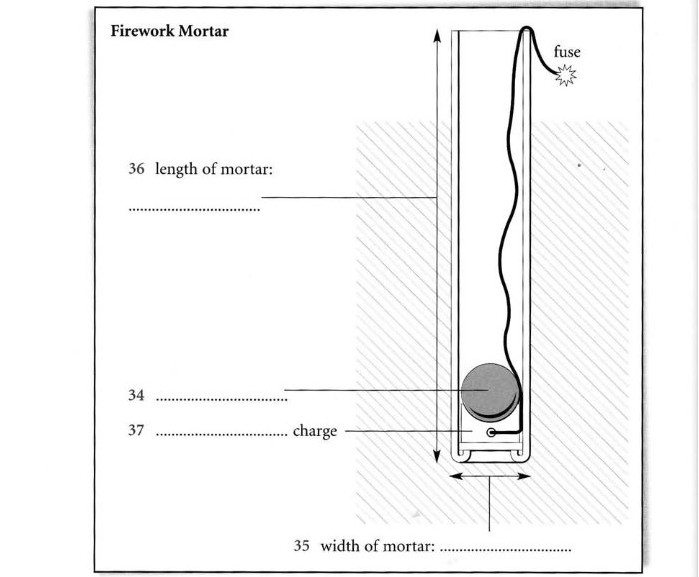
| Q34 | shell | A modern aerial firework – the kind used nowadays in big public displays, not the small rocket type that you might remember from your childhood – is normally made in the form of a shell, often a sphere about the size of a peach | Excerpt/Transcript Explanation: The transcript states that modern aerial fireworks are generally shaped as a shell, which looks like a round ball about the size of a peach. Answer Explanation: The answer "shell" refers to the outer case or body of a modern firework that holds the explosive powder and stars inside. Reason For Correctness: The correct answer is "shell" because the lecturer explains that modern aerial fireworks used in big public displays are typically constructed in the form of a shell, which is usually a peach-sized sphere containing stars and black powder. |
| Q35 | 75 millimetres / 75 millimetre diameter / 75 millimeters / 75 millimeter diameter / 75 millimetre-diameter / 75 millimeter-diameter | A shell of this kind is launched from a 75 millimetre-diameter mortar, which in some ways resembles the type used by the military | Excerpt/Transcript Explanation: The transcript explains that the mortar pipe used to fire this type of shell measures 75 millimetres across in diameter. Answer Explanation: The answer refers to the diameter measurement of the mortar tube, which is 75 millimetres (or 75 mm). Reason For Correctness: The correct answer is supported by the speaker's statement about how the shell is launched. The lecturer specifically notes that the firework shell is shot from a mortar tube that has a diameter of 75 millimetres. |
| Q36 | 500 millimetres / 500 millimeters | The mortar is a steel or – increasingly, for safety reasons – shatterproof plastic pipe. This is likely to be 500 millimetres long and sealed at one end | Excerpt/Transcript Explanation: The transcript states that the pipe (mortar) used to launch fireworks is normally 500 millimetres in length. Answer Explanation: The answer refers to the length measurement of 500 millimetres (mm). Reason For Correctness: The correct answer is 500 millimetres (or 500 mm / five hundred millimetres) because the speaker describes the mortar pipe used to launch the firework shell, stating that it is typically "500 millimetres long". |
| Q37 | the lifting / lifting | When this is lit, it quickly burns down to the lifting charge, which explodes to launch the shell | Excerpt/Transcript Explanation: The transcript explains that when the firework's fuse is lit, the fire reaches the lifting charge, causing an explosion that shoots the firework shell into the air. Answer Explanation: The answer refers to "lifting", which describes the type of charge at the bottom of the tube that explodes to push or launch the firework shell into the sky. Reason For Correctness: The correct answer is "lifting" because the lecturer explains the launching mechanism of the aerial firework shell. At the bottom of the mortar pipe, below the shell, there is a cylinder containing black powder. When the long fuse is lit, it burns down to the "lifting charge", which explodes to launch the shell upwards. |
| Q38 | B | Some shells contain explosives designed to crackle in the sky, or whistles that explode outwards with the stars | Excerpt/Transcript Explanation: The transcript explains that some fireworks have parts made to create sounds like crackling or whistling when they explode in the sky. Answer Explanation: The answer means that this type of firework shell can produce sounds (such as crackling or whistling) when it blows up. Reason For Correctness: The correct answer is B because the speaker explains that multibreak shells can include parts designed to make sounds in the air. Specifically, the speaker mentions that some contain explosives made to "crackle" or have "whistles" that fly out when exploding. In contrast, choice C is incorrect because the speaker states that the sections are lit by "different fuses," not a single fuse. |
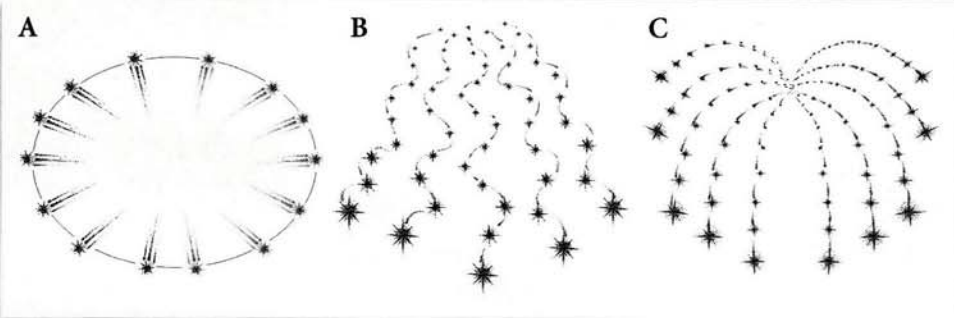
| Q39 | C | To create a specific figure in the sky, for instance a heart shape, you create an outline of the figure in stars inside the shell. You then place explosive charges inside those stars to blow them outward into the shape of a large heart | Excerpt/Transcript Explanation: The transcript explains that if you want a heart shape in the sky, you must arrange the firework stars in the shape of a heart inside the shell before it explodes. Answer Explanation: The answer means that the firework makes a heart shape in the sky because the glowing explosive pieces (stars) are placed in a heart shape inside the firework shell. Reason For Correctness: The correct answer is C because the lecturer explains that the pattern in the sky comes from how the stars are placed inside the shell. To make a heart shape, you make an outline of a heart using the stars inside the shell, which then explode outward. Keywords to note are 'heart shape', 'outline of the figure in stars inside the shell' (which matches 'stars arranged in the form of a heart inside a shell'). |
| Q40 | B | The Serpentine, the last one for now, is different again. When this one bursts, it sends small tubes of incendiaries scattering outwards in random paths, which may culminate in exploding stars | Excerpt/Transcript Explanation: The transcript explains that when a Serpentine firework explodes, burning parts shoot out in random winding directions and then finish by exploding into stars. Answer Explanation: The answer B is the correct option representing the visual pattern of a Serpentine shell. Reason For Correctness: The correct answer is B because the speaker describes the 'Serpentine' firework pattern as sending small burning tubes outwards in 'random paths', which finally end with bursts of 'exploding stars'. Choice B accurately matches this visual description of squiggly/random lines terminating in small star explosions. |
Transcript
LECTURER: Good afternoon everyone, and welcome to this short talk on the subject of fireworks. Now, fireworks, as I'm sure many of you know, were invented in China, though there has long been disagreement as to exactly when, or even in which century. The consensus nowadays, though, is that it was in the sixth, as there is considerable evidence of war rockets being made then. We also know that fireworks were in use by the seventh century in Arabia, where they were called 'Chinese Arrows', reflecting their military potential. It then took a long time for them to spread to Europe: in fact it wasn't until the twelve hundreds that fireworks made their appearance there.
The basic ingredients of fireworks have changed little to this day. Their explosive capacity comes mainly from black powder, also known as gunpowder, which is produced from a mixture of charcoal, sulphur and potassium nitrate. A modern aerial firework – the kind used nowadays in big public displays, not the small rocket type that you might remember from your childhood – is normally made in the form of a shell, often a sphere about the size of a peach. Inside the shell are a number of stars surrounded by black powder, and running through the centre of the round shell is a charge that makes the firework explode when it reaches the desired altitude. This is known as the bursting charge. When this explodes, it ignites the outside of the stars, which begin to burn with bright showers of sparks. Since the explosion throws the stars in all directions, you get the huge sphere of sparkling light that is so familiar at firework displays. A shell of this kind is launched from a 75 millimetre-diameter mortar, which in some ways resembles the type used by the military. The mortar is a steel or – increasingly, for safety reasons – shatterproof plastic pipe. This is likely to be 500 millimetres long and sealed at one end. The other end is aimed at the sky and at the bottom of the pipe, below the shell, is placed a cylinder containing black powder. This has a long fuse which projects out of the tube. When this is lit, it quickly burns down to the lifting charge, which explodes to launch the shell. In so doing, it also lights the shell's fuse. The shell's fuse burns while the shell rises to its correct altitude, and then ignites the bursting charge so it explodes. More complicated shells are divided into sections and burst in two or three phases. Shells like this are called multibreak shells. They may contain stars of different colours and compositions to create softer or brighter light, more or less sparks, etc. Some shells contain explosives designed to crackle in the sky, or whistles that explode outwards with the stars. The sections of a multibreak shell are ignited by different fuses and the bursting of one section ignites the next. The shells must be assembled in such a way that each section explodes in sequence to produce a distinct separate effect. The pattern that an aerial shell paints in the sky depends on the arrangement of stars inside the shell. For example, if the stars are equally spaced in a circle, with black powder inside the circle, you will see an aerial display of smaller star explosions equally spaced in a circle. To create a specific figure in the sky, for instance a heart shape, you create an outline of the figure in stars inside the shell. You then place explosive charges inside those stars to blow them outward into the shape of a large heart. Each charge has to be ignited at exactly the right time or the whole thing is spoiled. Many other shapes have particular names, like the Willow. This is formed by stars that fall in the shape of willow tree branches spreading a little to the side and then downwards. The high charcoal composition of the stars makes them long-burning, so they may even stay visible until they hit the ground. The Ring Shell is fairly basic. It is produced by stars exploding outwards to produce a symmetrical ring of coloured lights. More complex is the pattern created by the Palm, which contains large comets, or charges in the shape of a solid cylinder. These travel outwards, explode and then curve downwards like the limbs of a palm tree. The Serpentine, the last one for now, is different again. When this one bursts, it sends small tubes of incendiaries scattering outwards in random paths, which may culminate in exploding stars. It can be quite spectacular.