🔥 Today Only: Save 30% on Premium — Offer Ends Soon! - Upgrade Now!
Process Diagram

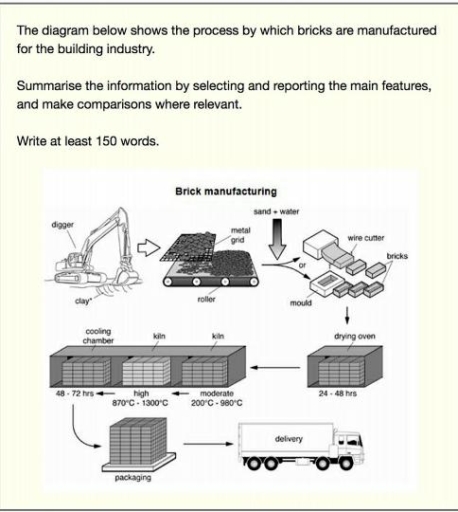
Band 7+: The diagram below shows the process by which bricks are manufactured for the building industry. Summarise the information by selecting and reporting the main features, and make comparisons where relevant. Write at least 150 words.

Image for topic: The diagram below shows the process by which bricks are manufactured for the building industry. Summarise the information by selecting and reporting the main features, and make comparisons where relevant. Write at least 150 words.
Our system will evaluate the answer based on this AI-generated description.
The image illustrates the brick manufacturing process in a sequential diagram form, featuring various equipment and steps involved. It starts with the extraction of clay using a digger, followed by clay processing through a roller. The processed clay is then mixed with sand and water, and passed through a metal grid to achieve a consistent blend. This mixture can be shaped into bricks using either a wire cutter or a mould, resulting in the formation of wire cut bricks or moulded bricks respectively. Subsequently, bricks are transferred to a drying oven where they stay for 24-48 hours. This step is followed by placing the bricks in a kiln for further hardening; depending on the kiln type, bricks are heated at temperatures ranging from 200°C in a moderate kiln to 980°C, or from 870°C to 1300°C in a high kiln over a period of 48-72 hours. Post kiln processing, bricks are moved to the packaging stage and then loaded onto a delivery truck for distribution.
Given the complexity of the image, the above description may not be entirely accurate.
Note: Both the topic and the answer were created by one of our users.

The following process diagram illustrates the procedures of brick manufacturing.

Overall, it is clear that the brick-making process involves seven general steps including digging clay at the beginning and delivering at the end.

First of all, with the help of a digger clay is extracted and transferred to a roller, which consists of a metal grid used for transforming clay into sand. The mixture of dry sand and water is poured into a predefined brick mould and then the bricks are put into a drying oven. Usually, a minimum of 24 to 48 hours is required to dry the bricks. The next step involves a furnace that has two subchambers: a baking and cooling chamber. Firstly, the bricks are sent to the furnace where they are baked at a moderate temperature of 200 to 980 degrees Celsius. After that, they are reheated at a high temperature of 870 to 1300 degrees Celsius and then passed to the cooling chamber. Once the heating process is completed, the bricks are kept in the cooling chamber for 48 to 72 hours. Finally packaging of the bricks is done with care, and they are sent out for distribution.

Word Count: 194

Answers On The Same Topic:

The diagram below shows the process by which bricks are manufactured for the building industry. Summarise the information by selecting and reporting the main features, and make comparisons where relevant. Write at least 150 words.

The process elevates data about actions that are needed in order to produce bricks for building business.Overall, the procedure consist of seven stages. To begin with the clay is dug up using digger. At the beginning of the process clay goes through the metal grid which grinds it. Once clay is crushed into pieces it […]

The diagram below shows the process by which bricks are manufactured for the building industry. Summarise the information by selecting and reporting the main features, and make comparisons where relevant. Write at least 150 words.

the diagram illustrates how bricks are manufactured for construction. To begin with clay is dug by big digger. to following this clay goes through matel grid for filtration process. for further process send and water are mixed with clay. after then bricks can be shaped by either wire cutter of mould. bricks are kept in […]

The diagram below shows the process by which bricks are manufactured for the building industry. Summarise the information by selecting and reporting the main features, and make comparisons where relevant. Write at least 150 words.

The image illustrates how bricks are manufactured for construction purposes. Overall, the process includes seven stages of sequential creation, which are completely operated using special equipment. The process starts when clay, as raw material, is dug by a huge digger. This clay, in the following stage, goes through a metal grid, where it is filtered, […]

The diagram below shows the process by which bricks are manufactured for the building industry. Summarise the information by selecting and reporting the main features, and make comparisons where relevant. Write at least 150 words.

The diagram illustrates the process by which bricks are produced for the construction industry, consisting of seven distinct steps. At first, specialized earth is gathered using a digger and then filtered through a metal grid to remove bulkier chunks of clay. The remaining refined clay is transferred with the help of a roller, after which […]

See All

Other Topics:

The diagram below shows the making a storage area from a material called concrete canvas

The given diagram provides the process of creating a storage facility from material called concrete canvas. It is clear that there are eight steps of the making storage area. The first and last stages are manufacturing and storing. The concrete canvas is made with three layers such as a fibrous top surface, a dry concrete […]

he diagram below describes how stormwater is recycled in an Australian city.

The diagram below illustrates how stormwater is recycled in an Australian city. Overall, rainwater is collected and undergoes to a recycling process before being used, but before being used water will be treated with chlorine and then will be usable. Rainwater is collected and sent to a recycling plant, which is divided into four stages. […]

The diagram below shows the process of handling high-level radioactive waste from a nuclear power plant.

First, high-level radioactive waste is produced in a nuclear power plant during the generation of electricity. This waste is extremely hazardous and must be carefully managed. Next, the waste is transferred into a cooling system, usually a large water-filled pool. Here, it is stored for several years to allow the temperature and radiation levels to […]

The diagram below shows the recycling process for aluminum cans. Summarize the information by selecting and reporting the main features, and make comparisons where relevant.

The diagram shows the process of recycling aluminium cans, from their initial disposal to their eventual reuse. Overall, the process consists of several stages, beginning with the collection of used cans and culminating in their reuse. This process is a complex one that requires the use of special machinery. In the initial stage, used aluminium […]

The diagram below give information about two road tunnels in one australian city

The diagram illustrate two road tunnels had been constructed with specification and similar features in one of the main city in Australia between 1987-1992 and 2004-2007. Overall, while the two tunnels consisted similar structure, tunnel B’s capacity, cost, and tunnel’s length and depth were more different than tunnel A. Although both tunnels displayed similar structure, […]

Smoked foods are popular worldwide because of their special flavor and their long life. The diagram below shows the structure of a home smokey and how it is used.

The pictures describe the process of using and structure of a home smokery step by step. Overall, the process of work a home smokery devides to two processes. An fresh air from outside of smokery is charging by logs and secondly a hot air goes throw pipe and smokes the product. As a result of […]

See All
We have detected unusual activity on your device.
Please verify your identity to continue.
Note: This verification step won't sign you in. If you have a premium account, please log in to access the service as usual.
Google/Gmail Verification
Or verify using Email/Code
We've sent a verification code to:
youremail@gmail.com (Not your email?)
Enter it below to complete the verification process.
Ensure your email address is correct, your inbox is not full, and you check your spam folder. If no email arrives, consider using an alternative email.
You will need a Premium plan to perform your action!
Note: If you already have a premium account, please log in to access our services as usual.

Plans & Pricing

Our mission is to make quality education accessible for everyone.
However, to keep our hardworking team running and this service alive, we genuinely need your support!
By opting for a premium plan, not only do you sustain us in achieving the mission, but you also unlock advanced features to enrich your learning experience.

Free

For learners who aren't pressed for time

What's included on Free
100+ Cambridge IELTS Tests
Instant IELTS Writing Task 1 & 2 Evaluation (2 times/month)
Instant IELTS Speaking Part 1, 2, & 3 Evaluation (5 times/month)
Instant IELTS Writing Task 1 & 2 Essay Generator (2 times/month)
500+ Dictation & Shadowing Exercises
100+ Pronunciation Exercises
Flashcards
Other Advanced Tools

Premium

For those serious about advancing their English proficiency, and for IELTS candidates aspiring to boost their band score by 1-2 points (especially in writing & speaking) in just 30 days or less

What's included on Premium
Save Your IELTS Test Progress
Unlock All Courses & IELTS Tests
Unlimited AI Conversations
Unlimited AI Writing Enhancement Exercises
Unlimited IELTS Writing Task 1 & 2 Evaluation
Unlimited IELTS Speaking Part 1, 2, & 3 Evaluation
Checked Answers Will Not Be Published
Unlimited IELTS Writing Task 1 & 2 Essay Generator
Unlimited IELTS Speaking Part 1, 2, & 3 Sample Generator
Unlimited Usage Of Advanced Tools
Priority Support within 24h (12-month plan only)

Due to the nature of our service and the provided free trials, payments are non-refundable.
Nếu bạn là người Việt Nam và không có hoặc không muốn trả bằng credit/debit cards, bạn có thể thanh toán bằng phương thức chuyển khoản:


Chọn gói:
419,000₫ 277,000 ₫ cho gói 1 tháng (chỉ 9,233₫/ngày)
1,239,000₫ 597,000 ₫ cho gói 3 tháng (chỉ 6,633₫/ngày)
2,469,000₫ 1,027,000 ₫ cho gói 6 tháng (chỉ 5,706₫/ngày)
4,929,000₫ 1,417,000 ₫ cho gói 12 tháng (chỉ 3,936₫/ngày)


Sau khi chuyển khoản, vui lòng đợi trình duyệt tự động điều hướng bạn trở lại Engnovate và bạn sẽ ngay lập tức nhận được mã kích hoạt tài khoản premium.
Nếu có lỗi xảy ra, bạn có thể liên hệ với team thông qua một trong các phương thức: email đến helloengnovate@gmail.com hoặc nhắn tin qua facebook.com/engnovate.
Vì toàn bộ công cụ trên website đều có thể sử dụng thử miễn phí, Engnovate không hỗ trợ hoàn tiền.