Our system will evaluate the answer based on this AI-generated description.
The image depicts a bar chart illustrating student accommodation preferences in percentage from the 1960s to the 2000s. In the 1960s "At home with own family" stands at 68%, "Students hall of residence" at 22%, "Paying guest with a host family" is 8%, "Room in a shared house or flat with other students" is approximately 2%. The 1970s show "At home with own family" decreasing slightly to around 63%, "Students hall of residence" drops to 17%, "Paying guest with a host family" marginally increases to 9%, and "Room in a shared house or flat with other students" rises to around 11%. During the 1980s, a significant shift occurs with "At home with own family" plummeting to 48%, "Students hall of residence" increases to 26%, while "Paying guest with a host family" decreases slightly to 7%, and "Room in a shared house or flat with other students" surges to nearly 19%. In the 1990s, "At home with own family" continues to decrease to 43%, "Students hall of residence" sees a slight drop to 24%, "Paying guest with a host family" remains stable at 7%, and "Room in a shared house or flat with other students" increases to approximately 26%. In the 2000s, "At home with own family" slightly rises around 45%, "Students hall of residence" increases to 27%, "Paying guest with a host family" again remains stable at 7%, and "Room in a shared house or flat with other students" sees a small increase to just above 26%.
Given the complexity of the image, the above description may not be entirely accurate.
Skyrocket your IELTS band score by 1-2 points in under a month with our premium plan!
Note: Both the topic and the answer were created by one of our users.
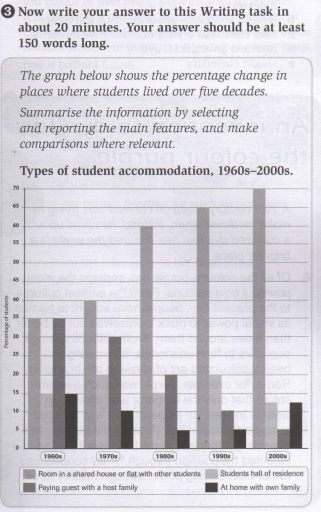
The bar graph illustrates the proportional differences between 4 types of student accommodations over a five-decade period from the 1960s to the 2000s.
Overall, in the 1960s, sharing houses with host families and with other peers were the most popular choices. Over the period, the former increased and reached the top in the 2000s, while the opposite was true with the latter category. Meanwhile, living in students’ apartments and staying with family experienced a slight decrease in the 2000s.
In the 1960s, staying with other students and with host families accounted for the highest percentage, both at 35%. However, the two categories experienced opposite trends. Whereas home-staying with other peers rose significantly and reached a peak of 70%, the portion of the other type dramatically declined to only 5% in the 2000s.
During the same period, living in the hall of residence fluctuated slightly before falling to 13% in the 2000s. Also, the ratio of students staying at their own houses mildly decreased from 15% to 12% in the 2000s.
Word Count: 170
