
The Biomes in Brazil - IELTS Listening Answers & Explanations
From Succeed in IELTS Academic Listening Test 4 · Part 4 · Questions 31–40
Audio
Questions
Questions 31–36 Map Labeling
Label the map below.
Write the correct letter, A-H, next to questions 31-36.
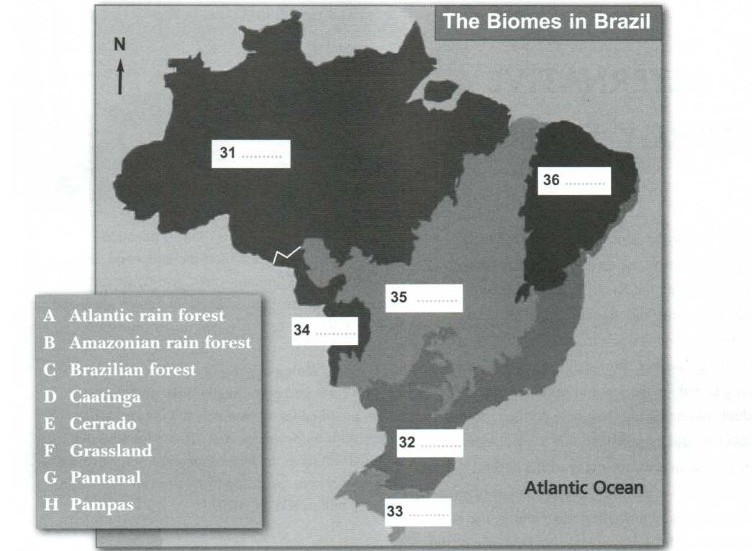
A. Atlantic rain forest | B. Amazonian rain forest | C. Brazilian forest
D. Caatinga | E. Cerrado | F. Grassland
G. Pantanal | H. Pampas
Questions 37–40 Table Completion
Complete the table below.
Write NO MORE THAN ONE WORD AND/OR A NUMBER for each answer.
| AREA | Cattle | Goats | Sheep |
|---|---|---|---|
| Cerrado | 37 | none | none |
| Caatinga | 23.9 | 8.8 | 38 |
| Pantanal | 39 | none | none |
| Pampas | 26 | 40 | 6 |
Answers & Explanations Summary
| # | Answer | Evidence | Explanation |
|---|---|---|---|
| Q31 | B | The largest biome in Brazil is the Amazonian Rainforest Biome, which you can see located in the north of the country | Excerpt/Transcript Explanation: The transcript explains that the Amazonian Rainforest Biome is the largest biome and is situated in the northern part of Brazil. Answer Explanation: The answer is option B, which refers to the Amazonian rain forest. Reason For Correctness: The correct answer is B because the speaker introduces the biomes on the map by pointing out that the biggest area in the north of Brazil is the "Amazonian Rainforest Biome". Therefore, this location corresponds to the Amazonian rain forest. |
| Q32 | A | the second being the Atlantic rainforest Biome, which is located in a relatively narrow strip running up the eastern Atlantic coast | Excerpt/Transcript Explanation: The transcript explains that the Atlantic rainforest biome forms a narrow line along Brazil's eastern coast next to the Atlantic Ocean. Answer Explanation: The answer is option A, which represents the Atlantic rain forest. Reason For Correctness: The correct answer is A because the speaker describes the Atlantic rainforest as being situated in a long, thin area along the eastern ocean coast of Brazil. The key phrase to listen for is "running up the eastern Atlantic coast". |
| Q33 | H | In the very southernmost part of Brazil, bordered by the Atlantic rainforest, lies the very small and relatively unstudied Pampas biome, which is grassland | Excerpt/Transcript Explanation: The transcript explains that the area located at the far south of Brazil is called the Pampas biome. Answer Explanation: The answer is option H, which refers to the Pampas biome. Reason For Correctness: The correct answer is H because the speaker guides listeners through the map of Brazil's biomes. While describing the locations, the speaker points out that the Pampas biome is situated in the southernmost part of Brazil, bordering the Atlantic rainforest. |
| Q34 | G | Starting at the left of the map, you can see the smallest of the three, which is the Pantanal Biome a unique seasonally flooded wetland area | Excerpt/Transcript Explanation: The transcript explains that on the left side of the map in that region, you can find the Pantanal Biome, which is the smallest of the three central biomes. Answer Explanation: The answer is G, which stands for the Pantanal biome. Reason For Correctness: The correct answer is G because the speaker describes the biomes running across the middle of the map of Brazil. The speaker notes that when "starting at the left of the map," the smallest area shown there is "the Pantanal Biome." Therefore, this spot on the map matches option G, Pantanal. |
| Q35 | E | In the centre of the country is the Cerrado, the second largest biome in Brazil | Excerpt/Transcript Explanation: The transcript states clearly that the Cerrado is found in the central part of the country. Answer Explanation: The answer "E" refers to the Cerrado biome. Reason For Correctness: The correct answer is E because the speaker describes the biomes stretching across the middle of the country and specifically points out that the Cerrado is located in the centre of Brazil. |
| Q36 | D | Finally, the last biome, called Caatinga, is located between the Cerrado and the Atlantic forest in the north east of the country | Excerpt/Transcript Explanation: The transcript explains that the biome known as Caatinga sits in the northeastern part of the country, positioned between two other regions: the Cerrado and the Atlantic forest. Answer Explanation: The answer is option D, which refers to the Caatinga biome. Reason For Correctness: The correct answer is D because the speaker describes the Caatinga as being situated in the north east of Brazil, right between the Cerrado and the Atlantic forest. Therefore, the area matching this geographic position on the map is the Caatinga. |
| Q37 | 72.3 | The Cerrado now supports 72.3 million cattle, which amounts to 41 percent of the cattle in Brazil | Excerpt/Transcript Explanation: The transcript states clearly that the Cerrado region currently has 72.3 million cattle. Answer Explanation: The answer "72.3" is the number (in millions) of cattle living or raised in the Cerrado area. Reason For Correctness: The correct answer is confirmed by the speaker's statement about the Cerrado biome. The table lists the number of livestock in millions for each area, without repeating the word "million" (for example, 23.9 for Caatinga and 26 for Pampas). In the Cerrado region, the speaker specifically mentions that it "supports 72.3 million cattle". Therefore, 72.3 is the correct number to fill in the table under the "Cattle" column for Cerrado. |
| Q38 | 8.1 | Agriculture is limited by the lack of water but this biome supports 8.8 million goats and 8.1 million sheep, besides 23.9 million cattle | Excerpt/Transcript Explanation: The transcript states that the Caatinga area has 8.8 million goats, 8.1 million sheep, and 23.9 million cattle. Answer Explanation: The answer is the number 8.1, representing 8.1 million sheep. Reason For Correctness: The correct answer is 8.1 because the table asks for the number (in millions) of sheep raised in the Caatinga biome. The speaker clearly states that the Caatinga region supports 8.1 million sheep. |
| Q39 | 3 | Three million cattle are raised in this biome, however the available grazing area is limited by flooding so large areas can sustain only low numbers of animals | Excerpt/Transcript Explanation: The transcript directly states that 3 million cattle live and feed in the Pantanal biome. Answer Explanation: The answer "3" means that there are 3 million cattle raised in the Pantanal area. Reason For Correctness: The correct answer is 3 because when discussing the Pantanal Biome, the speaker specifically mentions that "Three million cattle are raised in this biome". In the table, the numbers are already represented in millions, so writing "3" correctly completes the column for cattle in the Pantanal. |
| Q40 | none | The Pampas supports 26 million cattle and 6 million sheep, in mostly natural unmodified pastures; however this biome is being threatened with rapid conversion to the agriculture of cash crops | Excerpt/Transcript Explanation: The transcript states that the Pampas area has 26 million cattle and 6 million sheep, without mentioning any goats. Answer Explanation: The answer "none" means that no goats are raised or mentioned for the Pampas region in the table. Reason For Correctness: The correct answer is "none" because the table records the number of farm animals (cattle, goats, and sheep) in different areas. The speaker notes that the Pampas biome supports 26 million cattle and 6 million sheep, but does not list any goats. Therefore, following the pattern of the table where biomes without these animals are marked as "none" (such as the Cerrado and Pantanal), the missing entry for goats in the Pampas is "none". |
Transcript
To begin our topic on sustainable development in South America, I would like to briefly acquaint you with the 6 biomes present in the country. Each of these biomes has its own geographic and environmental features, has unique resources that people may exploit, and indeed, each is facing different threats from human development.
Biomes, if you recall, are regions that are climatically and geographically defined and contain distinct communities of plants and animals. They are sometimes named for the plant communities that occur such as forest, savannah, and grassland; whether these plants are evergreen or deciduous; and climatic factors as well, for example, tropical, temperate, etc.
All right, let's take a look at this map of Brazil. The largest biome in Brazil is the Amazonian Rainforest Biome, which you can see located in the north of the country. It's one of two rainforest biomes in Brazil; the second being the Atlantic rainforest Biome, which is located in a relatively narrow strip running up the eastern Atlantic coast. In the very southernmost part of Brazil, bordered by the Atlantic rainforest, lies the very small and relatively unstudied Pampas biome, which is grassland. Finally, stretching like a belt across the middle of the country, between the two rainforest biomes, lie the Pantanal, the Cerrado, and the Caatinga. Starting at the left of the map, you can see the smallest of the three, which is the Pantanal Biome a unique seasonally flooded wetland area. In the centre of the country is the Cerrado, the second largest biome in Brazil. Cerrado is tropical savannah - a scattering of grassland and deciduous forest that experiences a short dry season. Finally, the last biome, called Caatinga, is located between the Cerrado and the Atlantic forest in the north east of the country. The Caatinga has a very long dry season, lasting 8 to 9 months, and is covered in deciduous scrub.
So, let's begin with the Amazonian Rainforest Biome. As I mentioned previously, it's rainforest, and it's incredibly diverse. It contains the largest single reserve of biological organisms in the world. No one really knows how many species occur in the Amazon forest, but scientists estimate that there could be as many as 5 million. Recently this biome has been under a great deal of pressure from agriculture, with large swathes being cleared and burned to create pasture for the 19 million cattle that the area supports. However, the soils are acidic with very low levels of certain important minerals, and are quickly degraded when heavily grazed, which necessitates more clearing and burning of forest. The rainforest is further disturbed by selective logging of valuable tree species.
The second largest biome in Brazil is the Cerrado, which is a tropical savannah environment made up of sparse trees and drought resistant grasses. The Cerrado also contains a huge biodiversity; it's estimated that one third of Brazil's plant and animal species are located in this region. But since 1995, the cultivated pasture area in the Cerrado has increased by almost 70%. It is a common practice to use newly cleared land for the cultivation of crops for a few years, and then when it starts to degrade, to use it for pasture for cattle. The Cerrado now supports 72.3 million cattle, which amounts to 41 percent of the cattle in Brazil.
Next, we have the biome called the Caatinga, which is a tropical dryland with a dry season that lasts 8 or 9 months of the year. Vegetation is deciduous, sparse and thorny, and contains a high number of species endemic to Brazil. Agriculture is limited by the lack of water but this biome supports 8.8 million goats and 8.1 million sheep, besides 23.9 million cattle.
The Pantanal Biome, a wetland formed by the flooding of the rivers of the Paraguay basin, is the world's biggest flooded plain. Vegetation is patchy and variable; it consists of tall grasses, bushes, and widely dispersed trees similar to those of the Cerrado, except that in the Pantanal they are partially submerged for a portion of the year. Three million cattle are raised in this biome, however the available grazing area is limited by flooding so large areas can sustain only low numbers of animals. UNESCO recognizes it as a "World Biosphere Reserve" and also as a "World Natural Heritage Site." Ecotourism is becoming important in this region, which diversifies the economic activity.
The Atlantic Rain Forest is the most endangered biome in Brazil and also its most affluent region. It's the most important agricultural and industrial area of the country. It supports 36 million cattle, and most of the country's dairy production takes place there. More than 70% of the Brazilian population, the largest Brazilian cities and the production of about 80% of Brazil's gross domestic product are all located in what used to be the Atlantic Forest. Today, as a result, less than 10 per cent of the Atlantic forest is left. The Biome is also beginning to be recognised as ecologically very important; in the state of Bahia, for example, international researchers have identified a world record of 458 tree species in a single hectare of Atlantic Forest. That is even more diverse than the Amazon rain forest. At the moment, less than 2% of the remaining Atlantic forest is under protected status, and the scientific community is scrambling to secure what little undisturbed forest still remains.
Finally, the Brazilian Pampas Biome has a temperate climate - it's the only biome in Brazil that is not tropical. Grasslands scattered with shrubs and trees are the dominant vegetation. The shallow soil, originating from sedimentary rocks, often has an extremely sandy texture that makes it fragile and highly prone to water and wind erosion. The Pampas supports 26 million cattle and 6 million sheep, in mostly natural unmodified pastures; however this biome is being threatened with rapid conversion to the agriculture of cash crops.
All right, so, next week we will go into more detail about the economic policies of the Brazilian government in relation to the development of each of these biomes.