🔥 Today Only: Save 30% on Premium — Offer Ends Soon! - Upgrade Now!
Process Diagram

Band 7+: Task 1 The diagrams below show the stages and equipment used in the cement-making process, and how cement is used to produce concrete for building purposes. Summarise the information by selecting and reporting the main features, and make comparisons where relevant. Write at least 150 words.

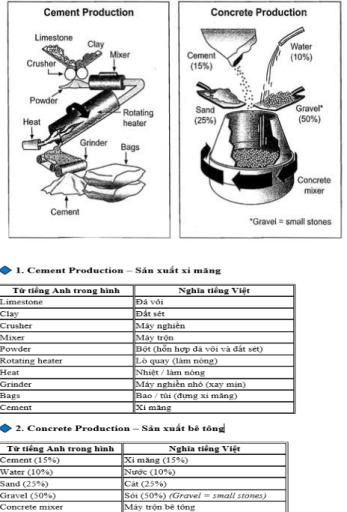
Image for topic: Task 1 The diagrams below show the stages and equipment used in the cement-making process, and how cement is used to produce concrete for building purposes. Summarise the information by selecting and reporting the main features, and make comparisons where relevant. Write at least 150 words.
Our system will evaluate the answer based on this AI-generated description.
The image contains two diagrams depicting cement and concrete production, plus two tables with related terminology: Cement Production diagram includes limestone, clay, mixer, crusher, powder, rotating heater, heat, grinder, bags, cement; Concrete Production diagram shows cement (15%), water (10%), sand (25%), gravel (50%), concrete mixer, gravel defined as small stones; Table 1 - Cement Production - includes English to Vietnamese translations: Limestone translated to Đá vôi, clay đất sét, crusher máy nghiền, mixer máy trộn, powder bột (hỗn hợp đá vôi và đất sét), rotating heater lò quay (làm nóng), heat nhiệt/làm nóng, grinder máy nghiền (ép nhỏ), bags bao/túi (đựng xi măng), cement xi măng; Table 2 - Concrete Production - lists English to Vietnamese translations: Cement translated to xi măng (15%), water nước (10%), sand cát (25%), gravel sỏi (50%), note states gravel = small stones; both tables title sections 1. Cement Production (Sản xuất xi măng) and 2. Concrete Production (Sản xuất bê tông).
Given the complexity of the image, the above description may not be entirely accurate.
Note: Both the topic and the answer were created by one of our users.

The diagrams indicate the process of producing cement and how this material is used in order to make concrete for building construction.

Overall, cement production includes several stages, starting from the raw materials to the final packed product, while concrete is made by mixing cement with other materials in a concrete mixer.

In the first diagram, limestone and clay are put into a crusher where they become powder. Then this material is mixed and goes through a rotating heater. After heating, the material is sent into a grinder which make it finer and become cement. Finally, the cement is packed in bags for use.

In the second diagram, concrete is created by combining cement, water, sand and gravel in a concrete mixer. Cement makes up 15%, water is 10%, sand is 25% and gravel is the biggest part at 50%. These ingredients are mixed together to produce concrete, which can be used in buildings.

Word Count: 154

Answers On The Same Topic:

Task 1 The diagrams below show the stages and equipment used in the cement-making process, and how cement is used to produce concrete for building purposes. Summarise the information by selecting and reporting the main features, and make comparisons where relevant. Write at least 150 words.

The diagram illustrates the process of manufacturing a cement and how it is used to produce a concrete. Overall, cement production involves multiple stages, beginning with the crushing and ending with packaging the cement. In contrast, concrete is much simpler to manufacture, requiring four fundamental products. Notably, the process is highly machine-driven, requiring a minimal […]

Task 1 The diagrams below show the stages and equipment used in the cement-making process, and how cement is used to produce concrete for building purposes. Summarise the information by selecting and reporting the main features, and make comparisons where relevant. Write at least 150 words.

The first diagram illustrates the five stages of production of cement, while the second diagram shows how materials are used in the production of concrete. It is evident that there are five stages of production of cement. The process begins with the input of raw materials and ends with a bag of finished product. To […]

Task 1 The diagrams below show the stages and equipment used in the cement-making process, and how cement is used to produce concrete for building purposes. Summarise the information by selecting and reporting the main features, and make comparisons where relevant. Write at least 150 words.

The first diagram illustrates the process of cement manufacture, and the second diagram shows the materials that go into the production of concrete. It is clear that there are five stages in the production of cement, beginning with the input of raw materials and ending with bags of the finished product. To produce concrete, four […]

Task 1 The diagrams below show the stages and equipment used in the cement-making process, and how cement is used to produce concrete for building purposes. Summarise the information by selecting and reporting the main features, and make comparisons where relevant. Write at least 150 words.

The diagram demonstrates what steps and equipment have to used in the production of cement and the way how cement is used to making concrete for construction purposes. Overall, to making cement the product requires several stages including crushing, mixing, heating and the last packing process. In contrast, production of concrete consists different four ingredients […]

Task 1 The diagrams below show the stages and equipment used in the cement-making process, and how cement is used to produce concrete for building purposes. Summarise the information by selecting and reporting the main features, and make comparisons where relevant. Write at least 150 words.

The diagram illustrates the stages and equipment used in the cement-making process, and how to produce concrete for building purposes out of cement and other ingridients. Overall, cement production comprises ten stages, beginning with a limestone and ending with the produced cement bags, therefore concrete producion invovles of five levels. Initially, limestone and clay added […]

See All

Other Topics:

The diagram below shows the life cycle of a flower and the various stages it goes through. Summarise the information by selecting and reporting the main features, and make comparisons where relevant

The diagram illustrates different stages involved in the development of a plant. Overall, it can be seen that the life cycle is a continuous cyclical progress consisting of eight distinct steps, beginning with seeds and eventually returning to the initial stage. During these stages, the seeds are planted, germinated, sprouted, increased in size and became […]

The diagram below shows the stages and equipment used in cement making process, and how cement is used to produce concrete for building puropses

The diagram illustrates the process of cement production, including the stages and equipment involved, and how cement is subsequently used to produce concrete for construction purposes. Overall, the two diagrams depict two distinct processes. Cement production involves crushing and grinding, while concrete production entails mixing cement with water, sand, and gravel. Cement production begins with […]

The diagram below shows the manufacturing process for making sugar from sugar cane. Summarise the information by selecting and reporting the main features, and make comparisons where relevant.

The diagram illustrates that the process of produced sugar from sugar cane to used different methods. Overall, it is clear that fastly growing crops which necessary almost 12 to 18 months . Then used six types of method . After that, it would make perfectly sugar which ready for eat. At fast, people have to […]

The diagram below shows the process by which bricks are manufactured for the building industry. Summarise the information by selecting and reporting the main features, and make comparisons where relevant. Write at least 150 words.

The diagram illustrates the process of manufacturing bricks for the building industry. Overall, it is a linear process consisting of several stages, beginning with the extraction of clay and ending with the packaging and delivery of the finished bricks. The main stages include preparing the raw materials, shaping and drying the bricks, heating them at […]

The diagram below shows how chipboard is created from wood and then used to make furniture. Provide an overview of the information by identifying and describing the key details, and include comparisons where appropriate.

The provided diagram delineates the processes of creating chipboard from wood and manufacturing furniture from this material. Overall, the process consists of 2 stages preparation and production. Iinitializing with logging of trees and ending with assembled furniture. Primarly, trees are cutted and trimmed to produce logs. Then the logs are sent into special facility that […]

See All
We have detected unusual activity on your device.
Please verify your identity to continue.
Note: This verification step won't sign you in. If you have a premium account, please log in to access the service as usual.
Google/Gmail Verification
Or verify using Email/Code
We've sent a verification code to:
youremail@gmail.com (Not your email?)
Enter it below to complete the verification process.
Ensure your email address is correct, your inbox is not full, and you check your spam folder. If no email arrives, consider using an alternative email.
You will need a Premium plan to perform your action!
Note: If you already have a premium account, please log in to access our services as usual.

Plans & Pricing

Our mission is to make quality education accessible for everyone.
However, to keep our hardworking team running and this service alive, we genuinely need your support!
By opting for a premium plan, not only do you sustain us in achieving the mission, but you also unlock advanced features to enrich your learning experience.

Free

For learners who aren't pressed for time

What's included on Free
100+ Cambridge IELTS Tests
Instant IELTS Writing Task 1 & 2 Evaluation (2 times/month)
Instant IELTS Speaking Part 1, 2, & 3 Evaluation (2 times/month)
Instant IELTS Writing Task 1 & 2 Essay Generator (2 times/month)
500+ Dictation & Shadowing Exercises
100+ Pronunciation Exercises
Flashcards
Other Advanced Tools

Premium

For those serious about advancing their English proficiency, and for IELTS candidates aspiring to boost their band score by 1-2 points (especially in writing & speaking) in just 30 days or less

What's included on Premium
Save Your IELTS Test Progress & Analyze Mistakes By Question Type
Save Your Own Flashcard Sets & Use Them On Any Device
Unlock All Courses, IELTS Tests, Section & Part Practice
Unlimited AI Conversations
Unlimited AI Writing Enhancement Exercises
Unlimited IELTS Writing Task 1 & 2 Evaluation
Unlimited IELTS Speaking Part 1, 2, & 3 Evaluation
Checked Answers Will Not Be Published
Unlimited IELTS Writing Task 1 & 2 Essay Generator
Unlimited IELTS Speaking Part 1, 2, & 3 Sample Generator
Unlimited Usage Of Advanced Tools & AI Features
Priority Support within 24h (12-month plan only)

Due to the nature of our service and the provided free trials, payments are non-refundable.