🔥 Today Only: Save 30% on Premium — Offer Ends Soon! - Upgrade Now!
Process Diagram

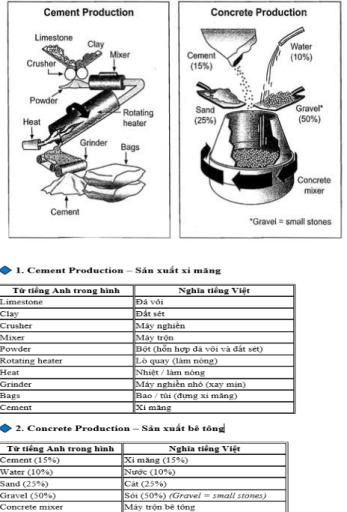
Band 5+: Task 1 The diagrams below show the stages and equipment used in the cement-making process, and how cement is used to produce concrete for building purposes. Summarise the information by selecting and reporting the main features, and make comparisons where relevant. Write at least 150 words.

Image for topic: Task 1 The diagrams below show the stages and equipment used in the cement-making process, and how cement is used to produce concrete for building purposes. Summarise the information by selecting and reporting the main features, and make comparisons where relevant. Write at least 150 words.
Our system will evaluate the answer based on this AI-generated description.
The image contains two diagrams depicting cement and concrete production, plus two tables with related terminology: Cement Production diagram includes limestone, clay, mixer, crusher, powder, rotating heater, heat, grinder, bags, cement; Concrete Production diagram shows cement (15%), water (10%), sand (25%), gravel (50%), concrete mixer, gravel defined as small stones; Table 1 - Cement Production - includes English to Vietnamese translations: Limestone translated to Đá vôi, clay đất sét, crusher máy nghiền, mixer máy trộn, powder bột (hỗn hợp đá vôi và đất sét), rotating heater lò quay (làm nóng), heat nhiệt/làm nóng, grinder máy nghiền (ép nhỏ), bags bao/túi (đựng xi măng), cement xi măng; Table 2 - Concrete Production - lists English to Vietnamese translations: Cement translated to xi măng (15%), water nước (10%), sand cát (25%), gravel sỏi (50%), note states gravel = small stones; both tables title sections 1. Cement Production (Sản xuất xi măng) and 2. Concrete Production (Sản xuất bê tông).
Given the complexity of the image, the above description may not be entirely accurate.
Note: Both the topic and the answer were created by one of our users.

The diagram demonstrates what steps and equipment have to used in the production of cement and the way how cement is used to making concrete for construction purposes.

Overall, to making cement the product requires several stages including crushing, mixing, heating and the last packing process. In contrast, production of concrete consists different four ingredients which only mixes in process.

In the first stage, limestone and clay are crushed into tiny pieces which is manufacture powder. The powder firstly mixed in a blender and after that conveyed to a rotating heater. Moreover, the blend has been heated, then it is passed through a glinder, which is produces cement. When the process is finished, the cement packed into bags, finally prepared for use in concrete production.

In the second stage, the process of making concrete involves 15% of cement, 10% of water, 25% of sand and exactly a half of gravel. These all components are mixes in a particular concrete blender. When the process in completed the product can be avaiable for use in construction.

Word Count: 174

Answers On The Same Topic:

Task 1 The diagrams below show the stages and equipment used in the cement-making process, and how cement is used to produce concrete for building purposes. Summarise the information by selecting and reporting the main features, and make comparisons where relevant. Write at least 150 words.

The diagram illustrates the stages and equipment used in the cement-making process, and how to produce concrete for building purposes out of cement and other ingridients. Overall, cement production comprises ten stages, beginning with a limestone and ending with the produced cement bags, therefore concrete producion invovles of five levels. Initially, limestone and clay added […]

Task 1 The diagrams below show the stages and equipment used in the cement-making process, and how cement is used to produce concrete for building purposes. Summarise the information by selecting and reporting the main features, and make comparisons where relevant. Write at least 150 words.

The diagram illustrates the stages and equipment used in the production of cement, which is essential for creating concrete used in the construction of buildings. Overall, cement production consists of several steps, including crushing, mixing, heating, and finally, the packing process. In contrast, the production of concrete involves a mixing process that incorporates four different […]

Task 1 The diagrams below show the stages and equipment used in the cement-making process, and how cement is used to produce concrete for building purposes. Summarise the information by selecting and reporting the main features, and make comparisons where relevant. Write at least 150 words.

For cement production, we will need a limestone, clay, a crusher, a mixer, a rotating heater, heat for the rotating heater, a grinder, bags for containing. First of all, put both the limestone and the clay into the crusher to turn them into a powder, for the next step, put the produced powder into the […]

Task 1 The diagrams below show the stages and equipment used in the cement-making process, and how cement is used to produce concrete for building purposes. Summarise the information by selecting and reporting the main features, and make comparisons where relevant. Write at least 150 words.

The following tables illustrate the procedure by which cement is manufactured in order to be used for concrete production, necessary for the construction of buildings. The process encompasses numerous stages, from crushing, mixing, and heating diverse materials with the assistance of several machinery, such as crushers, mixers, and heaters. During the first stage, limestone and […]

See All

Other Topics:

The diagram shows how processes in the earth's rock cycle create and transform different types of rocks. Summarise the information by selecting and reporting the main features and make comparisons where relevant. Write at least 150 words.

The diagram illustrates the process of creation and transformation different types of rocks taking place in the earth’s rock cycle.There are approximately 9 stages which form 3 types of rock-sedimentary, igneous and metamorphic. It presents how not only things below Earth’s surface,but also above are fundamental in transforming. Igneous rock starts its creation from magma, […]

The diagram below shows how a biofuel called ethanol is produced. Summarize the information by selecting and reporting the main features and make comparisons where relevant.

The diagram illustrates the production of a biofuel called ethanol. Overall, the process consists of several stages, beginning with plant growth and ending with the use of ethanol as a fuel. It is a cyclical process, as carbon dioxide released during consumption is reused in the initial stage. Initially, plants and trees grow by absorbing […]

The diagram below shows how chipboard is created from wood and then used to make furniture. Provide an overview of the information by identifying and describing the key details, and include comparisons where appropriate.

The images illustrate the process of producing chipboard from wood, highlighting two main stages: preparation and production. The diagram outlines nine steps, starting from cutting down trees to creating products such as tables and chairs. The first step involves cutting down trees in the forest and trimming them into logs to facilitate grinding. Next, wood […]

The diagram below shows how chipboard is created from wood and then used to make furniture. Provide an overview of the information by identifying and describing the key details, and include comparisons where appropriate.

The pictures elucidate the process of making chipboard from wood, and the way how furniture is invented in two main stages as preparation and production. There are 9 steps in the diagram, from cutting the trees to making a product such as tables and chairs. The first step is that trees are cut and brought […]

the diagram below shows the recyling process of aluminium cans. summarise the information by selecting and reporting main features and make comparisons where relevant.

The flow chart illustrates the multi-stage process through which the aluminium cans are recycled. Overall, it is rather sophisticated process which consists 6 stages starting from consumer reuse and collection of used cans and ending with production of newly manufactured cans which ready for reuse. The process commences when the collection is done, where used […]

You should spend about 20 minutes on this task. The diagram below shows how Olive Oil is manufactured. Write a report for a university lecturer describing the information below. You should write at least 150 words.

The diagram illustrate olive oil manufacturing process with details Overall,this journey start with the planting olive trees and collecting its fruit which is called olives and send those to a process chain In the end of the process olives turns to oil and get in to our homes. Initially, Olives grow up and be ready […]

See All
We have detected unusual activity on your device.
Please verify your identity to continue.
Note: This verification step won't sign you in. If you have a premium account, please log in to access the service as usual.
Google/Gmail Verification
Or verify using Email/Code
We've sent a verification code to:
youremail@gmail.com (Not your email?)
Enter it below to complete the verification process.
Ensure your email address is correct, your inbox is not full, and you check your spam folder. If no email arrives, consider using an alternative email.
You will need a Premium plan to perform your action!
Note: If you already have a premium account, please log in to access our services as usual.

Plans & Pricing

Our mission is to make quality education accessible for everyone.
However, to keep our hardworking team running and this service alive, we genuinely need your support!
By opting for a premium plan, not only do you sustain us in achieving the mission, but you also unlock advanced features to enrich your learning experience.

Free

For learners who aren't pressed for time

What's included on Free
100+ Cambridge IELTS Tests
Instant IELTS Writing Task 1 & 2 Evaluation (2 times/month)
Instant IELTS Speaking Part 1, 2, & 3 Evaluation (5 times/month)
Instant IELTS Writing Task 1 & 2 Essay Generator (2 times/month)
500+ Dictation & Shadowing Exercises
100+ Pronunciation Exercises
Flashcards
Other Advanced Tools

Premium

For those serious about advancing their English proficiency, and for IELTS candidates aspiring to boost their band score by 1-2 points (especially in writing & speaking) in just 30 days or less

What's included on Premium
Save Your IELTS Test Progress
Unlock All Courses & IELTS Tests
Unlimited AI Conversations
Unlimited AI Writing Enhancement Exercises
Unlimited IELTS Writing Task 1 & 2 Evaluation
Unlimited IELTS Speaking Part 1, 2, & 3 Evaluation
Checked Answers Will Not Be Published
Unlimited IELTS Writing Task 1 & 2 Essay Generator
Unlimited IELTS Speaking Part 1, 2, & 3 Sample Generator
Unlimited Usage Of Advanced Tools
Priority Support within 24h (12-month plan only)

Due to the nature of our service and the provided free trials, payments are non-refundable.
Nếu bạn là người Việt Nam và không có hoặc không muốn trả bằng credit/debit cards, bạn có thể thanh toán bằng phương thức chuyển khoản:


Chọn gói:
419,000₫ 277,000 ₫ cho gói 1 tháng (chỉ 9,233₫/ngày)
1,239,000₫ 597,000 ₫ cho gói 3 tháng (chỉ 6,633₫/ngày)
2,469,000₫ 1,027,000 ₫ cho gói 6 tháng (chỉ 5,706₫/ngày)
4,929,000₫ 1,417,000 ₫ cho gói 12 tháng (chỉ 3,936₫/ngày)


Sau khi chuyển khoản, vui lòng đợi trình duyệt tự động điều hướng bạn trở lại Engnovate và bạn sẽ ngay lập tức nhận được mã kích hoạt tài khoản premium.
Nếu có lỗi xảy ra, bạn có thể liên hệ với team thông qua một trong các phương thức: email đến helloengnovate@gmail.com hoặc nhắn tin qua facebook.com/engnovate.
Vì toàn bộ công cụ trên website đều có thể sử dụng thử miễn phí, Engnovate không hỗ trợ hoàn tiền.