Our system will evaluate the answer based on this AI-generated description.
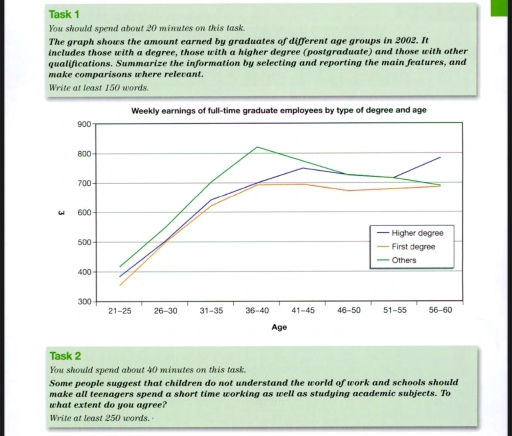
The image displays a line graph showcasing weekly earnings for full-time graduate employees categorized by type of degree and age in 2002. For 'Higher degree': age 21–25 earnings around £400, 26–30 earnings £600, peak at 31–35 with earnings approximately £800, 36–40 earnings about £750, 41–45 earnings around £700, 46–50 earnings about £650, 51–55 earnings marginally above £600, and 56–60 earnings just above £600. For 'First degree': age 21–25 earnings slightly below £400, 26–30 earnings approximately £550, 31–35 earnings at £700, 36–40 earnings slightly above £700, 41–45 and 46–50 earnings slightly below £700, 51–55 and 56–60 earnings around £600. For 'Others': age 21–25 earnings near £350, 26–30 earnings close to £500, 31–35 earnings around £600, 36–40 earnings slightly below £600, 41–45 earnings at £550, 46–50 earnings slightly below £550, 51–55 and 56–60 earnings around £500.
Given the complexity of the image, the above description may not be entirely accurate.
Skyrocket your IELTS band score by 1-2 points in under a month with our premium plan!
Note: Both the topic and the answer were created by one of our users.
The line graph illustrates the earnings of full-time graduate workers of different age group in 2002.
Overall , high income is observed through middle age group employees. Younger people are more likely to have low salary and they are less experienced. While older workers seems to have stable formed salary.
There was a steady rise between 21-25 and 41-45 years old workers and 56-60 whose salary reached its peak with approximately 800 pounds with higher degree. Also individuals with first degree got salary increase from below 400 pounds to 700 pounds.
The line graph showed that people who have higher degree get more money than those who have first degree especially to old age. But developing in other degrees will pay the highest price reaching above 800 pounds at 36-40 age.
Word Count: 131
