Our system will evaluate the answer based on this AI-generated description.
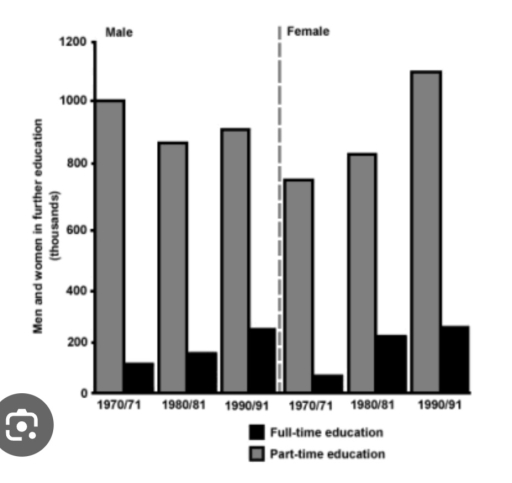
The image contains a bar graph comparing the number of men and women in further education over three time periods (1970/71, 1980/81, 1990/91) divided by gender (Male, Female) and type of education (Full-time, Part-time). For males in 1970/71, full-time education was around 200, part-time was just below 1000; in 1980/81, full-time was just above 600, part-time was around 600; in 1990/91, full-time was around 800, part-time was around 200. For females in 1970/71, full-time education was around 100, part-time was just above 200; in 1980/81, full-time was just below 600, part-time was around 300; in 1990/91, full-time was just below 1000, part-time was just below 200. Vertical axis denotes 'Men and women in further education ('000s)', horizontal axis reflects the time periods divided by gender, and bars indicate full-time (solid) and part-time (striped) education.
Given the complexity of the image, the above description may not be entirely accurate.
Skyrocket your IELTS band score by 1-2 points in under a month with our premium plan!
Note: Both the topic and the answer were created by one of our users.
The chart show number of men and women in further education in Britain in 1970/71, 1980/81 and 1990/91. Also it show full time and part time study.
Overall, part time study more popular than full time in all years. In first years men more than women, but later women number increase.
For men, about 1 million studied part time in 1970/71. Then it go down to around 900 thousand in 1980/81 and almost same in 1990/91. Full time men students increase from about 100 thousand to around 250 thousand.
For women, about 700 thousand study part time in 1970/71. After that number increase and in 1990/91 it about 1.1 million. Full time women also grow from about 50 thousand to around 250 thousand.
Word Count: 123
