Our system will evaluate the answer based on this AI-generated description.
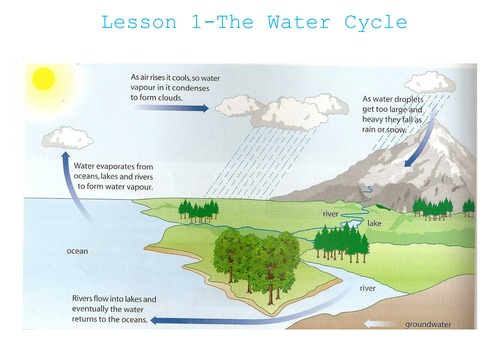
The image features an illustrated diagram titled "Lesson 1-The Water Cycle" depicting the cyclical flow of water across a landscape comprising an ocean, coastline, green plains, trees, rivers, a lake, and a mountain range beneath a sun and clouds. Starting at the left above the "ocean", an upward-curving arrow leads to a cloud with the label "Water evaporates from oceans, lakes and rivers to form water vapour." A horizontal right-pointing arrow connects to clouds mid-sky, labeled "As air rises it cools, so water vapour in it condenses to form clouds." Clouds over the landscape and mountain depict precipitation falling, accompanied by a downward-angled arrow on the mountain and the annotation "As water droplets get too large and heavy they fall as rain or snow." On the mountain and plains, waterways are labeled "river" and "lake". A broad blue arrow follows a "river" emptying into the ocean, labeled "Rivers flow into lakes and eventually the water returns to the oceans." At the bottom right, beneath the land surface, a leftward-pointing arrow is labeled "groundwater".
Given the complexity of the image, the above description may not be entirely accurate.
Skyrocket your IELTS band score by 1-2 points in under a month with our premium plan!
Note: Both the topic and the answer were created by one of our users.
The diagram illustrates the natural water cycle, showing how water moves continuously between the Earth’s surface and the atmosphere through evaporation, condensation, precipitation and collection.
Overall, the water cycle is a continuous process driven primarily by the sun’s heat. Water evaporates from bodies of water, condenses to form clouds, and subsequently falls back to the Earth’s surface as precipitation, before collecting in rivers and lakes and repeating the cycle.
Initially, the sun heats water in rivers, lakes and other bodies of water, causing it to evaporate and rise into the atmosphere as water vapour. As the vapour rises and cools, it undergoes condensation, forming clouds. This represents the second major stage of the cycle.
Once sufficient moisture has accumulated in the clouds, precipitation occurs. As illustrated, water falls from the clouds in the form of rain and reaches the Earth’s surface, including vegetation and the surrounding land. Some of this water flows over the ground and eventually returns to nearby rivers and lakes.
In the final stage, water accumulates in these bodies of water through a process known as collection. It then becomes available for further evaporation when heated by the sun, allowing the entire cycle to begin again. Thus, water is continuously circulated between the atmosphere and the Earth’s surface.
Word Count: 211
