Our system will evaluate the answer based on this AI-generated description.
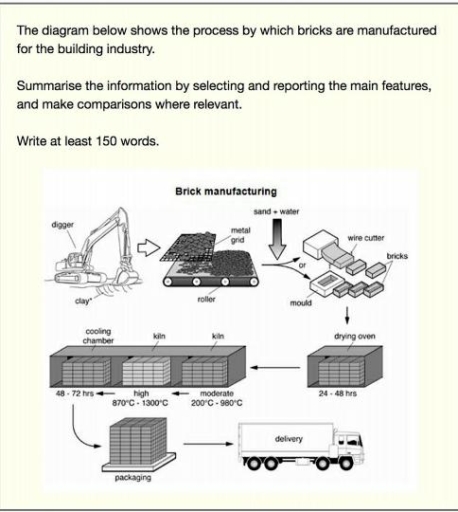
The image illustrates the brick manufacturing process in a sequential diagram form, featuring various equipment and steps involved. It starts with the extraction of clay using a digger, followed by clay processing through a roller. The processed clay is then mixed with sand and water, and passed through a metal grid to achieve a consistent blend. This mixture can be shaped into bricks using either a wire cutter or a mould, resulting in the formation of wire cut bricks or moulded bricks respectively. Subsequently, bricks are transferred to a drying oven where they stay for 24-48 hours. This step is followed by placing the bricks in a kiln for further hardening; depending on the kiln type, bricks are heated at temperatures ranging from 200°C in a moderate kiln to 980°C, or from 870°C to 1300°C in a high kiln over a period of 48-72 hours. Post kiln processing, bricks are moved to the packaging stage and then loaded onto a delivery truck for distribution.
Given the complexity of the image, the above description may not be entirely accurate.
Skyrocket your IELTS band score by 1-2 points in under a month with our premium plan!
Note: Both the topic and the answer were created by one of our users.
The following process diagram illustrates the procedures of brick manufacturing.
Overall, it is clear that the brick-making process involves seven general steps including digging clay at the beginning and delivering at the end.
First of all, with the help of a digger clay is extracted and transferred to a roller, which consists of a metal grid used for transforming clay into sand. The mixture of dry sand and water is poured into a predefined brick mould and then the bricks are put into a drying oven. Usually, a minimum of 24 to 48 hours is required to dry the bricks. The next step involves a furnace that has two subchambers: a baking and cooling chamber. Firstly, the bricks are sent to the furnace where they are baked at a moderate temperature of 200 to 980 degrees Celsius. After that, they are reheated at a high temperature of 870 to 1300 degrees Celsius and then passed to the cooling chamber. Once the heating process is completed, the bricks are kept in the cooling chamber for 48 to 72 hours. Finally packaging of the bricks is done with care, and they are sent out for distribution.
Word Count: 194
