Our system will evaluate the answer based on this AI-generated description.
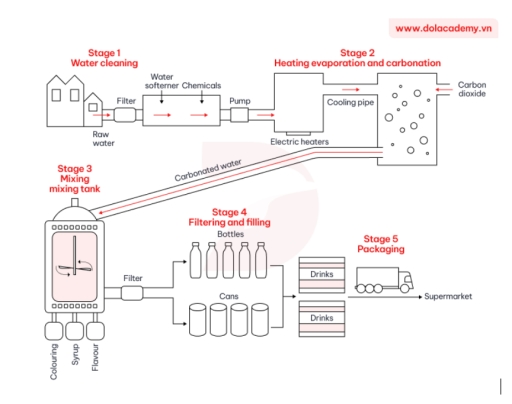
The image depicts a five-stage industrial production process. Stage 1 Water cleaning: Raw water from buildings passes sequentially through a Filter, a treatment tank where Water softener and Chemicals are added, and a Pump. Stage 2 Heating evaporation and carbonation: The treated water flows into a chamber with Electric heaters, travels through a Cooling pipe into a tank infused with Carbon dioxide, producing Carbonated water. Stage 3 Mixing mixing tank: Carbonated water travels through a long overhead pipe into a mixing tank equipped with internal rotating stirrers, with bottom inputs of Colouring, Syrup, and Flavour. Stage 4 Filtering and filling: The mixed liquid passes through another Filter and is distributed into containers, branching into five Bottles and four Cans. Stage 5 Packaging: The filled containers are packed into stacked boxes labeled Drinks and loaded onto a delivery truck destined for the Supermarket.
Given the complexity of the image, the above description may not be entirely accurate.
Skyrocket your IELTS band score by 1-2 points in under a month with our premium plan!
Note: Both the topic and the answer were created by one of our users.
The diagram illustrates how bottled and canned carbonated drinks are produced. Overall, it is a linear process consisting of five main stages, beginning with water purification and ending with the packaging and distribution of the finished products.
Firstly, raw water undergoes a purification process. It is initially passed through a filter before flowing into a water softener. Following this, chemicals are added to treat the water further. The purified water is then transferred by a pump to the next stage. The second stage involves heating, evaporation and carbonation. The water passes through electric heaters before being transported through a cooling pipe. It then enters a carbonation chamber, where carbon dioxide is added to produce carbonated water. Next, the carbonated water is transferred to a mixing tank, where three additional ingredients are introduced: colouring, syrup and flavouring.
After that, once the mixture is ready, it passes through another filter. In the fourth stage, the filtered liquid is used to fill both bottles and cans. Finally, the filled containers are packed into boxes, which are subsequently loaded onto trucks and transported to supermarkets for distribution.
Word Count: 183
