🔥 Today Only: Save 30% on Premium — Offer Ends Soon! - Upgrade Now!
Process Diagram

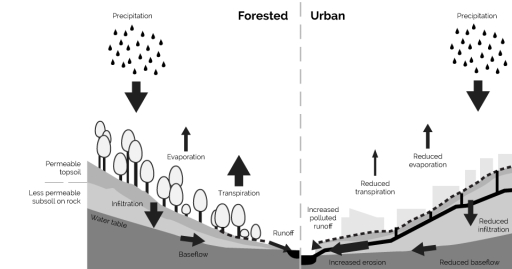
Band 7+: The diagram below shows the water cycle in both forested and urban areas. Summarise the information by selecting and reporting the main features and make comparisons where relevant.

Image for topic: The diagram below shows the water cycle in both forested and urban areas. Summarise the information by selecting and reporting the main features and make comparisons where relevant.
Our system will evaluate the answer based on this AI-generated description.
The image presents a comparative graphical depiction of water runoff in forested and urban settings. Both sections of the graph start with precipitation elements at the top. In the forested section, arrows point downward showing "Infiltration" through a "Permeable topsoil" and "Less permeable subsoil on rock" leading to "Water table" and then "Baseflow" with lateral arrows indicating "Evaporation" and "Transpiration" at the tree level, and "Runoff" at surface level. In contrast, the urban section arrows point towards "Reduced transpiration" and "Reduced evaporation" at the building level, with a significant arrow marked "Increased runoff" with side annotation "polluted" leading to "Increased erosion" with a consequential decrease in "Infiltration" and "Baseflow" compared to the forested section. There are no numerical data points or percentages provided.
Given the complexity of the image, the above description may not be entirely accurate.
Note: Both the topic and the answer were created by one of our users.

In this education, geographic diagram, an interpretation of the water cycle and its stages is demonstrated and categorized into forested and urban areas.

Firstly, it is shown that the water first starts in the clouds, where it then undergoes the process of precipitation, a process where water in the clouds rains and falls onto land. In forested areas, rain water is infiltrated into the permeable topsoil, where it can easily flow and dissolve inside and into the soil. On the contrary, rain water in urban areas cannot easily infiltrate the ground as it may be more packed and solid than soil in rural regions. As a result, the baseflow of the water is reduced, water that is eroded on the surface is increased and ultimately, pollution in the runoff of the water is increased. This can tackle the process of evaporation and transpiration in the urban areas, whereas in the forested areas, rain water that runs off the surface is easily evaporated and transpired back into the sky.

In conclusion, the unnatural structure of major downtown cities or countries may tackle the water cycle and reduce its effects, whereas natural forested areas are optimal for the water cycle.

Word Count: 198

Answers On The Same Topic:

The diagram below shows the water cycle in both forested and urban areas. Summarise the information by selecting and reporting the main features and make comparisons where relevant.

The process diagram illustrtates the water cycle in two different reigons namely, forested and urban enviroments.The water cycle consists of four stages which are precipitation,trtanspiration,infiltration and runoff. Overall,the water cycle consists of four stages which are precipitation,trtanspiration,infiltration and runoff. The cycle of rainfalls start with infiltrtation and end with the evaporation and this is the […]

The diagram below shows the water cycle in both forested and urban areas. Summarise the information by selecting and reporting the main features and make comparisons where relevant.

The diagram compares the water cycle in forested and urban environments, highlighting the differences in water movement. Overall, the water cycle is a continuous process that repeats over time. In both environments, the process starts with precipitation (rainfall) and ends with runoff. In the forested area, rainwater infiltrates the permeable topsoil and moves downward through […]

The diagram below shows the water cycle in both forested and urban areas. Summarise the information by selecting and reporting the main features and make comparisons where relevant.

The water cycle plays a key role in maintaing a healthy ecosystem. Life would be impossible without rain! The diagrams showcase how various environmental factors both positively and negatively impact the rain cycle. The picture on the left demonstrates the process of precipitation in a rainforest. The presence of trees and permeable topsoil encourages plenty […]

The diagram below shows the water cycle in both forested and urban areas. Summarise the information by selecting and reporting the main features and make comparisons where relevant.

The diagram compares the water cycle processes in forested and urban areas. It highlights key differences in infiltration, runoff, and evaporation between the two environments. In forested regions, precipitation is largely absorbed by the permeable topsoil, allowing significant infiltration into the ground. This contributes to the formation of a stable water table and baseflow. Evaporation […]

The diagram below shows the water cycle in both forested and urban areas. Summarise the information by selecting and reporting the main features and make comparisons where relevant.

The diagram in question provides a insight view on water cycle forested and urban sides. overall, the the water cycle of both areas are same. As the picyure shows the water cycle has the same path in both areas, and it commences with the precipitation. as water fall to the permeable topsoil , and the […]

See All

Other Topics:

The diagram below shows the stages and equipment used in cement making process, and how cement is used to produce concrete for building puropses

The diagram illustrates the process of cement production, including the stages and equipment involved, and how cement is subsequently used to produce concrete for construction purposes. Overall, the two diagrams depict two distinct processes. Cement production involves crushing and grinding, while concrete production entails mixing cement with water, sand, and gravel. Cement production begins with […]

The diagram below shows the manufacturing process for making sugar from sugar cane. Summarise the information by selecting and reporting the main features, and make comparisons where relevant.

The diagram illustrates that the process of produced sugar from sugar cane to used different methods. Overall, it is clear that fastly growing crops which necessary almost 12 to 18 months . Then used six types of method . After that, it would make perfectly sugar which ready for eat. At fast, people have to […]

The diagram below shows the process by which bricks are manufactured for the building industry. Summarise the information by selecting and reporting the main features, and make comparisons where relevant. Write at least 150 words.

The diagram illustrates the process of manufacturing bricks for the building industry. Overall, it is a linear process consisting of several stages, beginning with the extraction of clay and ending with the packaging and delivery of the finished bricks. The main stages include preparing the raw materials, shaping and drying the bricks, heating them at […]

Task 1 The diagrams below show the stages and equipment used in the cement-making process, and how cement is used to produce concrete for building purposes. Summarise the information by selecting and reporting the main features, and make comparisons where relevant. Write at least 150 words.

The diagram illustrates the process of manufacturing a cement and how it is used to produce a concrete. Overall, cement production involves multiple stages, beginning with the crushing and ending with packaging the cement. In contrast, concrete is much simpler to manufacture, requiring four fundamental products. Notably, the process is highly machine-driven, requiring a minimal […]

The diagram below shows how chipboard is created from wood and then used to make furniture. Provide an overview of the information by identifying and describing the key details, and include comparisons where appropriate.

The provided diagram delineates the processes of creating chipboard from wood and manufacturing furniture from this material. Overall, the process consists of 2 stages preparation and production. Iinitializing with logging of trees and ending with assembled furniture. Primarly, trees are cutted and trimmed to produce logs. Then the logs are sent into special facility that […]

Task 1: The diagrams below show the stages and equipment used in the cement- making process, and how cement is used to produce concrete for building purposes. Summarise the information by selecting and reporting the main features, and make comparison where relevant.

The diagrams illustrate the stages involved in producing cement from raw materials and the subsequent process of manufacturing concrete for construction purposes. Overall, cement production is a multi-stage industrial process that converts limestone and clay into bagged cement through crushing, mixing, heating and grinding. In contrast, concrete production is a simpler mixing process that combines […]

See All
We have detected unusual activity on your device.
Please verify your identity to continue.
Note: This verification step won't sign you in. If you have a premium account, please log in to access the service as usual.
Google/Gmail Verification
Or verify using Email/Code
We've sent a verification code to:
youremail@gmail.com (Not your email?)
Enter it below to complete the verification process.
Ensure your email address is correct, your inbox is not full, and you check your spam folder. If no email arrives, consider using an alternative email.
You will need a Premium plan to perform your action!
Note: If you already have a premium account, please log in to access our services as usual.

Plans & Pricing

Our mission is to make quality education accessible for everyone.
However, to keep our hardworking team running and this service alive, we genuinely need your support!
By opting for a premium plan, not only do you sustain us in achieving the mission, but you also unlock advanced features to enrich your learning experience.

Free

For learners who aren't pressed for time

What's included on Free
100+ Cambridge IELTS Tests
Instant IELTS Writing Task 1 & 2 Evaluation (2 times/month)
Instant IELTS Speaking Part 1, 2, & 3 Evaluation (2 times/month)
Instant IELTS Writing Task 1 & 2 Essay Generator (2 times/month)
500+ Dictation & Shadowing Exercises
100+ Pronunciation Exercises
Flashcards
Other Advanced Tools

Premium

For those serious about advancing their English proficiency, and for IELTS candidates aspiring to boost their band score by 1-2 points (especially in writing & speaking) in just 30 days or less

What's included on Premium
Save Your IELTS Test Progress & Analyze Mistakes By Question Type
Save Your Own Flashcard Sets & Use Them On Any Device
Unlock All Courses, IELTS Tests, Section & Part Practice
Unlimited AI Conversations
Unlimited AI Writing Enhancement Exercises
Unlimited IELTS Writing Task 1 & 2 Evaluation
Unlimited IELTS Speaking Part 1, 2, & 3 Evaluation
Checked Answers Will Not Be Published
Unlimited IELTS Writing Task 1 & 2 Essay Generator
Unlimited IELTS Speaking Part 1, 2, & 3 Sample Generator
Unlimited Usage Of Advanced Tools & AI Features
Priority Support within 24h (12-month plan only)

Due to the nature of our service and the provided free trials, payments are non-refundable.