Our system will evaluate the answer based on this AI-generated description.
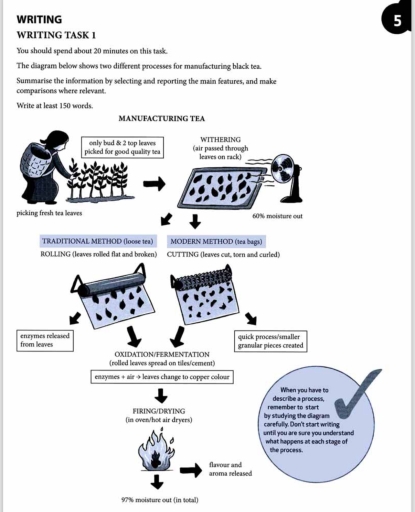
The image is entitled "WRITING TASK 1" and prescribes spending 20 minutes on it, requiring a comparison of two black tea manufacturing processes – traditional and modern methods. The traditional method includes picking 2 top leaves, withering (60% moisture out), rolling (leaves rolled flat and broken), oxidation/fermentation occurring in a controlled environment (enzymes released from leaves), and finally firing/drying (97% moisture out in total). The modern method comprises similar initial steps of picking and withering, but instead of rolling, it involves cutting (leaves cut, torn, and curled) and a quick process with smaller granular pieces created for fermentation, resulting in a stronger and more copper-colored tea. The diagram contains the note, "When you have to describe a process, remember to start by studying the diagram carefully. Don't start writing until you see each stage of the process."
Given the complexity of the image, the above description may not be entirely accurate.
Skyrocket your IELTS band score by 1-2 points in under a month with our premium plan!
Note: Both the topic and the answer were created by one of our users.
The diagram illustrates two different methods used in the production of black tea, known as the traditional and modern processes. Both methods start from picking fresh leaves and end with drying to produce the final tea product.
Initially, only the bud and the top two leaves are carefully handpicked for good-quality tea. The freshly collected leaves are then withered by passing air through them until the moisture level decreases to about 60%. After this stage, the process diverges into two different methods.
In the traditional method, the leaves are rolled, which causes them to be broken and allows enzymes to be released. This is followed by oxidation or fermentation, where the rolled leaves are left on steel trays, turning the leaves a copper color.
In contrast, the modern method uses a cutting machine to tear and curl the leaves, producing smaller, granular pieces. These pieces oxidize more quickly due to their size and shape.
Finally, both methods proceed to the firing or drying stage, where the leaves are exposed to hot air to develop flavor and aroma. At the end of the process, the moisture content is reduced to around 97%, and the black tea is ready for packaging and consumption.
Word Count: 201
