Our system will evaluate the answer based on this AI-generated description.
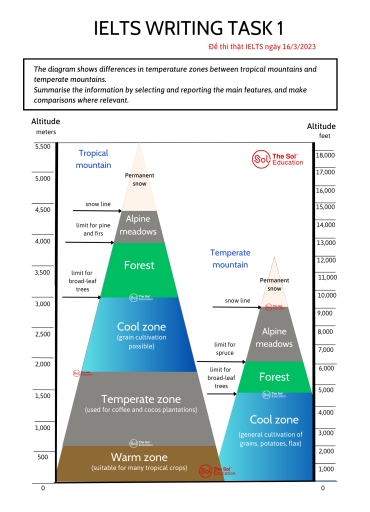
The image displays the temperature zones between tropical mountains and temperate mountains, divided into Warm, Cool, Temperate, Forest, Alpine meadows, and Tropical mountains. Altitude in meters and feet is given. Warm zone: suitable for mainly tropical crops (1000-1500 meters/3000-5000 feet), Cool zone: used for coffee and cocoa plantations (1500-2500 meters/5000-8000 feet), Temperate zone: used for coffee and cocoa plantations (2500-3000 meters/8000-10000 feet), Forest: limit for pine trees (2500-3500 meters/8000-11500 feet), Cool zone: general cultivation of grains, potatoes, flax (3000-4000 meters/10000-13000 feet), Alpine meadows (3500-4500 meters/11500-14500 feet), Temperate mountain: Alpine meadows (3500-4500 meters/11500-14500 feet), Tropical mountain: Alpine meadows (4000-5500 meters/13000-17000 feet), Forest: limit for broad-leaf trees (3500-4500 meters/11500-14500 feet), Alpine meadows: limit for pine trees (4500 meters/14500 feet), Alpine meadows: permanent snow line (4500-5000 meters/14500-16000 feet), Tropical mountain: permanent snow line (5000 meters/16000 feet), Temperate mountain: permanent snow line (5000 meters/16000 feet).
Given the complexity of the image, the above description may not be entirely accurate.
Skyrocket your IELTS band score by 1-2 points in under a month with our premium plan!
Note: Both the topic and the answer were created by one of our users.
The diagram illustrates the temperature zones of tropical and temperate mountains in comparison.
Overall, tropical mountains are generally higher than temperate mountains and feature a greater variety of zones.
Temperate mountains include the cool zone, forests, alpine meadows, and permanent snow. This is similar to tropical mountains, which do not have temperate or warm zones. The first area in temperate mountains is the cool zone, characterized by the general cultivation of grains, potatoes, and flax, and it reaches an elevation of about 5,000 feet. Following this is the forest zone, where broad-leaf trees are limited and which rises to around 6,000 feet. The last two zones are alpine meadows and permanent snow, located at the mountain’s peak, from 6,000 feet to 10,000 feet and from 10,000 feet to 11,000 feet, respectively.
Tropical mountains, on the other hand, have a warm zone at the base that is suitable for various tropical crops, reaching approximately 1,500 feet in height. The next level is the temperate zone, which spans from 1,500 feet to around 6,000 feet and is primarily used for planting coffee and cocoa. The remaining levels of tropical mountains are similar to those of temperate mountains.
Word Count: 195
