🔥 Today Only: Save 30% on Premium — Offer Ends Soon! - Upgrade Now!
Multiple Graphs

Band 8+: The diagram shows differences in temperature zones between tropical mountains and temperate mountains.

Image for topic: The diagram shows differences in temperature zones between tropical mountains and temperate mountains.
Our system will evaluate the answer based on this AI-generated description.
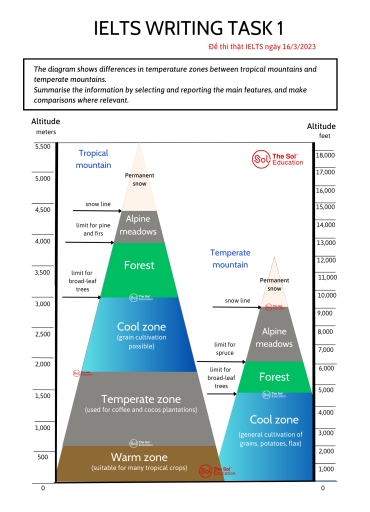
The image displays the temperature zones between tropical mountains and temperate mountains, divided into Warm, Cool, Temperate, Forest, Alpine meadows, and Tropical mountains. Altitude in meters and feet is given. Warm zone: suitable for mainly tropical crops (1000-1500 meters/3000-5000 feet), Cool zone: used for coffee and cocoa plantations (1500-2500 meters/5000-8000 feet), Temperate zone: used for coffee and cocoa plantations (2500-3000 meters/8000-10000 feet), Forest: limit for pine trees (2500-3500 meters/8000-11500 feet), Cool zone: general cultivation of grains, potatoes, flax (3000-4000 meters/10000-13000 feet), Alpine meadows (3500-4500 meters/11500-14500 feet), Temperate mountain: Alpine meadows (3500-4500 meters/11500-14500 feet), Tropical mountain: Alpine meadows (4000-5500 meters/13000-17000 feet), Forest: limit for broad-leaf trees (3500-4500 meters/11500-14500 feet), Alpine meadows: limit for pine trees (4500 meters/14500 feet), Alpine meadows: permanent snow line (4500-5000 meters/14500-16000 feet), Tropical mountain: permanent snow line (5000 meters/16000 feet), Temperate mountain: permanent snow line (5000 meters/16000 feet).
Given the complexity of the image, the above description may not be entirely accurate.
Note: Both the topic and the answer were created by one of our users.

The diagram compares different altitude zones of vegetation and temperature on tropical and temperate mountains, based on changes in climate and land use at various elevations.

Overall, the tropical mountain has a wider range of distinct zones and supports vegetation at much higher altitudes. In contrast, the temperate mountain has fewer zones, and the limits for both tree growth and permanent snow occur at lower elevations.

On the tropical mountain, there are six zones in total. At the base, from 0 to 500 meters, is the warm zone where various tropical crops can be grown. This is followed by the temperature zone (500-1500m), which is suitable for coffee and cocoa plantations. The cool zone, between 1500 and 3000 meters, allows for the cultivation of grains. Above this, a forest zone stretches from 3000 to 4000 meters, where broadleaf and coniferous trees grow until the limit for pine and fir is reached. Alpine meadows cover the area between 4000 and about 4500 meters, and permanent snow is found above 4500 meters.

The temperate mountain, by comparison, has only four main zones. From 0 to 1200 meters is a cool zone where crops like grains, potatoes, and flax are grown. The forest zone lies between 1200 and 1700 meters and ends at the spruce tree limit. Above this, alpine meadows extend up to about 2900 meters, just below the snow line. Permanent snow appears above that point, beginning slightly below 3000 meters.

Word Count: 240

Answers On The Same Topic:

The diagram shows differences in temperature zones between tropical mountains and temperate mountains.

The diagram compares temperature zones of tropical and temperate mountains in terms of differences in their distribution and altitudinal range. Overall, tropical mountains not only differ from temperate mountains by having a wider range of temperatures based on altitudes and higher altitudes to reach permanent snow, but also by significant differences between their use for […]

The diagram shows differences in temperature zones between tropical mountains and temperate mountains.

The diagram illustrates how temperature zones differ by altitude between tropical and temperate mountains. Overall, the tropical mountains span a significantly broader vertical range, and contain more distinct ecological zones. Meanwhile, the permanent snow line is positioned at a much higher altitude in the tropics. In the tropical regions, the warm zone stretches from sea […]

The diagram shows differences in temperature zones between tropical mountains and temperate mountains.

The diagram illustrated the difference between tropical mountain and temperature mountain which is a place for planting different species along with its altitude. There are six groups in tropical mountain and four groups in temperate mountain. To beign with the tropical mountain, there has a warm zone which is suitable for many tropical crops such […]

The diagram shows differences in temperature zones between tropical mountains and temperate mountains.

The given diagram represents comparison in temperature zones between tropical mountains and temperate mountains. Overall, vegetation in tropical moutains are more diverse than that of temperate mountains. Tropical mountains are higher altitude than temperate mountains. There is a snow line at about 2800 meters (10000 feets) on temperate mountains, which are shorter than that of […]

See All

Other Topics:

the diagrams below show changes in Felixstone in the UL between 1967 and 2001

The maps illustrate the changes that took place in the coastal town of Felixstone between 1967 and 2001. Overall, Felixstone underwent substantial redevelopment, with residential and recreational facilities being introduced. Meanwhile, the golf course remained largely unchanged. Looking first at the northern part of the area, farmland was initially located next to shops. By 2001, […]

The two charts below show the percentage of mothers and fathers in part-time and full-time employment between 1997 and 2017. Summarize the information by selecting and reporting the main features and make comparisons where necessary.

The two graphs below show the percentage of mothers and fathers with young children in England in full-time and part-time work between 1997 and 2017. The firstly graph show that, in the part time job was rather higher than in full time working in mothers. The percentage of mothers working part time was around 37 […]

The 2 charts below show the proportion of qualified graduates in a particular country.

The two pie charts show the proportion of qualified graduates in a particular country in 1980 and 2008. The graduates are divided by Arts and Science, and by degree level. Overall, Science graduates were the biggest group in both years. However, there was a clear change: fewer people got a first degree, while more people […]

The pie charts below show the number of hours spent in a british university library by undergraduates, postgraduates and the total student population.

The pie chart represents the number of hours, which are being spent by undergraduates, postgraduates, and the total student population in a British university. Overall, the most profound share makes up “spending from 1 to 7 hours” in the library among all student population and among undergraduates. In opposite, “15 hours” in the library are […]

The charts below show the percentage of people using public transport and that of people using private cars in five Australian cities between 2000 and 2010. Summarise the information by selecting and reporting the main features, and make comparisons where relevant.

The two line graphs illustrate the proportion of residents using public transport and private cars across five Australian cities – Sydney, Melbourne, Brisbane, Perth, and Adelaide – between 2000 and 2010. Overall, public transport usage remained substantially lower than private car reliance throughout the decade, yet it experienced a steady upward trend across all five […]

See All
We have detected unusual activity on your device.
Please verify your identity to continue.
Note: This verification step won't sign you in. If you have a premium account, please log in to access the service as usual.
Google/Gmail Verification
Or verify using Email/Code
We've sent a verification code to:
youremail@gmail.com (Not your email?)
Enter it below to complete the verification process.
Ensure your email address is correct, your inbox is not full, and you check your spam folder. If no email arrives, consider using an alternative email.
You will need a Premium plan to perform your action!
Note: If you already have a premium account, please log in to access our services as usual.

Plans & Pricing

Our mission is to make quality education accessible for everyone.
However, to keep our hardworking team running and this service alive, we genuinely need your support!
By opting for a premium plan, not only do you sustain us in achieving the mission, but you also unlock advanced features to enrich your learning experience.

Free

For learners who aren't pressed for time

What's included on Free
100+ Cambridge IELTS Tests
Instant IELTS Writing Task 1 & 2 Evaluation (2 times/month)
Instant IELTS Speaking Part 1, 2, & 3 Evaluation (2 times/month)
Instant IELTS Writing Task 1 & 2 Essay Generator (2 times/month)
500+ Dictation & Shadowing Exercises
100+ Pronunciation Exercises
Flashcards
Other Advanced Tools

Premium

For those serious about advancing their English proficiency, and for IELTS candidates aspiring to boost their band score by 1-2 points (especially in writing & speaking) in just 30 days or less

What's included on Premium
Save Your IELTS Test Progress & Analyze Mistakes By Question Type
Save Your Own Flashcard Sets & Use Them On Any Device
Unlock All Courses, IELTS Tests, Section & Part Practice
Unlimited AI Conversations
Unlimited AI Writing Enhancement Exercises
Unlimited IELTS Writing Task 1 & 2 Evaluation
Unlimited IELTS Speaking Part 1, 2, & 3 Evaluation
Checked Answers Will Not Be Published
Unlimited IELTS Writing Task 1 & 2 Essay Generator
Unlimited IELTS Speaking Part 1, 2, & 3 Sample Generator
Unlimited Usage Of Advanced Tools & AI Features
Priority Support within 24h (12-month plan only)

Due to the nature of our service and the provided free trials, payments are non-refundable.