Our system will evaluate the answer based on this AI-generated description.
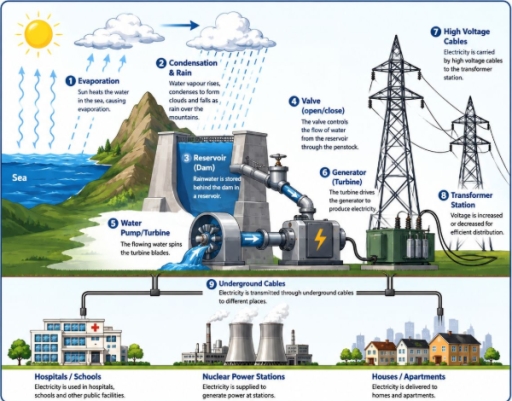
The image displays a 9-step process for hydroelectric power generation and distribution. Step 1 is Evaporation, where the sun heats sea water. Step 2 is Condensation & Rain, where water vapor forms clouds and falls as rain. Step 3 is the Reservoir (Dam), where rainwater is stored. Step 4 is a Valve (open/close) that controls water flow. Step 5 is the Water Pump/Turbine, where flowing water spins turbine blades. Step 6 is the Generator, driven by the turbine to produce electricity. Step 7 involves High Voltage Cables carrying electricity to the transformer station. Step 8 is the Transformer Station, where voltage is increased or decreased. Step 9 is Underground Cables, which transmit electricity to different places. The electricity is distributed to Hospitals/Schools, supplied to Nuclear Power Stations, and delivered to Houses/Apartments.
Given the complexity of the image, the above description may not be entirely accurate.
Skyrocket your IELTS band score by 1-2 points in under a month with our premium plan!
Note: Both the topic and the answer were created by one of our users.
The illustration demonstrates how hydro-electric power is generated.
Overall, it begins with evaporation of water from the sea, and finally results in transmission to different places.
First of all, the sun heats the water in the sea, causing evaporation.After that ,condensation happens where water vapour rises, condenses to form clouds and falls as rain over the mountains.So, this rainwater is sorted behind the dam in the reservoir. The valve controls the flow of water from the reservoir through the penstock as well as. On the other hand the flowing water spins the turbine blades.
Following that, the turbine drives the generator to produce electricity, which is carried by high voltage cables to the transformer station.Then, voltage is increased or decreased for efficient distribution.Finally, electricity is transmitted through underground cables to different places,for instance, to hospitals/schools, nuclear power stations and houses/ apartments.
Word Count: 141
