🔥 Today Only: Save 30% on Premium — Offer Ends Soon! - Upgrade Now!
Process Diagram

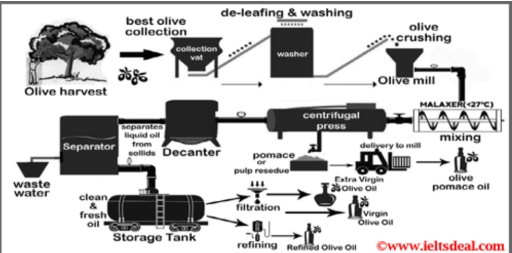
Band 5+: The diagram shows the manufacturing process of olive oil of different grades.

Image for topic: The diagram shows the manufacturing process of olive oil of different grades.
Our system will evaluate the answer based on this AI-generated description.
The image illustrates the detailed process of olive oil production starting with "Olive harvest," leading to "best olive collection" through mechanical means, into "collection vat" followed by "de-leafing & washing" using a "washer," then "olive crushing" occurs at the "Olive mill," processed in a malaxer at "27°C," leading to "mixing," and then separation happens via "Decanter" into "liquid oil from solids," with solids becoming "pomace or pulp residue"; liquid moves to "centrifugal press," directed towards "delivery to mill" to produce different olive oil grades: "Extra Virgin Olive Oil," "Virgin Olive Oil," and "Olive Pomace Oil"; routes excess into "separator" producing "waste water" and directs oils through "filtration" before storage in "Storage Tank" labeled as "clean & fresh oil," finalized by "refining" into "Refined Olive Oil."
Given the complexity of the image, the above description may not be entirely accurate.
Note: Both the topic and the answer were created by one of our users.

The diagram delineates manufacturing of process of olive oil.Overall, the whole steps includes several steps, commencing with harvesting olives by manually and culminating in using refined and extra virgin olive oil.

First of all, olives are harvested and are chosen best olives and put into collection vat.Then, best olives undergo de-leafing and washing procedure. After which, washing olives are crushed with the help of olive mill. Following this, crushed olives are mixed below 27 Celcius with malaxer. The next step devides into 2 main way, one of them is olives are pressed and theirs pomace and pulp resedue are removed which are delivered to mill where olive pomace oil is made. Another way is pressed olives go throw the decanter and seperator. At this step, liquid oil and sollids are seperated which are removed clumsy piece. Once being seperated, they are then sent to storage tank where liquid oil is cleaned and obtained fresh oil.

Ultimately, fresh oil is filtrated and its produce is extra virgin olive oil and is refined which is made refined olive oil.

Word Count: 177

Answers On The Same Topic:

The diagram shows the manufacturing process of olive oil of different grades.

The diagram demonstrates an industrial process by which olive oil is generated in different grades. Overall, the process involves three connecting stages of producing olive oil with different qualities, namely olive pomace, virgin olive, and refined olive oil. The process begins with olives being harvested from trees and sorted based on their quality. The best […]

The diagram shows the manufacturing process of olive oil of different grades.

The graph illustrates the procedure of olive oil in different categories in quality from harvest oil in nature. The process involves in various stage of manufacturing the finale olive oil being a personal product. Overall, there are many steps for this process included in 3 main ways to produce each types of olive oil. With […]

The diagram shows the manufacturing process of olive oil of different grades.

The diagram illustrates the production of olive oil in different grades. Overall, the process begins with harvesting olives in the field and ends with three distinct products: extra virgin olive oil, refined olive oil, and pomace oil. Once the harvested olives arrive at the factory, the first stage is to select the best fruits, followed […]

The diagram shows the manufacturing process of olive oil of different grades.

The diagram shows the process of making olive oil from different grades. The process starts with harvesting from the field and is then delivered to the factory for processing. When arriving at the factory, the first step is selecting the best fruits and separating the leaves as well as washing them. After that, the olives […]

See All

Other Topics:

The diagram below gives information about the recycling of glass and plastic containers. Summarise the information by selecting and reportingthe main features and making comparisons where relevant.

The flowchart illustrates the stages involved in the recycling of glass and plastic containers, tracing the process from collection to the new product. Overall, the procedure follows a cyclical, multi-stage sequence for both plastic and glass that begins with recycling materials being collected and transported to the recycling centre, and ends with the resulting material […]

The diagram below gives information about the recycling of glass and plastic containers. Summarise the information by selecting and reportingthe main features and making comparisons where relevant.

The flowchart illustrates the stages involved in the recycling of glass and plastic containers, tracing the process from collection to the new product. Overall, the procedure follows a linear, multi-stage sequence for both plastic and glass that begins with recycling materials being collected and transported to the recycling centre, and ends with the resulting material […]

The diagram below shows how one type of coal is used to produce electricity. Summarise the information by selecting and reporting the main features, and make comparisons where relevant.

The illustration demonstrates the production of electricity from a type of coal. Overall, the process has 9 steps, starting with coal that is mined, followed by the transformation into gas, and ending with electricity that is offered to houses or factories. The first 5 steps involve the transformation of the raw substance. Initially, coal is […]

You should spend about 20 minutes on this task. The diagram below shows the life cycle of a frog. Summarise the information by selecting and reporting the main features, and make comparisons where relevant. You should write at least 150 words.

The diagram illustrates a frog’s natural life cycle. Overall, the life cycle comprises seven stages, starting with the fertilization of eggs, followed by their development into tadpoles, and culminating in fully grown amphibians. In the initial phase, an adult frog lays eggs on seaweed, which then begin to take shape and develop into embryos. These […]

The diagrams show the structure of the solar panel and its use. Summarize the information by selecting and reporting the main features, and make comparisons where relevant.

The diagrams illustrate the structure of a solar system and how it can be used to heat both air and water. Overall, the solar panel consists of a box with transparent top, which allows solar energy to enter. In both cases, the main structure remains the same, with water pipe being added when the solar […]

The diagram below shows how coffee is produced and prepared for sale.

The diagram illustrates the process of producing instant coffee, from the intial collection of coffee beans to the final pacakaging of the product. Overall, it is a linear process consisting of several stages. The coffee beans are first dried and roasted before being ground. After that, they are treated in hot water and then frozen […]

See All
We have detected unusual activity on your device.
Please verify your identity to continue.
Note: This verification step won't sign you in. If you have a premium account, please log in to access the service as usual.
Google/Gmail Verification
Or verify using Email/Code
We've sent a verification code to:
youremail@gmail.com (Not your email?)
Enter it below to complete the verification process.
Ensure your email address is correct, your inbox is not full, and you check your spam folder. If no email arrives, consider using an alternative email.
You will need a Premium plan to perform your action!
Note: If you already have a premium account, please log in to access our services as usual.

Plans & Pricing

Our mission is to make quality education accessible for everyone.
However, to keep our hardworking team running and this service alive, we genuinely need your support!
By opting for a premium plan, not only do you sustain us in achieving the mission, but you also unlock advanced features to enrich your learning experience.

Free

For learners who aren't pressed for time

What's included on Free
100+ Cambridge IELTS Tests
Instant IELTS Writing Task 1 & 2 Evaluation (2 times/month)
Instant IELTS Speaking Part 1, 2, & 3 Evaluation (2 times/month)
Instant IELTS Writing Task 1 & 2 Essay Generator (2 times/month)
500+ Dictation & Shadowing Exercises
100+ Pronunciation Exercises
Flashcards
Other Advanced Tools

Premium

For those serious about advancing their English proficiency, and for IELTS candidates aspiring to boost their band score by 1-2 points (especially in writing & speaking) in just 30 days or less

What's included on Premium
Save Your IELTS Test Progress & Analyze Mistakes By Question Type
Save Your Own Flashcard Sets & Use Them On Any Device
Unlock All Courses, IELTS Tests, Section & Part Practice
Unlimited AI Conversations
Unlimited AI Writing Enhancement Exercises
Unlimited IELTS Writing Task 1 & 2 Evaluation
Unlimited IELTS Speaking Part 1, 2, & 3 Evaluation
Checked Answers Will Not Be Published
Unlimited IELTS Writing Task 1 & 2 Essay Generator
Unlimited IELTS Speaking Part 1, 2, & 3 Sample Generator
Unlimited Usage Of Advanced Tools & AI Features
Priority Support within 24h (12-month plan only)

Due to the nature of our service and the provided free trials, payments are non-refundable.